
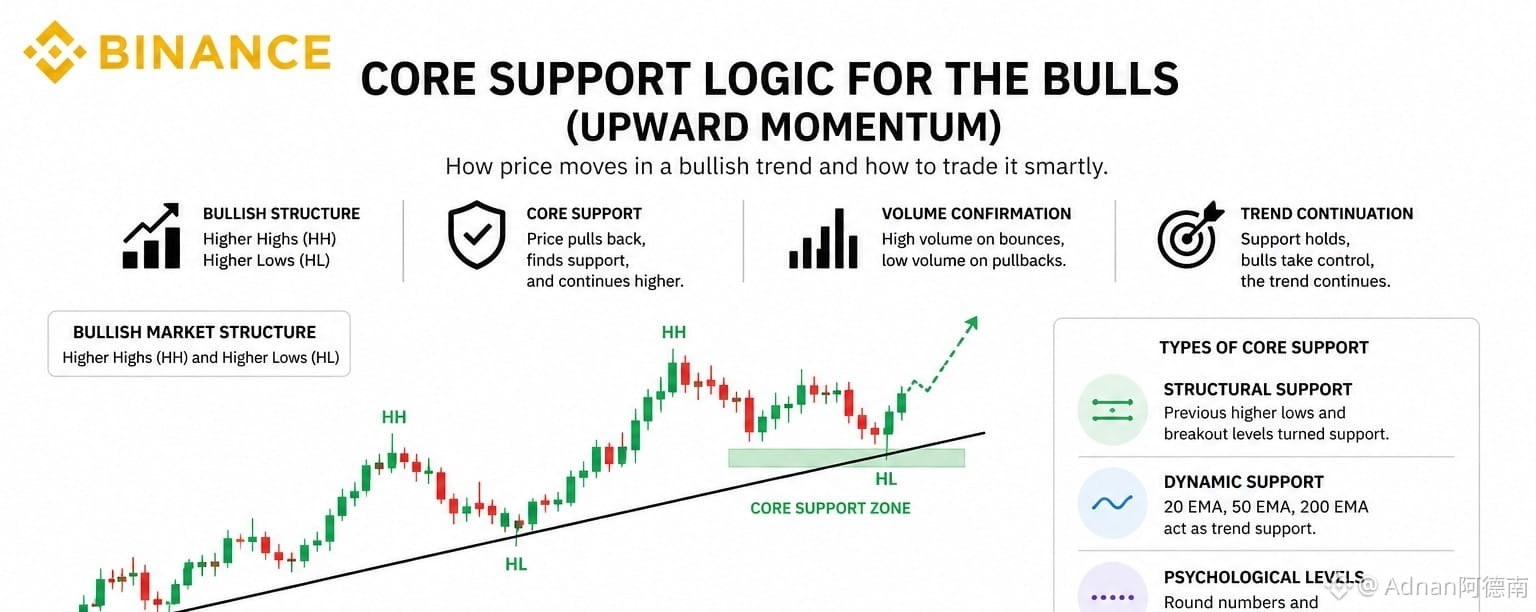

In a bullish market, price doesn’t just go up in a straight line—it pulls back, finds support, and then continues higher. Understanding this “core support logic” is what separates disciplined traders from those who chase price.
On high-liquidity platforms like Binance, this behavior is especially clean because large players (institutions, whales) tend to accumulate at predictable zones.
1. The Foundation: Market Structure
A true bullish trend is defined by:
Higher Highs (HH) → price pushes upward
Higher Lows (HL) → pullbacks that hold above previous lows
👉 Core support forms at these higher lows.
If higher lows keep holding, bulls are in control.
If they break consistently, the trend is weakening.
2. What Is “Core Support”?
Core support is not just any level—it’s a high-probability demand zone where:
Buyers repeatedly step in
Selling pressure gets absorbed
Price resumes upward movement
Think of it as the engine room of the trend.
3. The Bullish Cycle (How Price Moves)
A typical bullish cycle looks like this:
Impulse Move Up → strong buying
Pullback → profit-taking
Support Hold → buyers re-enter
Continuation → new higher high
This cycle repeats. Smart traders don’t chase step 1—they focus on step 3.
4. Types of Core Support
A. Structural Support (Most Important)
Previous higher lows
Breakout levels turned support
These are the cleanest zones for continuation trades.
B. Dynamic Support
Common tools:
20 EMA → fast trend support
50 EMA → stable trend support
200 EMA → macro support
Strong uptrends often respect the 20/50 EMA repeatedly.
C. Psychological Levels
Round numbers (e.g., 50,000 / 1.00 / 100)
High-volume zones
These attract liquidity and often align with real support.
5. Volume Confirms Everything
Support without volume is weak.
Strong bullish support shows:
High volume on bounces → real buying interest
Low volume on pullbacks → weak selling
On Binance, this is critical due to heavy leveraged trading.
6. Liquidity Sweeps (The Trap Zone)
Price often dips below support before going up.
This is:
Stop-loss hunting
Liquidity collection
Bullish Confirmation:
Quick reclaim of support
Strong bullish candle after the dip
This is often the best entry, not a breakdown.
7. Multi-Timeframe Strength
Strongest setups happen when:
Daily support aligns with 4H support
4H aligns with 1H entry
Weak setups rely only on lower timeframes.
8. Entry Logic for Bulls
A disciplined approach:
Wait for price to return to support
Look for rejection (wicks, bullish candles)
Confirm with volume
Enter with a stop below support
Avoid entering at the top—momentum is already priced in.
9. Warning Signs (Support Failure)
Be cautious if you see:
Strong breakdown with high volume
No immediate reclaim
Lower highs forming
This suggests bulls are losing control.
10. Core Principle
Bulls don’t chase price—they buy strength at support.
The edge comes from:
Patience
Structure awareness
Risk control
Final Insight
In upward momentum, support is not just protection—it’s opportunity.
The market rewards those who wait for price to come to them.
Master core support logic, and you shift from reacting to price…
to anticipating it.

#TetherFreezes$344MUSDTatUSLawEnforcementRequest #CanTheDeFiIndustryRecoverQuicklyFromAaveExploit?