@Pixels #pixel $PIXEL I didn’t begin thinking about Pixels as an economic system. At first, it simply felt like a living game world. Farms were active, players moved constantly between plots and villages, and the task board refreshed with new opportunities almost every few minutes. From the outsideand even during the first few weeks inside the loopit felt like growth. More players farming, more crops being harvested, more items crafted, more tasks completed. The world seemed busy in the way successful online games usually are when they’re expanding.
But the longer I spent inside Pixels, the more that feeling of expansion began to shift into something else. The activity was realthere were undeniably more players, more motion, more loops repeating across the mapbut the rewards didn’t expand in the same way the activity did. Something about the economy felt strangely contained, as if the system was not truly growing but instead reorganizing where value appeared.
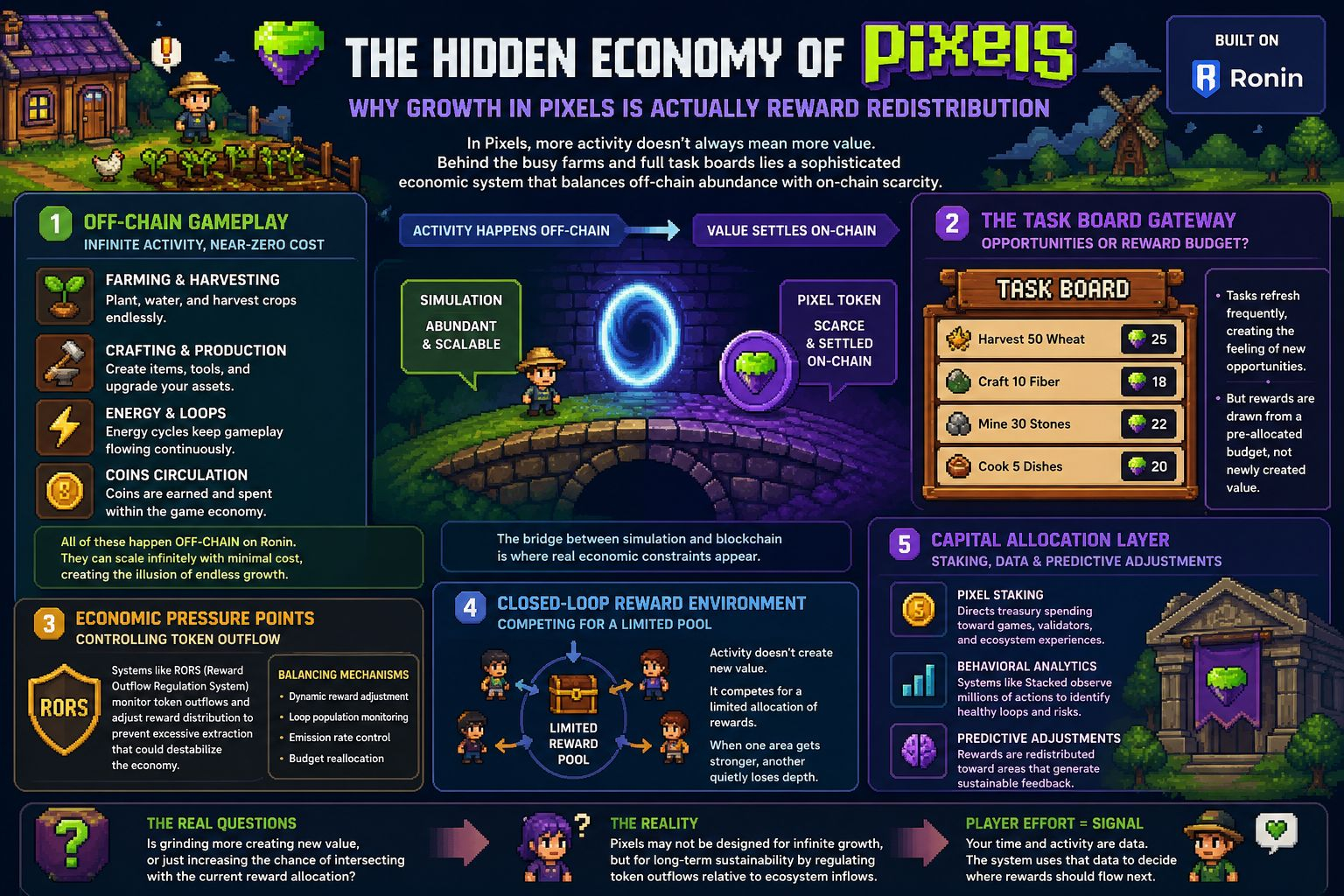
That observation becomes clearer when looking at the infrastructure that powers the game. Pixels runs on the Ronin Network, which allows the game to separate two very different layers of activity: gameplay and economic settlement.
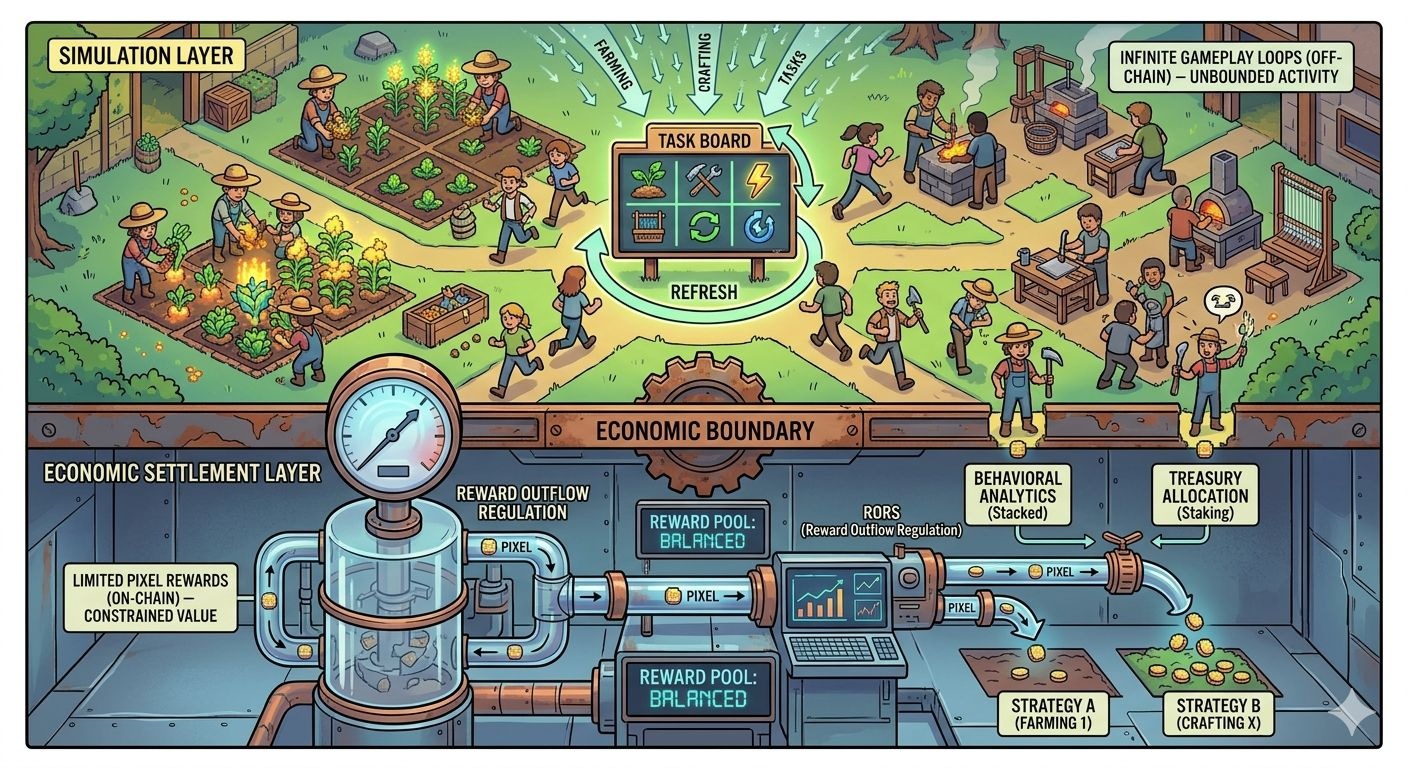
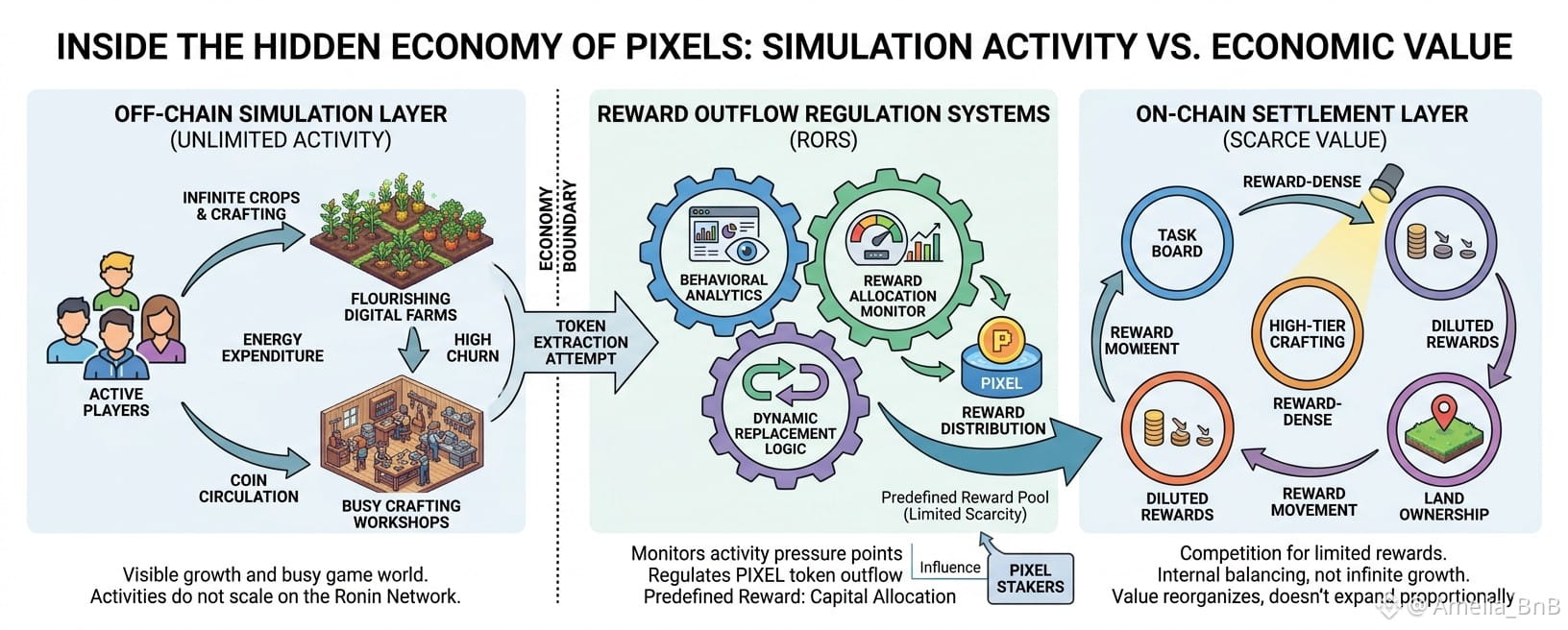
Inside the game, almost everything players do happens off-chain. Planting crops, harvesting resources, crafting items, spending energy, and circulating Coins are all part of a simulation layer that can scale almost infinitely. Because these actions do not require blockchain settlement, they can occur millions of times per day without cost or congestion. This is what creates the visible sense of expansion. The loops can multiply endlessly because they exist inside a computational environment rather than an economic one.
The constraint appears only when activity attempts to leave the simulation.
That moment occurs when rewards convert into the PIXEL token. Unlike farming crops or crafting items, PIXEL tokens must settle on-chain. They represent real economic value that can leave the game environment entirely. And because of that, they cannot expand indefinitely.
This boundary between off-chain abundance and on-chain scarcity is where the economic structure of Pixels becomes most visible.
One of the clearest examples is the Pixels Task Board. On the surface, it appears to be a constantly renewing set of opportunities. Tasks refresh frequently, encouraging players to complete activities for rewards. When I first interacted with it, I interpreted that refresh cycle as economic growthnew tasks meant new rewards entering the ecosystem.
But after watching it for long enough, a different pattern starts to emerge.
The tasks change. The activity shifts. Yet the reward depth rarely expands proportionally with the number of players completing them. Instead, it begins to feel as though the rewards are drawn from a predefined pool rather than generated dynamically by player activity.
This creates what I think of as an economic pressure pointan invisible boundary where simulated activity attempts to convert into real token extraction.
Most Web3 games eventually encounter this pressure. If players can infinitely convert gameplay into tokens, the economy collapses under inflation. If the system becomes too restrictive, players feel like their effort has no meaning. Sustainable Web3 economies therefore need some form of internal regulation.
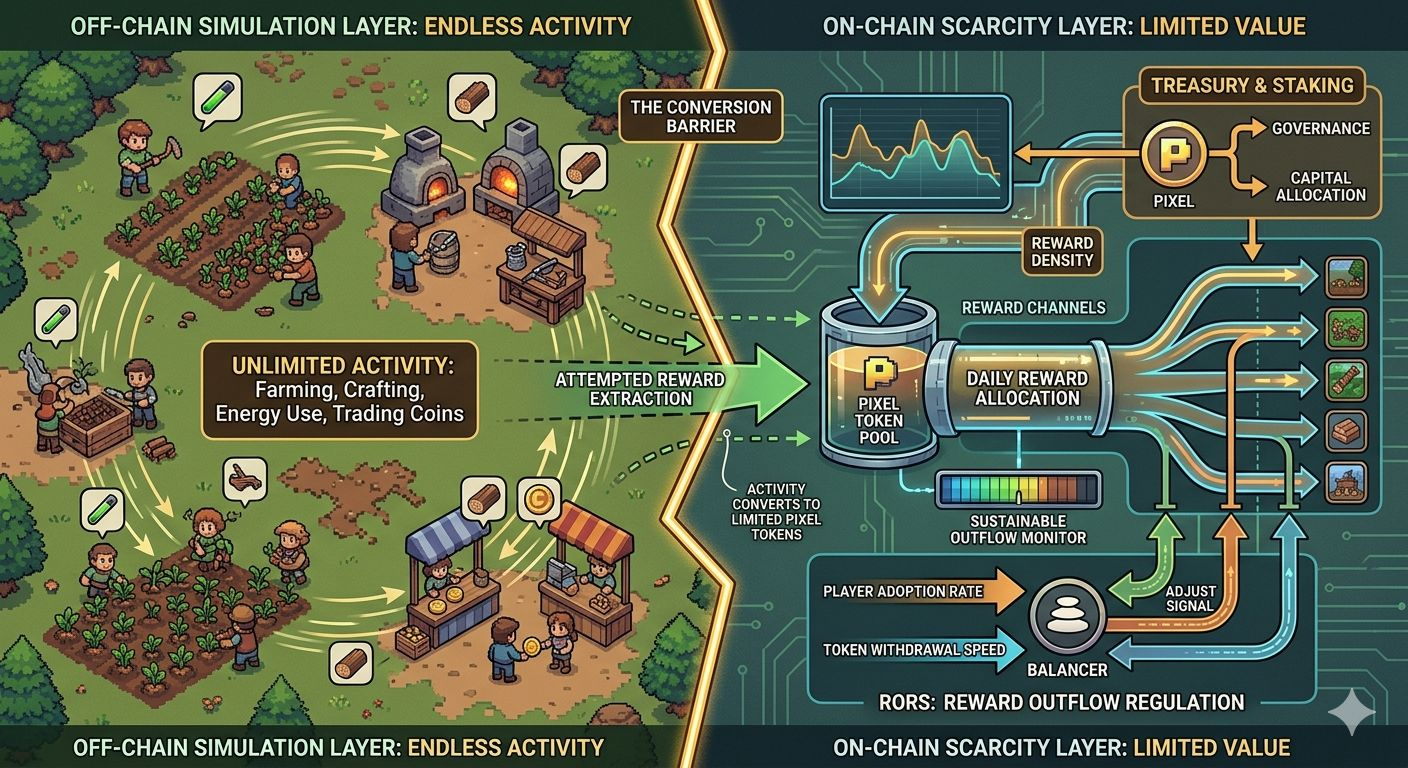
In Pixels, this regulation appears to operate through mechanisms designed to balance reward outflow. Systems sometimes referred to as RORSReward Outflow Regulation Systemslikely monitor how quickly tokens are leaving the ecosystem and adjust reward pathways accordingly. When too many players converge on a profitable loop, the system can rebalance by shifting rewards elsewhere or reducing payout density.
What players experience on the surface as changing opportunities may actually be a dynamic allocation process happening underneath.
This creates a closed-loop reward environment. Activity inside the game does not necessarily generate new economic value. Instead, it competes for a limited allocation of reward budget that the system distributes across different gameplay loops.
From that perspective, progression begins to look very different.
In traditional online games, growth typically means expansion. More players lead to more content, more rewards, and more opportunities across the board. Even if the distribution is uneven, the overall size of the economic space tends to increase.
In Pixels, growth may mean something closer to internal balancing.
When one gameplay loop becomes heavily populatedsuch as farming specific resources or completing a certain task typthe system may quietly reduce its reward density while strengthening another area. Players who move quickly into the newly strengthened loop feel like they discovered an opportunity. Those who remain in the old loop feel like rewards suddenly dried up.
The ecosystem didn’t shrink. It simply moved.
This is where the token itself becomes important. Through mechanisms like staking, holders of PIXEL tokens may influence how treasury funds are allocated across games, validators, or experiences within the broader ecosystem connected to the Ronin infrastructure. In effect, staking begins to function less like passive yield and more like capital allocation.
Resources are directed toward parts of the ecosystem that appear capable of sustaining healthy player behavior and economic feedback.
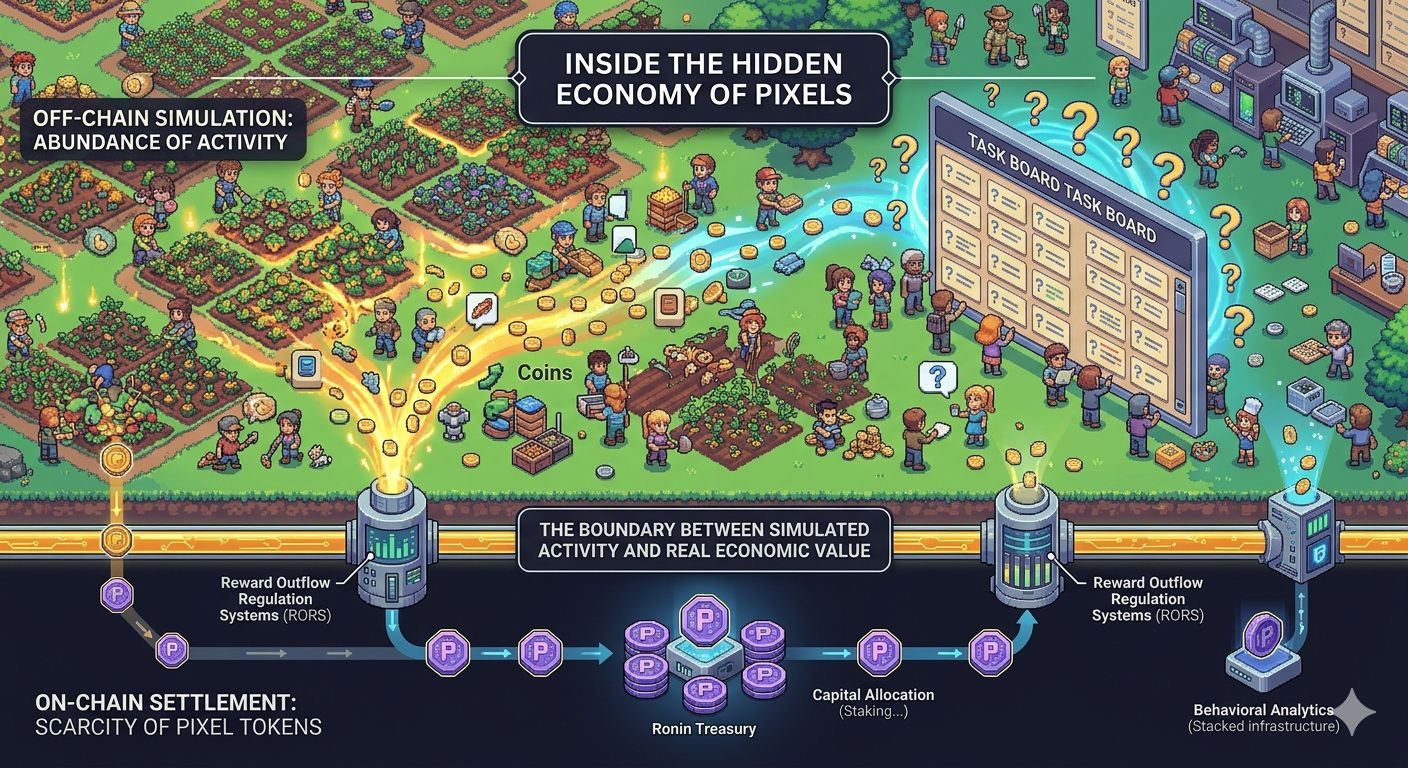
Layered on top of that, behavioral analytics systemssometimes associated with infrastructure like Stackedmay observe millions of gameplay actions across the network. By analyzing player movement, crafting patterns, task completion rates, and reward extraction speeds, the system can identify where economic pressure is forming.
If too much value begins leaving through a specific loop, the reward structure can be adjusted before the imbalance becomes visible to most players.
Seen through this lens, the feeling of progression inside Pixels becomes more philosophical than mechanical.
Grinding harder does not necessarily create new value. It simply increases the chance of intersecting with wherever the reward allocation currently resides. When players feel like they found a powerful strategy, they may actually be standing at the point where the system is temporarily directing its reward budget.
Eventually, that point moves.
And when it does, the ecosystem still looks active. Farms continue running. Crafting loops continue repeating. The world still feels busy.
But the rewards have shifted somewhere else.
This might be the most interesting economic idea hidden inside Pixels. The system may not be designed for infinite growth at all. Instead, it may be built to maintain long-term sustainability by constantly regulating the flow of tokens relative to the economic inflows generated by player attention, time, and capital.
If that interpretation is correct, then the real game inside Pixels is not farming crops.
It is learning how to read the movement of reward allocation within a living economic system.