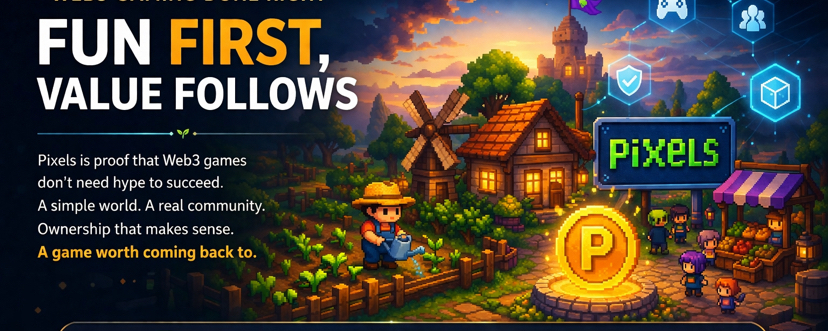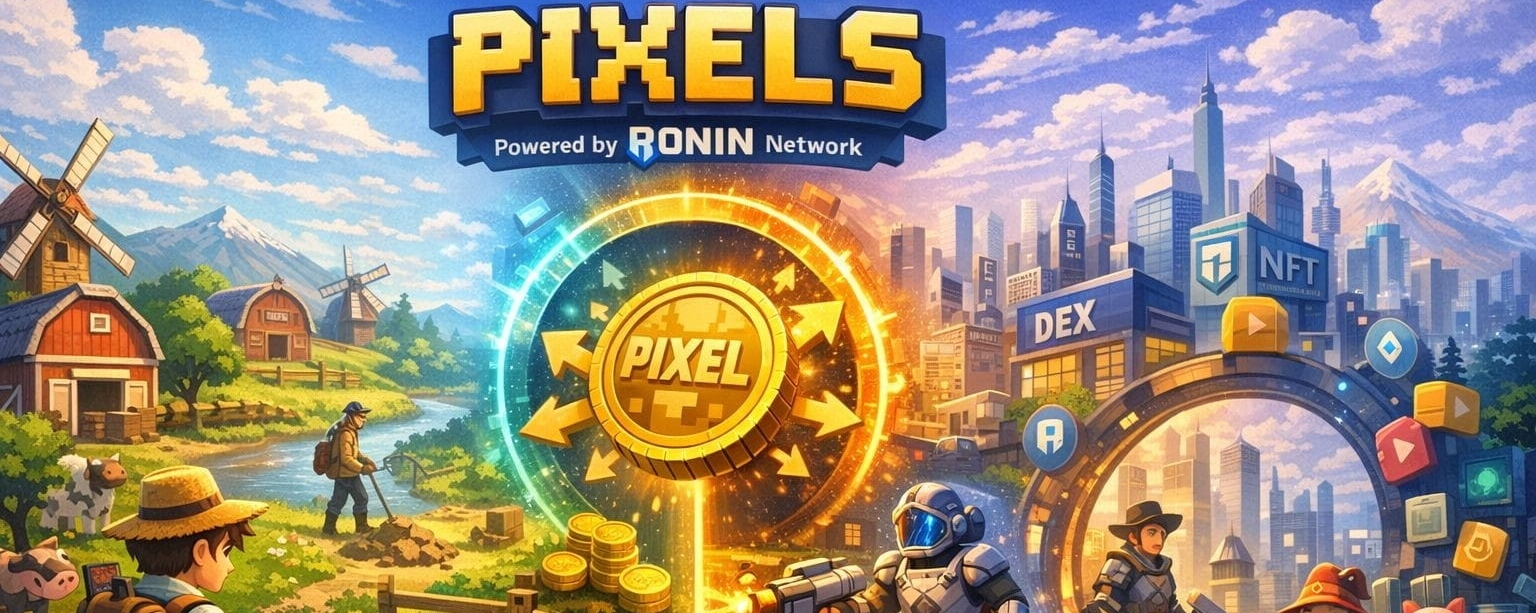
Pixels (PIXEL) is a social casual Web3 game powered by the Ronin Network, and at first glance it might look simple, almost too simple for the kind of attention digital games usually demand today. It is an open-world experience built around farming, exploration, and creation, but what makes it interesting is not any single mechanic. It is the feeling it leaves behind after you spend time inside it.
I don’t look at Pixels as something loud or competitive. It feels more like a slow digital routine that grows on you without asking for too much at once. You log in, you check your land, you do a bit of farming, maybe explore a little, maybe interact with others who are also just there, doing their own quiet tasks. Nothing is forced. Nothing is rushing you forward. And strangely, that becomes the hook.
The idea is not complicated, but it is layered in how it behaves. Farming is not just planting and collecting, it becomes a kind of rhythm you return to. Exploration is not just moving through a map, it feels like checking what has changed since the last time you were there. Creation is not just crafting items, it feels like slowly building a presence in a world that remembers your effort. It is small, but it stacks over time in a way that feels personal rather than mechanical.
There is something different about how the social part works too. It does not push interaction in a loud or artificial way. You might see other players nearby, you might trade or help, or you might just continue your own work without saying anything. That silence between players is not empty, it actually feels like shared space. Like everyone is part of the same world without needing constant communication.
The PIXEL token exists underneath all of this, connecting gameplay to an in-game economy. It is used for progression, participation, and ecosystem functions. It represents ownership in a broader sense, but it does not define the emotional experience of the game itself. The game can be played without thinking deeply about the token, but the token cannot exist meaningfully without the game. That balance is always fragile in systems like this, because once the economy becomes more important than the experience, the feeling of play starts to disappear.
Some people engage with PIXEL through exchanges like Binance, where the token can be traded. But trading and playing are two completely different behaviors. One is about movement in markets, the other is about time inside a world. Mixing those expectations is where misunderstandings usually begin, because the game is not built as a financial shortcut. It is built as a slow environment where actions accumulate over time.
The tokenomics behind PIXEL are structured around engagement and ecosystem participation, with allocations for community rewards, development, and long-term growth. On paper, this looks like a standard Web3 model, but in reality the success of such systems depends less on design and more on human behavior. If players stay active and find meaning in daily interaction, the system breathes. If they stop caring, the structure becomes inactive no matter how well it is designed.
The roadmap points toward expansion, deeper systems, and broader social mechanics. That usually sounds exciting, but it also introduces pressure. Every new feature changes the balance of the world. A game like this survives not just by adding things, but by making sure the original feeling is not lost in the process. Simplicity is easy to build at the start, but hard to protect over time.
There are also risks that sit quietly underneath everything. One is sustainability, because these ecosystems depend heavily on continuous participation. Another is complexity, because adding too many systems can turn a calm experience into something overwhelming. There is also a more subtle risk, where players slowly shift from experiencing the world to optimizing it. When that happens, the emotional side of the game weakens, even if the mechanics become stronger.
What stays with me most about Pixels is not the token or the structure, but the pacing. It does not behave like a space that demands constant attention. It behaves more like something that waits for you. A small digital place where effort is not measured in intensity but in consistency. You do a little, you come back later, and the world is still there, slightly changed, still quiet.
If it works long term, it will not be because it tried to be everything at once. It will be because it managed to keep something simple alive in a space that usually moves too fast to notice simple things.