
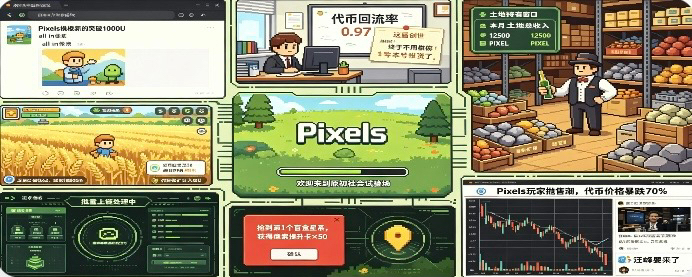

A lot of folks just stumbled upon @Pixels videos and screenshots, and their first reaction is: isn't this just some retro pixel farming game? You log in daily, water some crops, chop a few trees, mine some ore, and quietly pass the time. It looks chill and stress-free. When I first jumped into this space, I thought the same – just a casual chain game to mess around with, no heavy lifting needed. But after grinding through several months and logging in every day, I slowly realized this isn’t just a game for kicks. It’s clearly a virtual socioeconomic experiment wrapped in cute pixel aesthetics. On the surface, it seems like easygoing farming, but underneath, it's a complex game of virtual economics, packed with hardcore tech that many casual chain games lack. The deeper I dive in, the more intriguing it gets, but the more I ponder, the more I feel the harsh reality, even tinged with a sense of helplessness.
Let’s first talk about what everyone is most concerned about in Web3 games—can we make money, and can we play for the long haul? This logic can be broken down pretty straightforwardly. When Pixels first migrated to the Ronin chain, the data it released looked particularly impressive—over a million daily active players, and the floor price of land NFTs skyrocketed. Just a piece of ordinary land made people envious, and when the token $PIXEL launched, the entire blockchain gaming community was buzzing, with the hype reaching a peak comparable to the heyday of Axie, with players everywhere eager to get in.
But after five or six years of navigating the blockchain game scene, having lost money and stumbled into pitfalls, I’ve developed an eye that looks beyond superficial excitement to see the underlying logic. In my view, whether a Web3 game can survive long-term isn’t based on how many people jump in during a trend, nor on how hot the tokens and NFTs are; the core factor is whether its economic cycle can sustain itself and whether it has a continuous ability to generate revenue.
There's a crucial metric in Pixels that rarely gets talked about but is super important. Simply put, it measures how many of the 100 tokens given to players are eventually spent back in the game for buying items, upgrading land, or unlocking gameplay features, rather than being all dumped on the exchange, creating massive sell pressure. I specifically tracked this, and by the end of 2024, this figure didn't even hit 1, which means the game’s economy couldn't sustain itself. It was entirely reliant on a constant influx of new players depositing cash and buying assets, using the newbies' money to pay off the old players. To put it bluntly, it’s a subtle and covert way of “robbing Peter to pay Paul.” But what's refreshing is that the project team didn't try to hide this ugly data; they openly shared it, without beautifying or tricking the players. This level of honesty is really rare in the chaotic world of blockchain gaming.
More interesting and subtle than economic data is the game's reputation score mechanism. Every transaction we make in the game, every social interaction with other players, and even whether we’ve used scripts or cheats gets quietly recorded in the background. This data is processed through a model to calculate a unique reputation score. This score, though seemingly insignificant, directly impacts players’ interests—it determines how much 'farm tax' will be deducted when players withdraw tokens. Loyal players with high reputation scores face minimal tax deductions, almost like being exempt from taxes; meanwhile, those detected using scripts or cheats face painful tax rates that leave them earning nothing. What’s clever is that the deducted taxes flow 100% back to the token stakers, creating a small economic closed loop.
They never punish rule-breaking players with harsh bans; instead, they use this economic leverage to encourage players to self-regulate their behavior. In this game, we're not just players enjoying the fun—it's more like we're individual economic units being continuously assessed for credit and constrained by rules, where every action is directly tied to our interests.
As the game continues to evolve, I increasingly feel its realism, almost like a digital feudal landlord model. Free players, when they first dive in, can only experience the most basic farming and chopping trees, while the core high-yield gameplay and rare resource acquisition are all locked behind a paywall. To put it bluntly, they’re just tourists watching the spectacle. Moreover, the VIP thresholds keep rising, making it tough for regular small spenders to access the core benefits, slowly pushing them to the margins. In contrast, those early players who spent big on premium land don’t have to grind daily; they can sit back and enjoy stable returns from land leasing and resource production, mirroring the logic of landlords collecting rent in real life. The decentralization, equality, and true ownership of digital assets that Web3 touted have ultimately turned into a scenario where a few control core resources and reap the rewards from the majority of players. This disparity is really heartbreaking.
From a technical standpoint, although I’m not a professional coder, I often converse with tech-savvy friends in the circle. After digging deeper, I found that Pixels is not just a low-quality project that threw together a UI to cash in. Traditional blockchain games have a fatal flaw: every player action needs to be confirmed on-chain in real-time. Even with just a few hundred players online, no matter how fast the chain is, it can get bogged down, leading to significant lag and a terrible gaming experience.
But Pixels' tech design is particularly clever; it has a layered processing approach. When we click to farm, water, or harvest in the game, our phones or browsers immediately render the visuals, allowing us to see the results of our actions without waiting for on-chain confirmations, ensuring a smooth gaming experience. Meanwhile, the backend batches and compresses the massive amounts of player operation data before syncing it to the chain, balancing the security of on-chain assets with the need to solve concurrency issues. This technical prowess is indeed top-notch among blockchain games.
Its anti-script cheating logic is also quite on point; it doesn’t care how many assets you have in your wallet but tracks your operational behavior to determine if it’s real human action, effectively filtering out mechanical script accounts to protect the gaming environment for ordinary players. However, the internal competition driven by technology can be deadly; the output efficiency of scripts and algorithms far exceeds our manual labor. After toiling all day, we might earn less than what a script can do in just a few minutes, making ordinary players’ labor increasingly undervalued and leading to growing exhaustion.
Honestly, I still log into Pixels every day, not because its gameplay is so addictive, but more to witness where this virtual little world will eventually lead. It uses the simplest pixelated farming shell to replicate the economic rules, class disparities, and credit systems from real life. I can complain about its unfriendliness towards free players and how severe the resource monopoly is, while at the same time, I admire its genuine honesty, without any fake packaging.
Day in and day out, we toil away, trading our time and energy for on-chain tokens and assets, thinking we own exclusive digital land, when in reality, we’re just spinning in circles within rules set by others. Ultimately, Pixels has transcended the realm of gaming; it's a microcosm of real society, making us both love it and hate it, while we can't help but keep an eye on it.
We constantly pursue freedom and fairness in the virtual world, yet we find ourselves trapped in the same dilemmas as in reality. Is this pixelated world truly an innovative attempt at Web3, or is it just another form of invisible shackles?
