I logged in expecting nothing unusual.
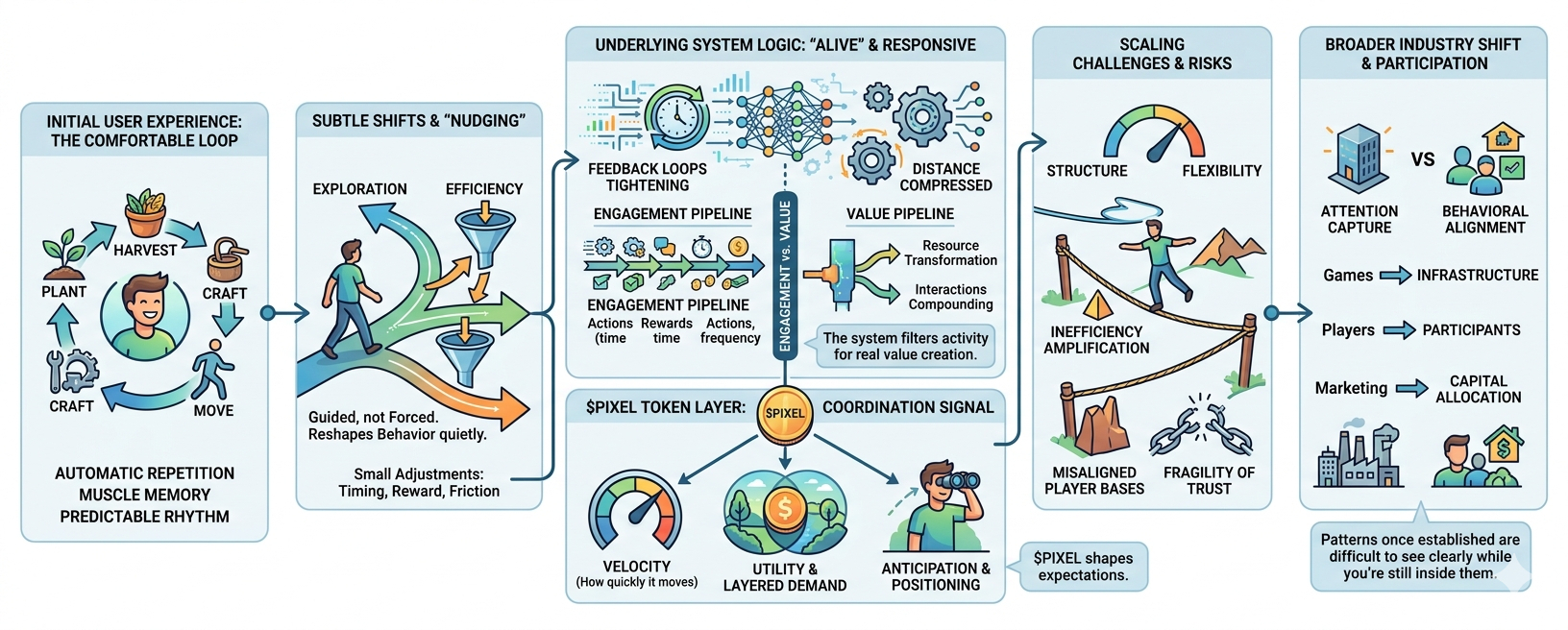
Plant, harvest, craft, move. The loop had become automatic—almost muscle memory at this point. There’s a comfort in that kind of repetition. You stop questioning it. You trust the rhythm. But somewhere in the middle of it, something felt slightly off. Not wrong, exactly—just unfamiliar in a way I couldn’t immediately explain.
I might be wrong, but it started to feel like I wasn’t just playing a game anymore. I was participating in something that was quietly adjusting around me.
At the surface, Pixels presents itself simply. A casual loop. Farming, exploration, creation. The kind of structure that feels accessible, even predictable. You act, you earn, you repeat. It’s easy to understand, and that simplicity is part of what makes it work. But the longer I stayed inside that loop, the more I began to notice that the outcomes didn’t feel evenly distributed. Some actions seemed to matter more than others, even when they looked identical on the surface.
That’s when the initial comfort started to give way to curiosity.
Systems don’t change loudly—they reshape behavior quietly. And in Pixels, that reshaping doesn’t announce itself. It emerges gradually, through small adjustments in timing, reward, and friction. At first, I thought I was optimizing my own playstyle. Choosing more efficient routes. Prioritizing better crops. Managing time more carefully. But looking closer, it felt less like I was making independent decisions and more like I was being guided toward certain patterns.
Not forced—just nudged.
There’s a subtle difference between freedom and direction. Pixels seems to operate in that space.
The loop itself remains simple, but the consequences of repeating it are not. Over time, certain behaviors begin to compound. Efficiency becomes more valuable than exploration. Consistency starts to outweigh experimentation. And without realizing it, I found myself optimizing for outcomes that weren’t explicitly stated anywhere.
That’s when the idea of the system as something “alive” started to make more sense to me.
Not alive in a literal sense, but responsive. Observant. Adaptive.
There’s a layer beneath the visible mechanics—something that feels like it’s learning. Every action produces data. Every decision feeds into a larger pattern. And that pattern, in turn, begins to influence the environment I’m operating in. Feedback loops tighten. Adjustments happen faster. What used to take time to understand now becomes immediate.
It’s almost as if the distance between action and consequence is being compressed.
I plant something, and the result isn’t just a resource—it’s information. I choose a path, and the system doesn’t just record it—it responds to it. Over time, these responses begin to shape the space itself. Not dramatically, but enough that I start to notice a difference in how I approach the next decision.
This is where the distinction between engagement and value becomes harder to ignore.
Engagement is easy to measure. Time spent, actions taken, loops completed. But value—real value—is something else entirely. It’s tied to what the system retains, redistributes, and ultimately converts into something sustainable. And in Pixels, those two layers don’t always align.
I can stay engaged without creating meaningful value. And I can create value without increasing visible engagement metrics.
That separation is important. It suggests that the system isn’t just rewarding activity—it’s filtering it.
Certain behaviors generate more than others. Not because they’re more frequent, but because they connect more directly to the underlying economic flow. Resources move. Goods transform. Interactions compound. And somewhere in that process, what looks like simple gameplay begins to resemble production.
That’s when the token layer starts to feel different.
$PIXEL, at first glance, behaves like any other in-game reward. You earn it, you use it, you move on. But the more I observed its role, the more it seemed less like a reward and more like a signal. A way of directing attention. A mechanism for coordinating behavior across different parts of the system.
Its velocity matters. How quickly it moves, where it flows, and what it touches along the way—all of these influence how the system evolves. If it moves too fast, it risks losing meaning. If it slows down too much, participation begins to fade. There’s a balance there, and maintaining it requires more than just distribution.
Utility plays a role too, but not in the obvious sense. It’s not just about where the token can be used—it’s about how those use cases overlap. When multiple environments depend on the same resource, demand begins to layer. And when that happens, behavior starts to shift again.
Players don’t just act based on immediate rewards—they begin to anticipate future ones.
That anticipation changes things.
It introduces a forward-looking element into what would otherwise be a repetitive loop. Decisions become less about the present and more about positioning. And in that space, the system gains another level of influence—not by controlling outcomes, but by shaping expectations.
Still, I don’t think this is without risk.
Scaling something like this isn’t straightforward. As more participants enter the system, maintaining balance becomes harder. Small inefficiencies can amplify quickly. Weak integrations—places where the token or mechanics don’t connect meaningfully—can dilute the entire structure. And different player bases bring different behaviors, which don’t always align neatly.
What works for one group might destabilize another.
There’s also a kind of fragility in systems that rely heavily on behavioral consistency. If the patterns shift too quickly, or if incentives lose clarity, the entire loop can start to feel unstable. And once that happens, it’s difficult to restore trust.
I might be overanalyzing it, but it seems like Pixels is navigating a narrow path between structure and flexibility.
Too much control, and it becomes rigid. Too much freedom, and it loses coherence.
But maybe that’s the point.
What I keep coming back to is how quietly all of this happens. There’s no single moment where the system reveals itself. No clear transition from “game” to “economy.” Instead, it unfolds gradually. One small adjustment at a time. One behavioral shift layered on top of another.
Until eventually, the difference becomes noticeable.
Not in what I’m doing—but in why I’m doing it.
And that feels like part of a broader shift I’ve been noticing beyond this one system. The industry itself seems to be moving in a similar direction. Away from pure attention capture and toward behavioral alignment. Less focus on acquiring users, more on shaping how they act once they’re inside.
Marketing spend starts to look more like capital allocation. Games start to resemble infrastructure.
And players—whether they realize it or not—become participants in something larger than entertainment.
I’m not sure what that means yet.
There’s something compelling about systems that offer ownership, even in small forms. The idea that actions can carry weight beyond the immediate moment. But at the same time, there’s a question of control. Of how much of that ownership is real, and how much is guided by underlying design.
Freedom and permission can look similar from the inside.
Efficiency can start to replace identity.
And somewhere in that tension, I find myself paying closer attention—not just to what the system allows, but to what it encourages.
Because in the end, it’s not the visible mechanics that define the experience. It’s the patterns they produce.
And those patterns, once established, are surprisingly difficult to see clearly while you’re still inside them