
I've been digging into a set of data lately, and the more I look, the more it feels off.
In the Q1 2026 report, there are two numbers sitting in the same table, but I haven't seen anyone put them together for analysis:
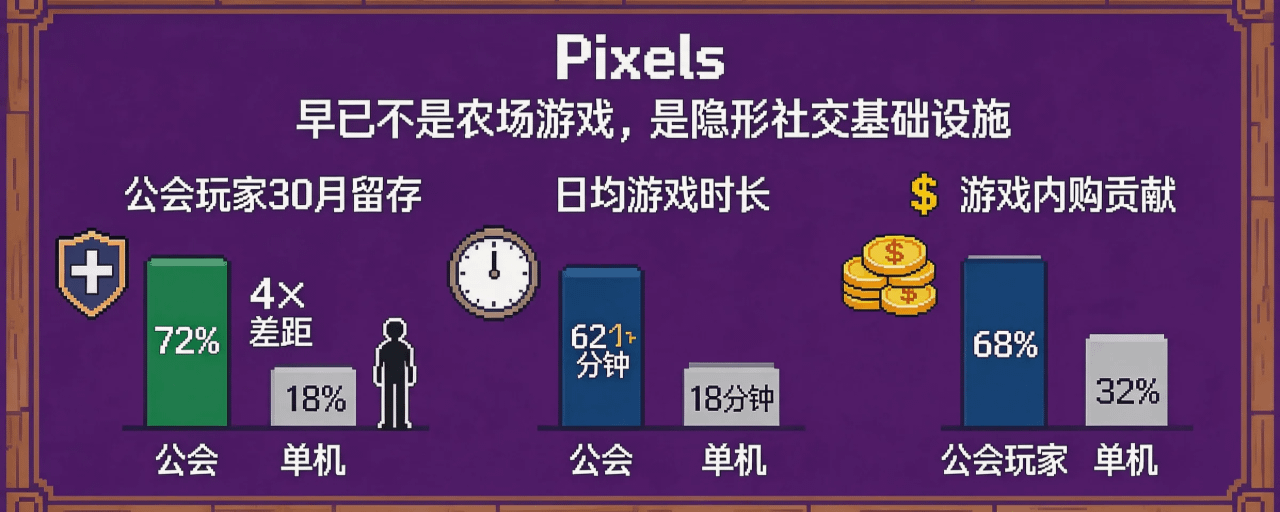
The 30-day retention rate for guild members is four times that of solo players.
The average daily playtime for guild members is 3.4 times that of solo players (62 minutes vs 18 minutes).
And then there's the third number: guild-associated players contributed 68% of in-game purchases.
I've been staring at these three numbers for a long time, and then it hit me—
Pixels is no longer just a farming game. It's gradually transformed into a social infrastructure, just still wearing the skin of a farming game.
This shift in understanding has led me to reconsider whether the valuation logic for PIXEL is fundamentally flawed. 🤔
First, let’s discuss why this number is so important.
Retention rate is one of the harshest metrics in the gaming industry. It doesn’t lie, isn’t influenced by emotions, and won’t be artificially inflated by a wave of airdrops.
Pixels' average 30-day retention in FY2025 is only 18%—this number isn't bad in Web3 gaming, but it's far from impressive. Compare it to any top-tier Web2 mobile game, and it will lose.
But the 30-day retention of guild members is 72%—this figure is also top-notch in Web2, nearing the level of mature social games like (Honor of Kings).
For the same Pixels, with the same game mechanics, the retention rate differs by a full 4 times.
This isn't the merit of the token economy, nor of the Farmer Fee, nor of the Energy system.
It's the strength of social relationships.
People stay in Pixels not to earn a few more PIXELs, but because they know someone in the guild, have things to do together, and have a place that belongs to them. This is structurally identical to why they don’t uninstall WeChat.
Then I started digging deeper, and the more I dug, the more interesting this clue became.
Pixels' guild system launched at the end of 2024, initially just a resource collaboration mechanism—guilds can share some land output and complete large tasks together for extra rewards.
However, Q1 2026 data shows that this system has already far exceeded its initial design boundaries.
What does an average daily gaming duration of 62 minutes mean? For comparison: during its peak, Axie Infinity's average daily duration was around 40 minutes, and Clash of Clans' was about 25 minutes. The gaming duration of guild players in Pixels is already close to hardcore MMO players' standards.
They're not grinding for energy; they're socializing.
A more crucial signal: 68% of in-game purchases come from guild-associated players. VIPs, pet upgrades, tools, NFTs—these people are continually and actively spending money in this ecosystem, not because they calculate the highest ROI, but because, in a community where they feel a sense of belonging, spending is part of the social behavior.
Upgrading equipment in your guild isn't just about efficiency; it's because your guild is competing next week, and you don’t want to let them down.
This psychological mechanism is entirely consistent with why you recharge for help wars in (Dream of the Red Chamber). And (Dream of the Red Chamber) has operated on this logic for twenty years.
Now let me talk about the core issue that keeps me up at night.
Everyone gives $PIXEL

When valuing, I used this set of logic:
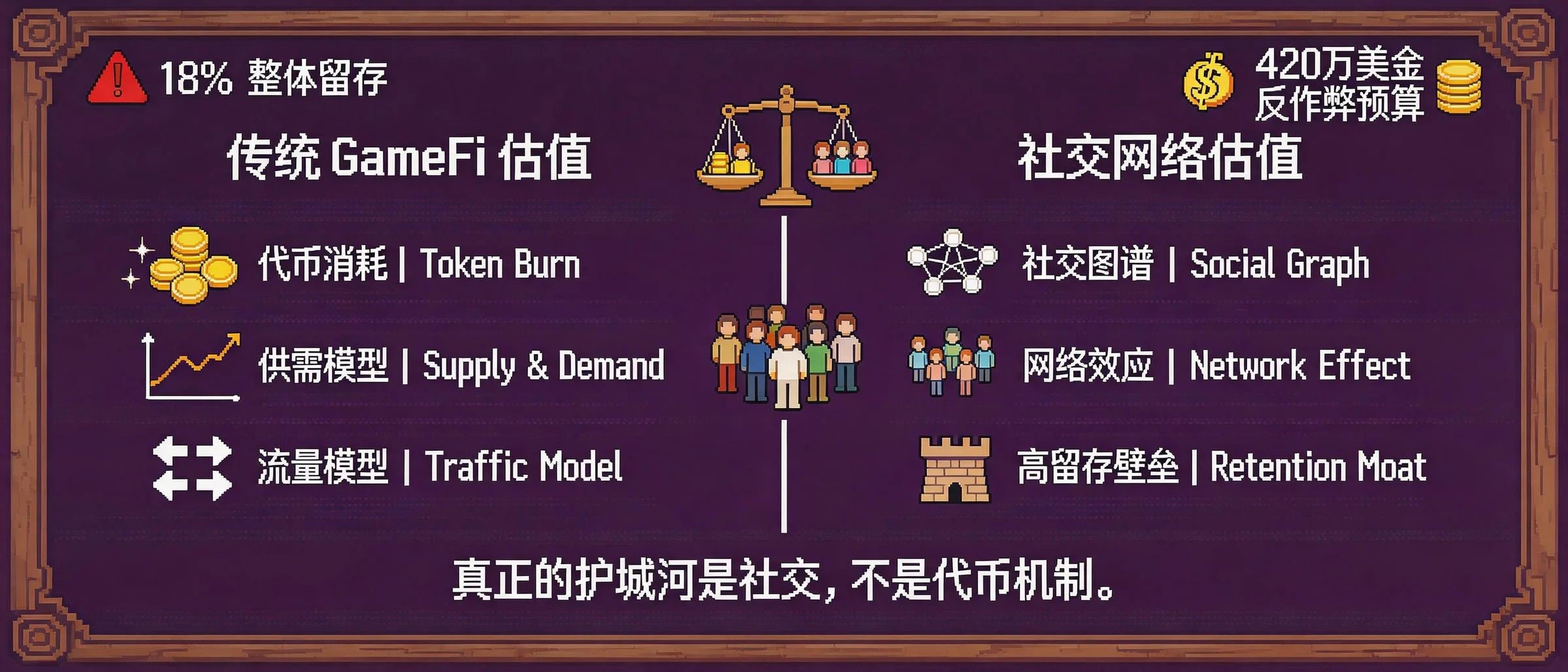
Token consumption → supply and demand relationship → price support.
This logic defines PIXEL as a functional token, and its value comes from 'how many people are using it for actions.' This is a traffic model, fundamentally pricing a tool.
But if Pixels' true moat is the social graph, then the valuation logic for PIXEL should be:
Social network scale × social stickiness → network effect value → ecological capture ability.
This is a network effect model, essentially pricing a social platform.
The ceilings calculated by these two models differ by an order of magnitude.
If WeChat's user scale is valued solely based on 'daily messaging frequency × server costs,' the resulting number would differ by dozens of times from Tencent's actual market value. The real value of WeChat isn't the messages themselves; it's that social network connecting 1.2 billion people—once formed, the migration cost is extremely high, and the substitutability is extremely low.
Pixels' guild system is quietly building a similar network.
Of course, its scale can't compare to WeChat. But the direction is the same: the deeper the social relationships players build here, the higher their cost of leaving, and the greater the value of this ecosystem to them.
But I have to say there's evidence that contradicts this logic, because it indeed exists.
The average 30-day retention for all players in FY2025 is only 18%.
This means that for every 100 new players entering Pixels, only 18 remain after 30 days. The other 82, after experiencing this world, leave without entering a guild, establishing social connections, or becoming that user with an average daily duration of 62 minutes.
The network effect has a cruel premise: you need enough people to stick around for the network to self-amplify.
An 18% overall retention rate means this social network's cold start isn't complete. Too many people are coming in, but the retention ratio is too low; the guild system can only cover a part of it.
The real issue isn't 'how high is guild retention,' but 'how to get more players to join a guild before they leave.'
This conversion rate is currently Pixels' most crucial growth variable, but I haven’t seen any public data tracking it.
Once Chapter 3's battle system and exploration map are launched, can we reduce the friction in the path of 'entering the game → joining a guild' and enable more new players to find a reason to stay within 30 days—this is more important than any adjustments to a token economy.
Finally, let me mention a number that few people talk about.
In FY2025, Pixels spent $4.2 million on anti-cheat.
This number itself isn't important; what's important is the information it reveals: Pixels is using real money to protect the genuine user experience within this social network. Bots and scripts erode not just the token economy but the gaming experience of real players; it diminishes their motivation to stay in the guild.
$4.2 million spent on anti-cheat is paying for the quality of the social network, not propping up the token price.
This prioritization choice says more about what the team is betting on than any announcement.
They're betting that this social network is worth more and harder to replicate than any token economic mechanism.
I don’t have a definitive answer on whether this bet is right. But at least it’s a bet supported by logic.
The current market cap of PIXEL reflects which set of logic's price; you do the math. 🙄