
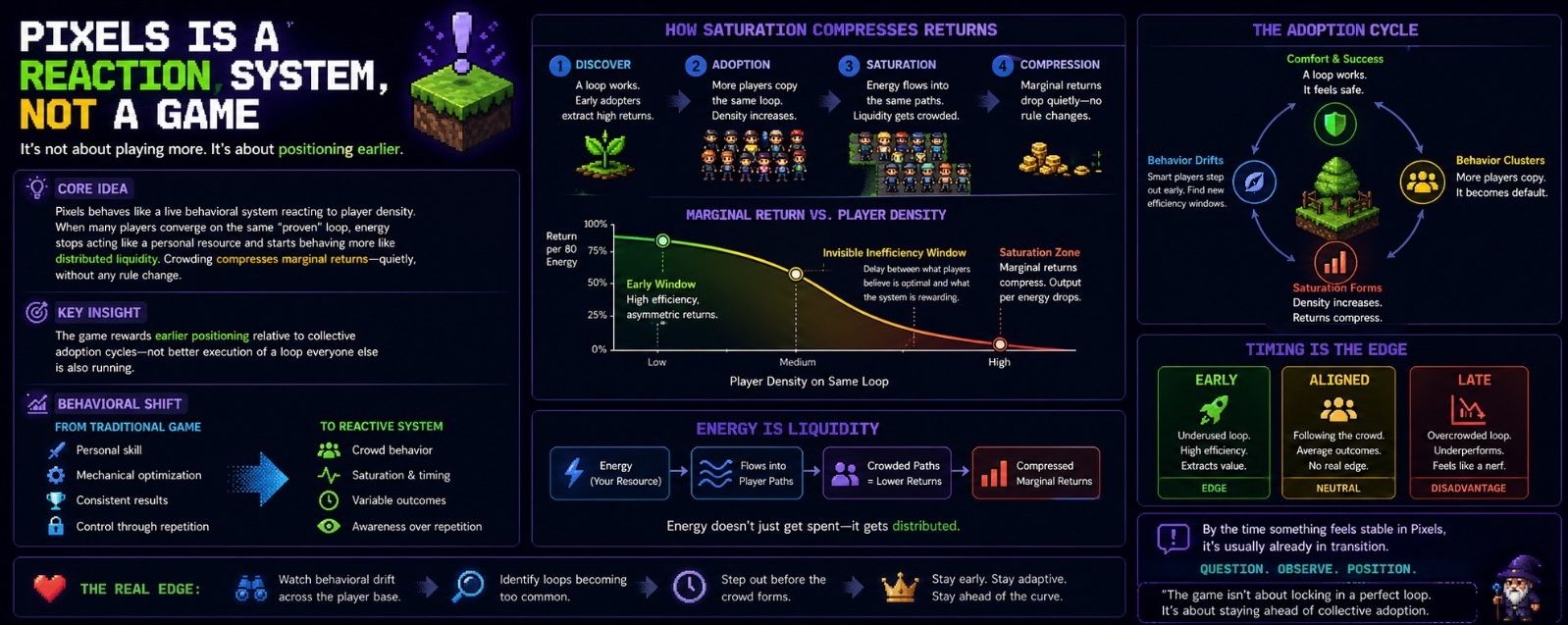

I’ve been sitting with Pixels for a while now, and the longer you stay inside it, the less it feels like a traditional farming loop and the more it starts to resemble a live behavioral system reacting to player density.
What stood out to me recently was a session where nothing on my side changed at all same crops, same route, same timing, same 60 energy allocation I’ve run before without friction. But the outcome didn’t match the past. Returns were slightly weaker. Not broken, not dramatic just quietly different.
In most game systems, you’d normally look for a mechanical explanation. A nerf, a patch, an inefficiency in execution. But Pixels doesn’t really behave like that once enough players are inside the same optimized understanding of it.
What actually shifts is saturation.
When a large portion of players converge on the same proven loop, energy stops acting like a personal resource and starts behaving more like distributed liquidity. It flows into the same narrow paths at the same time, and like any crowded market structure, marginal returns compress without any explicit change in rules.
The important part is that this compression is not immediate or obvious. There’s always a delay between what players believe is optimal and what the system is currently rewarding. That delay creates a kind of invisible inefficiency window.
Most players don’t see it because they anchor to recent success. If a loop worked yesterday, it becomes today’s default assumption. So behavior clusters, and clustering quietly reduces output per unit of energy.
From an analytical standpoint, the interesting shift isn’t in farming mechanics it’s in timing relative to crowd behavior.
I’ve started treating energy less like something you spend and more like something you position. There are moments where the highest-value decision is not deploying it at all, even when the obvious loop is available. Not because inactivity is inherently valuable, but because forced entry into saturated conditions is effectively negative selection.
That part is unintuitive for most players because activity feels like progress. Logging in, spending energy, completing cycles it creates a sense of control. But in a reactive system like this, control is often an illusion created by repetition, not efficiency.
What I’m watching more closely now is behavioral drift across the player base. Which loops are becoming too comfortable, too widely mirrored, too predictable. The moment a strategy becomes common knowledge, it starts transitioning from edge to baseline. And once it becomes baseline, it no longer produces asymmetric returns.
The real edge isn’t in discovering a strong loop. It’s in recognizing when that loop is being overused and quietly stepping out of its density curve before the crowd fully forms.
So from where I’m standing, Pixels isn’t really rewarding better play in a static sense. It’s rewarding earlier positioning relative to collective adoption cycles.
If you’re early, you extract efficiency. If you’re aligned with the majority, you average outcomes. If you’re late into a crowded pattern, you underperform without any obvious mistake in execution.
And the uncomfortable insight is this: by the time something feels stable in Pixels, it’s usually already in transition.
So the game isn’t about locking in a perfect loop anymore. It’s about constantly questioning whether your current loop is still underused or already being quietly diluted by everyone else who arrived at the same conclusion a little too late.
