
Pixels is building a Realms Scripting Engine for third-party developers. the first time I read that, I almost scrolled past it.
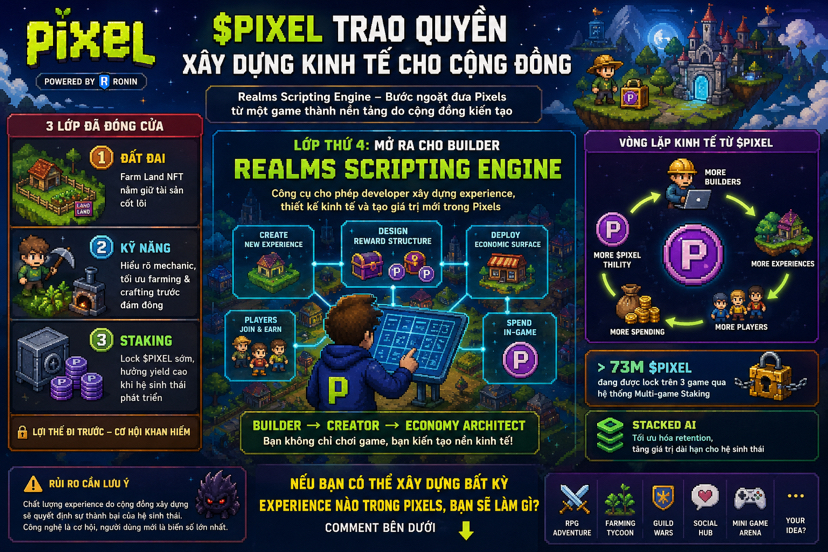
but what does it actually mean when the people who design the economic surfaces inside a game are no longer just the team?
most players think about the future of Pixels in terms of what the team ships next. the next chapter. the next season. the next mechanic. that mental model makes sense — it’s how every game has ever worked. the studio builds. the player engages. that’s the contract.
the Scripting Engine quietly rewrites that contract.
if outside developers can now build reward structures, deploy experiences, and design loops that run inside Pixels — then who exactly is the economy authored by? and if the answer starts shifting from “the team” toward “anyone who builds well enough” — what does that do to the value of building early?
now here’s where it gets interesting for PIXEL specifically.
every experience a third-party developer builds inside Pixels still runs on the same token. mint an NFT — PIXEL. join a guild — PIXEL. unlock a VIP tier — PIXEL. the token isn’t just a reward mechanism anymore. it becomes the connective tissue between every economic loop inside the ecosystem, whether that loop was designed by the core team or by a developer who joined last month.
that changes the demand equation in a way that’s easy to underestimate. right now, PIXEL demand is roughly proportional to how much the core team ships. more content, more reasons to spend. but with an open scripting layer, demand stops being a function of one team’s output and starts becoming a function of an entire ecosystem’s creativity. the ceiling moves.
and there’s already evidence this compounding model works. the multi-game staking system — currently holding over 73 million PIXEL locked across three games — shows that when you give people more surfaces to engage with, they don’t spread their attention thin. they go deeper. more games in the ecosystem haven’t diluted PIXEL’s utility. they’ve added to it.
the Scripting Engine could do the same thing, but at a different layer. staking expanded where you could put your tokens. scripting expands who gets to build the places your tokens flow through.
think about what that means at scale. if ten compelling experiences get built on the scripting engine in the next twelve months, each pulling players into new loops that require PIXEL to participate — that’s ten new sources of organic demand that didn’t exist before. not from speculation. not from a token unlock event. from actual players doing actual things inside an actual game.
of course none of this is guaranteed. open platforms are only as good as what gets built on them. and the quality bar matters enormously — one extractive experience can do real damage to player trust in a way that takes months to repair. how Pixels manages curation, reputation, and developer incentives on the scripting layer will probably determine whether this becomes a genuine demand multiplier or just an interesting experiment.
but the structural logic is sound. more builders means more loops. more loops means more PIXEL in motion. and PIXEL in motion is a very different asset than PIXEL sitting on an exchange waiting for the next catalyst.
so here’s what I keep coming back to: is the Scripting Engine the moment PIXEL stops being a gaming token and starts becoming infrastructure?
what do you think — does open-platform demand actually compound, or does it just fragment? 👇
