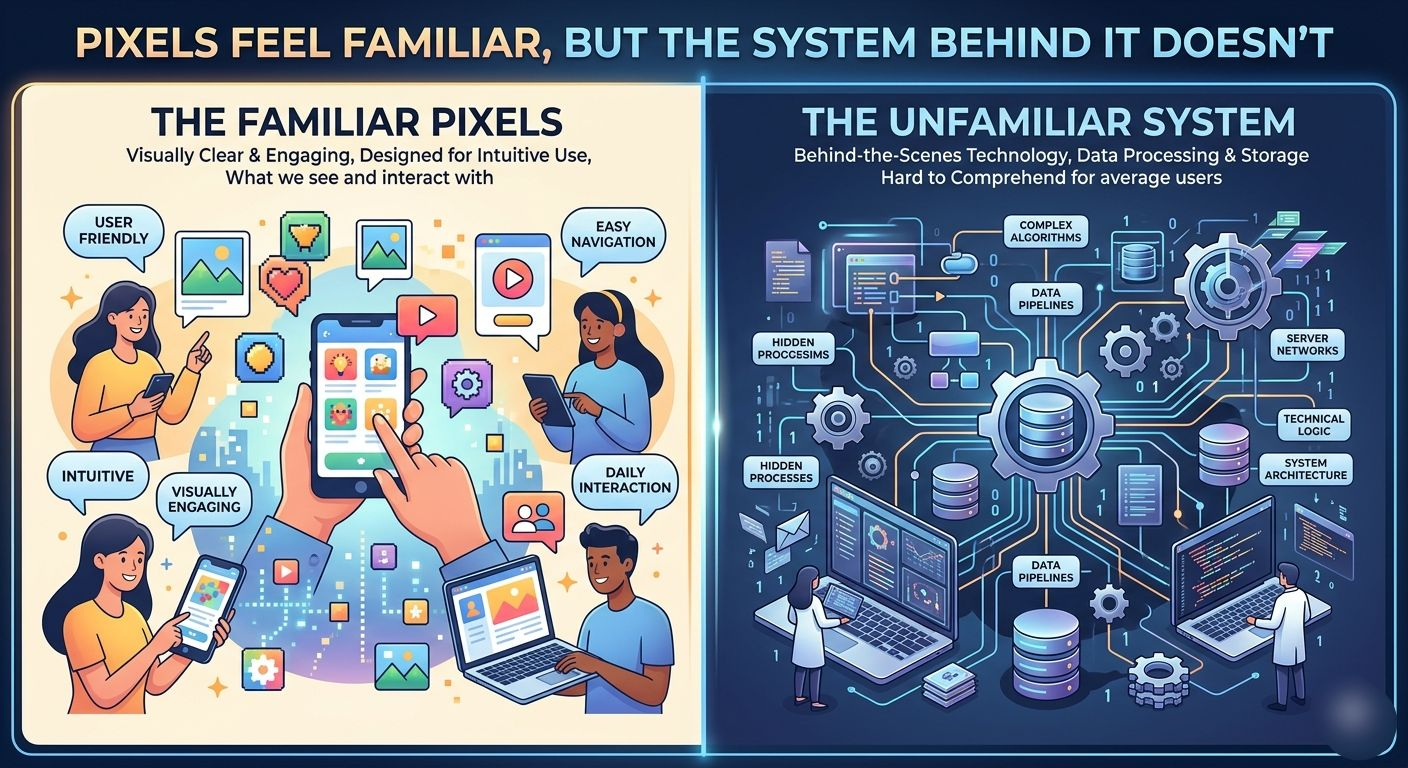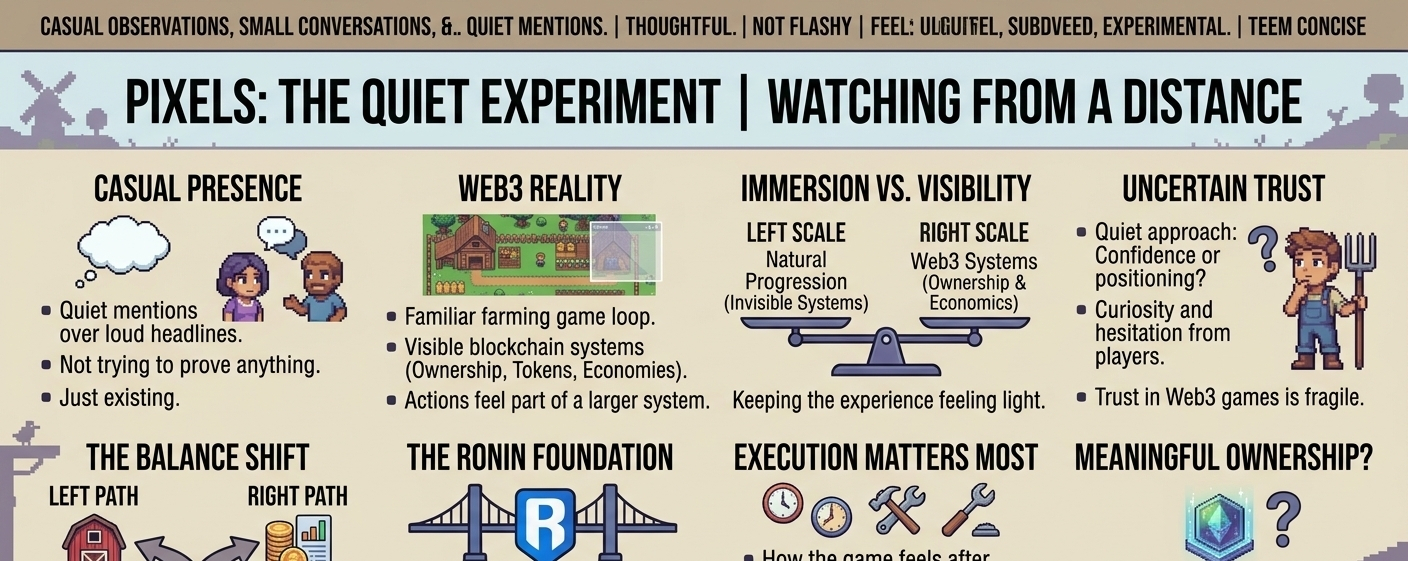
I keep seeing Pixels pop up in places where people aren’t trying to impress anyone. Just casual mentions, quiet observations, small conversations that don’t feel staged. That alone makes me pause a bit. In a space where most projects are constantly trying to prove something, this one feels like it’s just… existing. I’m watching it from a distance, trying to understand what it actually becomes when you ignore the usual Web3 noise.
At first it sounds simple. A farming game, social, open-world, built on Ronin. We’ve all seen versions of that before. Plant crops, explore, build, interact. Nothing about that screams innovation on the surface. But reality is different. The moment you attach blockchain to something this familiar, everything starts carrying extra weight. Even the simplest action begins to feel like part of a larger system.
I’m standing here thinking about how easy it is to underestimate that. Farming games only work when progression feels natural, almost invisible. You don’t think about the system, you just play. But in Web3, systems are always visible. There’s always something underneathownership, tokens, economies. That’s where things get interesting. Because the more visible the system becomes, the
harder it is to keep the experience feeling light.
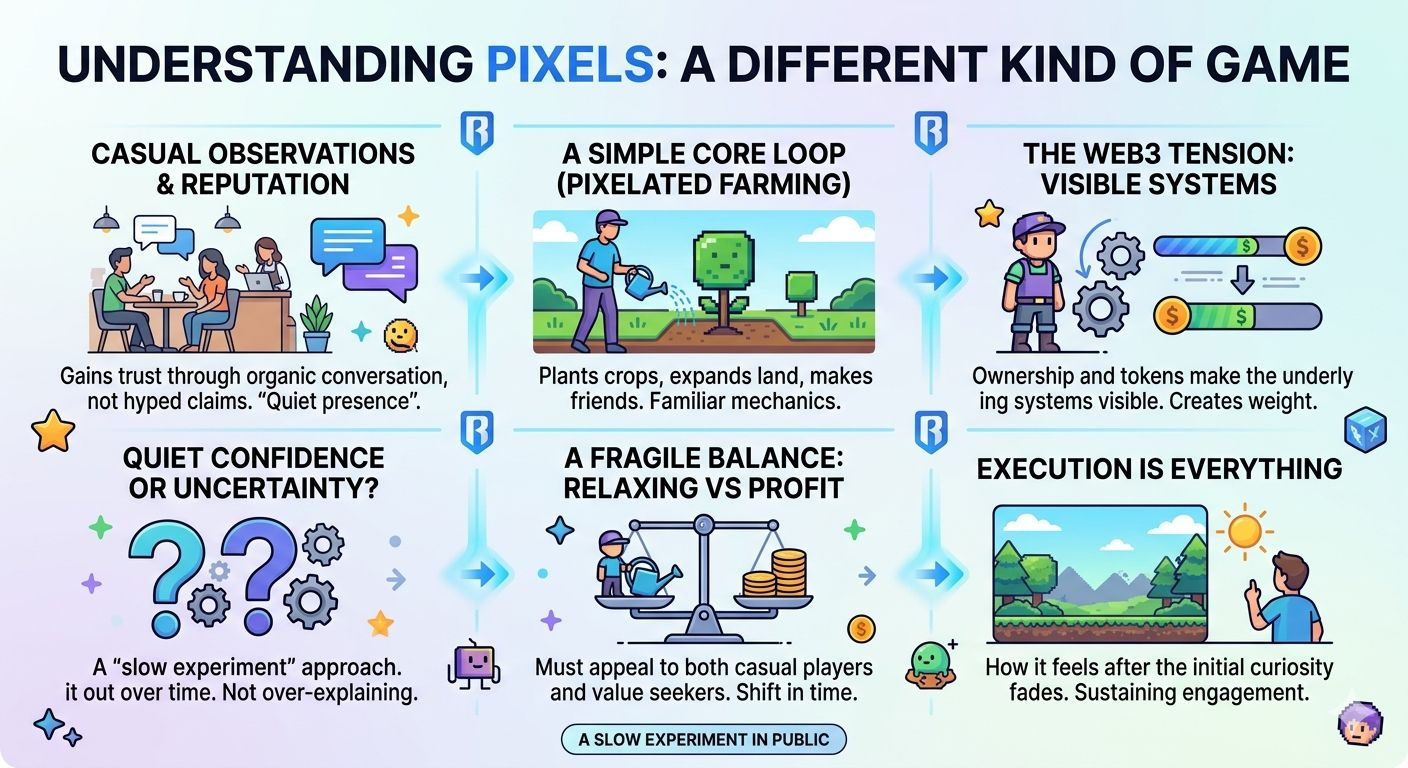
What I notice about Pixels is that it’s not trying too hard to explain itself. That can be a strength, but it can also hide uncertainty. I’m not fully convinced yet whether this quiet approach means confidence or just careful positioning. Maybe the team understands that over-explaining kills immersion. Or maybe they’re still figuring things out in real time. Either way, it doesn’t feel like a finished story.
I keep coming back to how people are interacting with it. Not the numbers, not the metrics, just the tone. There’s curiosity, but also hesitation. People are trying it, but they’re also watching it closely. That usually means one thingthe idea is interesting, but trust hasn’t fully formed yet. And trust in Web3 games is fragile. Once players feel like they’re being pushed toward a system instead of naturally pulled into it, they step back.
This is where it gets complicated. Pixels sits between two different mindsets. Some players just want to relax, farm, and explore. Others are thinking about value, efficiency, maybe even profit. Real systems don’t work in extremes. If it leans too far in one direction, it risks losing the other. And that balance isn’t something you solve onceit’s something that keeps shifting over time.
I also can’t ignore the role of Ronin here. It makes things smoother, no doubt. Lower friction helps people stay in the experience instead of fighting the system. But I’ve seen this beforegood infrastructure can only carry you so far. It removes problems, but it doesn’t create meaning. If the core loop isn’t satisfying, nothing else really matters.
Execution will decide everything. Not the idea, not the positioning, not even the timing. Just the small detailshow the game feels after an hour, after a week, after the initial curiosity fades. That’s where most projects quietly fall apart. Not because they’re bad, but because they can’t hold attention without constantly adding something new.
I keep thinking about ownership too. Everyone talks about it, but very few games make it feel real in a meaningful way. Does owning something in Pixels actually change how you play? Or is it just there, existing in the background? That question matters more than anything, and I don’t think there’s a clear answer yet.
I’m not looking at Pixels like it’s trying to change the industry overnight. It feels more like a slow experiment happening in public. And maybe that’s why it keeps showing up in these quiet conversations instead of loud headlines.
I’m not fully convinced yet. But I keep watching. And in a space like this, that usually means something is workingjust not in the obvious way.