
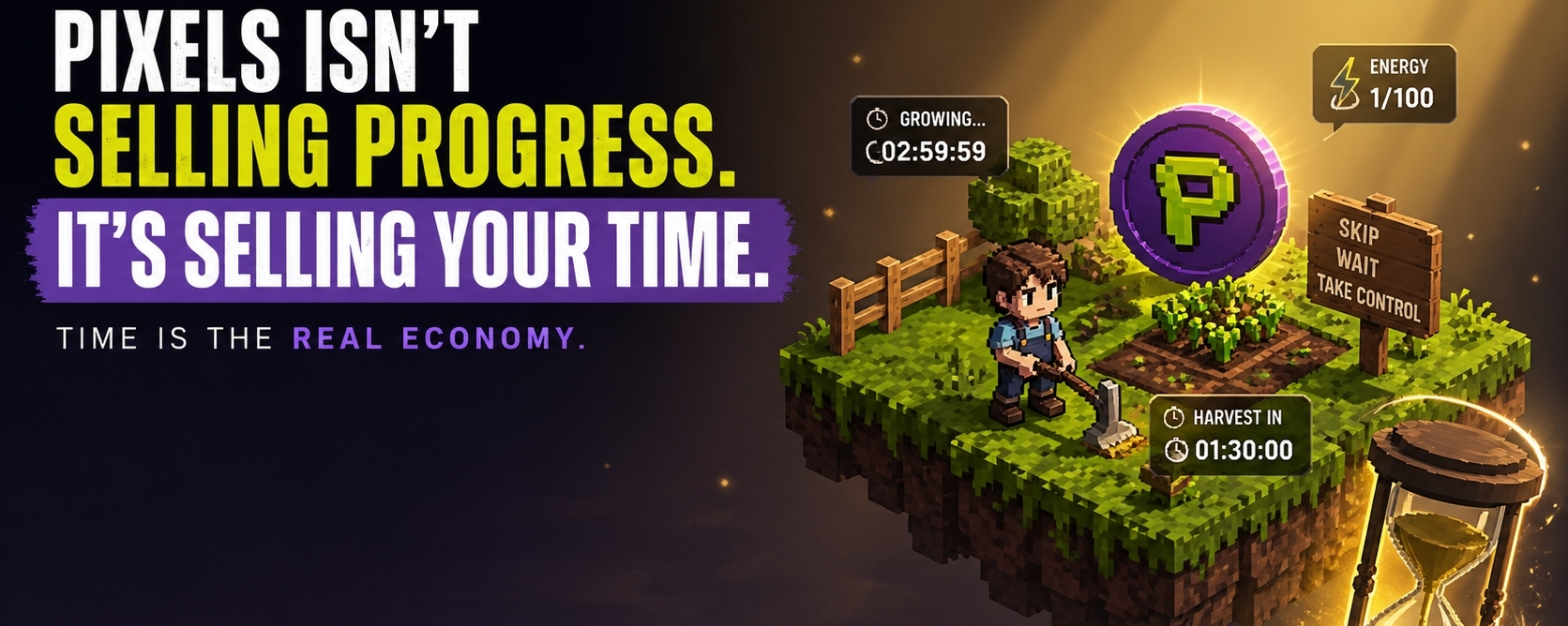
Pixels Isn’t Selling Progress. It’s Selling Your Time.
At first, Pixels felt familiar.
Another loop. Plant, wait, harvest. A system I have seen play out dozens of times, usually ending the same way. Tokens inflate, attention fades, and the whole thing slowly collapses under its own predictability.
So I did not think much of it.
But after watching how people actually play not just what the game says it is something did not quite line up.
Players are not reacting to what they earn.
They are reacting to how long it takes to earn it.
That sounds simple, almost too obvious. But it changes everything.
Most GameFi systems sell progress. Better tools, faster output, bigger rewards. Pixels technically does that too, but that’s not where the pressure comes from. The real weight sits in the delays. Small ones. Timers, energy limits, tiny pauses between actions.
Individually, they are nothing.
Together, they shape the entire experience.
And that is where $PIXEL quietly finds its place.
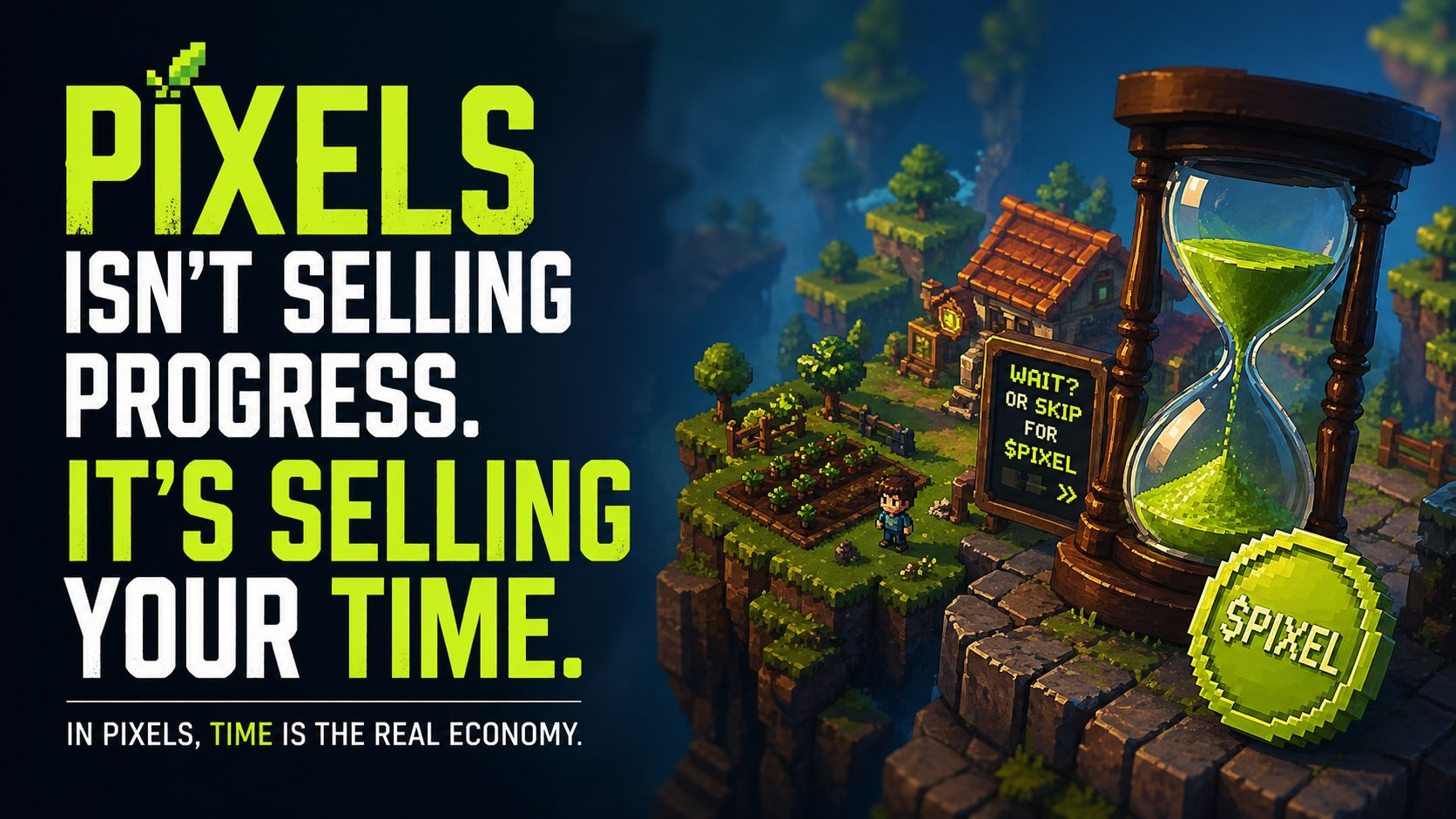
It does not feel like a currency in the usual sense. You are not really spending it to gain something new. You are spending it to remove something waiting, repetition, friction.
It is less about buying progress, more about deciding your time matters.
What surprised me is how often that decision shows up.
Not just from players trying to optimize or win but from people who simply don’t want to sit through the same loop again. They are not chasing efficiency. They are avoiding annoyance.
That kind of demand is subtle. You won’t see it clearly in metrics or dashboards. But it repeats, quietly, across thousands of small choices.
There is also a split in the system that feels intentional.
Coins handle the surface layer. They keep everything moving. You can stay there indefinitely, playing casually, progressing slowly. Nothing forces you out.
But the moment you want control real control over your time you cross into @Pixels
It is not a hard boundary. More like a soft pull.
The experience shifts depending on how much friction you are willing to tolerate.
That reminds me less of traditional games and more of how platforms manage access. Everyone can participate. But not everyone gets the same control over how the experience unfolds.
Pixels never says this directly. It does not have to.
You feel it.
This is also why I think most people are reading it wrong.
The conversation keeps circling around growth. More users, more adoption, more expansion. As if scale is the only thing that matters.
But I am not convinced.
Because this system does not rely on constant inflow as much as it relies on repetition.
If players keep running into moments where waiting feels unnecessary, the demand loop sustains itself. Not explosively. Not dramatically. Just consistently.
Skip this. Speed that up. Avoid doing that again.
Over and over.
But that balance is fragile.
If the game becomes too smooth, the need disappears. There is nothing left to skip.
If it becomes too slow, too obviously engineered to push spending, players push back or worse, they leave.
We have all done it. Closed a game instead of paying to make it tolerable.
That option never goes away.
So the system ends up walking a very thin line. Friction has to exist, but it has to feel natural. Almost invisible. Like part of the world, not something imposed on it.
That is difficult to maintain. Even harder at scale.
Which is why I do not think the model is guaranteed to work long term.
But I also dont think it’s being understood properly right now.
Pixels does not really sell progress.
It shapes how time feels.
Slower in some places. Faster in others. Optional, if you are willing to pay for that choice.
And $PIXEL sits right at that intersection the point where time becomes flexible.
Whether that turns into something durable or just a temporary habit depends on how carefully that feeling is maintained.
Because systems built on subtlety dont break loudly.
They just stop being felt.
And when that happens, everything else usually follows.
