
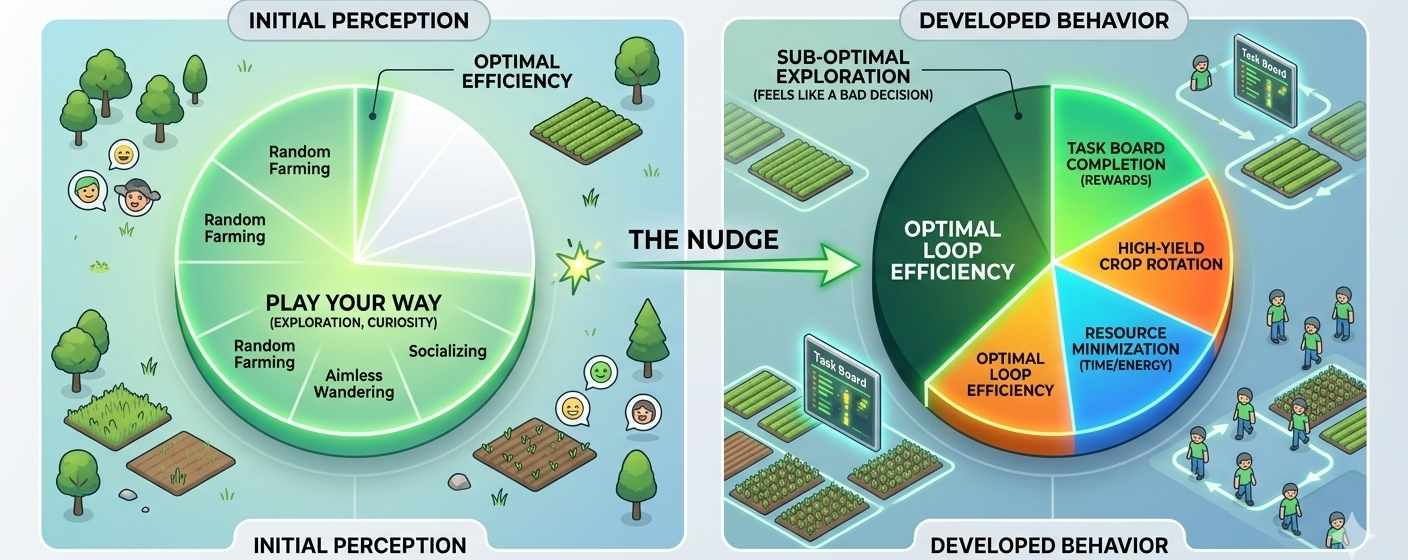
At first, it feels… easy. Open. Kinda relaxing, actually. You log in and there’s no one yelling at you, no arrows screaming “go here next.” Just a big map and this quiet sense that you can do whatever you want. Farm a bit. Wander off. Mess around.
And for a while, that illusion holds up.
You think you’re playing your way.
But here’s the thing—give it a little time, and something starts to feel off. Not wrong exactly. Just… off.
You notice certain actions pay better. Some tasks move the needle faster. Some paths just make more sense if you care even a little about progress. And yeah, maybe at first you ignore it. Do your own thing.
But then you catch yourself.
You start optimizing.
Not because the game forces you. It doesn’t. That’s the trick. You do it because it feels dumb not to.
And that’s where things get interesting.
The world still looks open. Nothing physically blocks you. You can go anywhere.
But let’s be real—most of that space stops mattering.
You could plant random crops in some corner of the map. You could wander off and explore just for the sake of it. But why would you, when there’s a clear path that actually pays?
That’s the shift.
The game doesn’t take away your freedom. It just makes every other option feel like a bad decision.
So yeah, technically you’ve got choices.
Practically? Not really.
Watch other players for a bit. Seriously.
You’ll see it.
Same routes. Same loops. Same behavior. Over and over again.
Nobody’s coordinating this. There’s no master plan. It just… happens. Everyone slowly figures out what works, and then they stick to it.
I’ve seen this before. Games always drift this way when efficiency becomes the goal.
And Pixels leans right into it.
The Task Board? That thing looks harmless. Just a guide, right?
Nah. It’s more than that.
It quietly tells you what matters. What’s worth your time. What isn’t. You log in, check it, knock out tasks, collect rewards. Done. Clean loop.
And after a while, you stop asking yourself what you feel like doing.
You start asking what’s optimal.
Small change. Huge impact.
Because once you start thinking like that, the game stops being a playground. It turns into a system you’re trying to solve.
Now let’s talk about the economy, because this is where it gets a little ruthless.
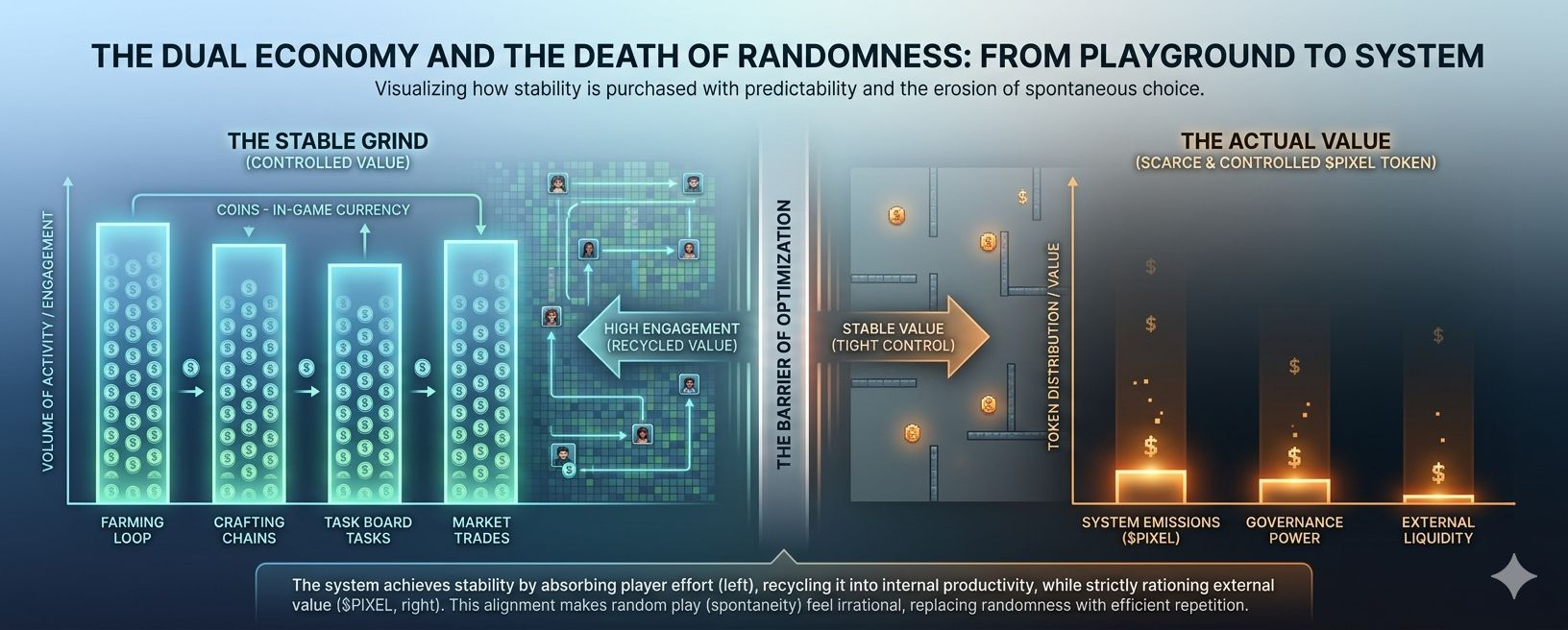
You spend most of your time earning coins. That’s the grind. Farming, crafting, tasks—it all feeds into that loop. And yeah, it feels good. Numbers go up, progress feels real, you stay engaged.
But those coins? They don’t leave the system.
They keep you inside it.
Meanwhile, the actual value—the $PIXEL token—that’s handled way more carefully. Controlled supply. Tight distribution. No chaos.
From a design perspective, it’s smart. Really smart. It avoids the mess we’ve seen in other play-to-earn games where everything just collapses under inflation.
But here’s the flip side—and people don’t talk about this enough.
You’re doing the work. You’re putting in time. Effort. Attention.
And most of what you get back stays locked in a closed loop.
You feel productive, sure. But you’re playing inside boundaries someone else set.
And yeah, you accept it.
Because the system works.
That’s the uncomfortable part.
Pixels didn’t mess up play-to-earn. It refined it.
It figured out how to keep players engaged without letting the economy spiral out of control. It balances things in a way that feels stable, predictable.
Almost too predictable.
Because once everyone figures out the “best” way to play, everything starts to look the same.
Same decisions. Same paths. Same outcomes.
And at that point, you’ve got to ask—
Is this still a game?
Or is it just a loop you’ve gotten really good at running?
What gets lost here isn’t fun. Not immediately, anyway.
It’s randomness.
That messy, inefficient, sometimes pointless kind of play where you try stuff just because you can. Where you wander off and maybe waste time—and maybe discover something cool.
That space shrinks.
Not because the game removes it.
Because the system makes it feel pointless.
And when something feels pointless, players drop it. Every time.
So yeah, Pixels is smart. No question.
It doesn’t force you into anything. It doesn’t lock you down.
It just nudges you. Quietly. Consistently.
Until you’re doing exactly what it wants.
And the wild part?
You think it was your idea.
That’s the real design here.
Not control.
Alignment.
And once you see it… yeah, you can’t really unsee it.
