
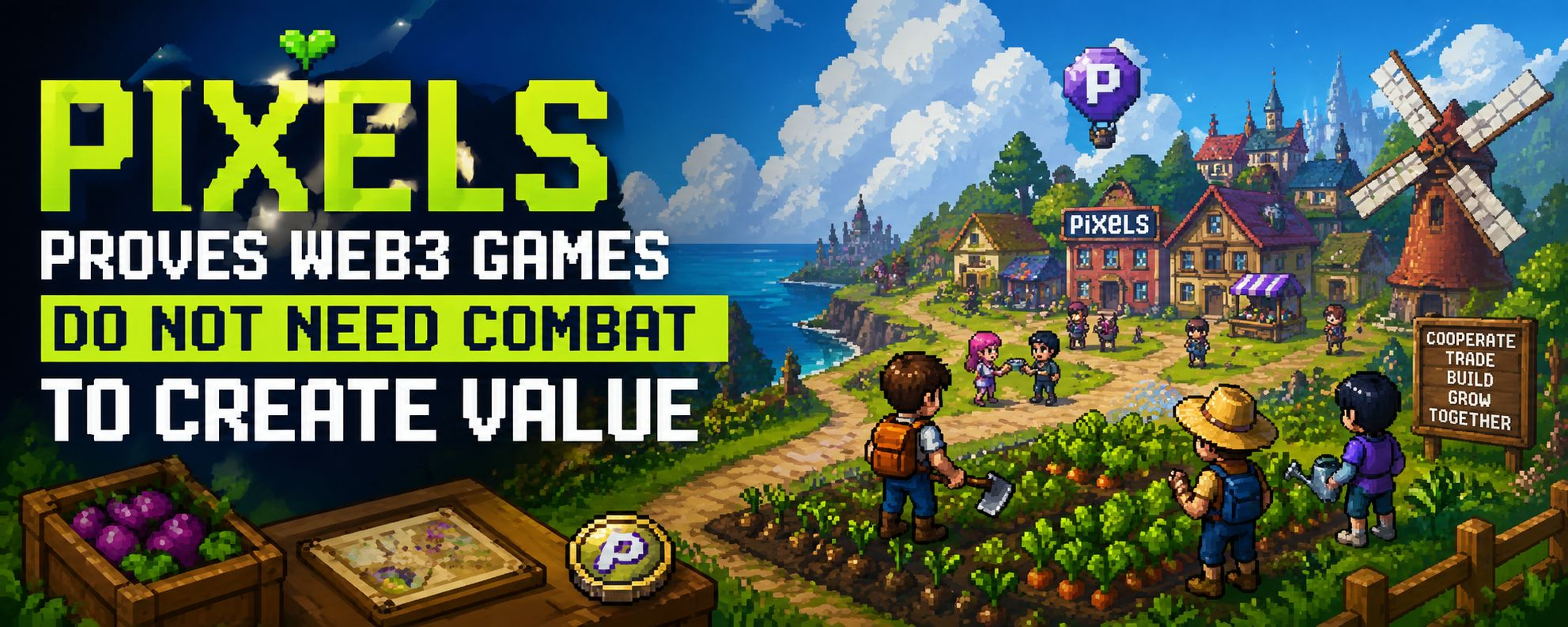
What makes Pixels interesting to me is not that it looks calm. It is that the calmness is doing economic work.
At first glance, Pixels can look almost too soft for Web3. No dramatic battlefield. No constant pressure to destroy another player. No loud promise that every click is a path to wealth. You farm, craft, trade, wait, return, and interact with others. It feels simple. But after watching how these loops evolve, I think that simplicity is exactly the point.
Pixels does something most crypto games struggle to do: it makes coordination feel natural.
In many Web3 games, the economy sits on top of the game like a heavy layer. You can feel the token model pressing against every action. Players do not always behave like players. They behave like short-term extractors looking for the fastest route to value. Pixels is different because the economic layer is quieter. It does not always ask players to speculate first. It asks them to participate first.
That distinction matters.
A farming loop is not just about crops. It is about rhythm. You learn when to act, what to produce, what to save, what to exchange, and who to align with. Over time, the game turns individual attention into shared output. Guilds, tasks, staking, and group-based incentives all point in the same direction. Pixels is not only rewarding activity. It is rewarding organized activity.
That is where I think the real monetization lives. Not in combat, but in coordination.
The valuable player in Pixels is not always the most aggressive one. It is often the consistent one. The player who returns daily. The player who understands timing. The player who joins the right group, contributes quietly, and helps turn scattered effort into something useful. That kind of player is boring in a trailer, but extremely valuable in an economy.
And maybe that is why Pixels feels more durable than many Web3 game experiments. Combat creates excitement, but coordination creates dependency. When people start relying on shared routines, shared goals, and shared systems, the game becomes more than entertainment. It becomes a place where habits gather.
My read is that Pixels is quietly proving a bigger point about Web3 gaming. The next strong game economy may not come from making players fight harder. It may come from making them coordinate better without making it feel like work.
That is a much harder design challenge. Anyone can add rewards to a game. Very few teams can make people organize around those rewards in a way that feels human, casual, and repeatable.
Pixels’ real achievement is that it makes economic coordination feel like play. And in a market full of games trying to sell intensity, that quiet design choice may be its strongest edge.