
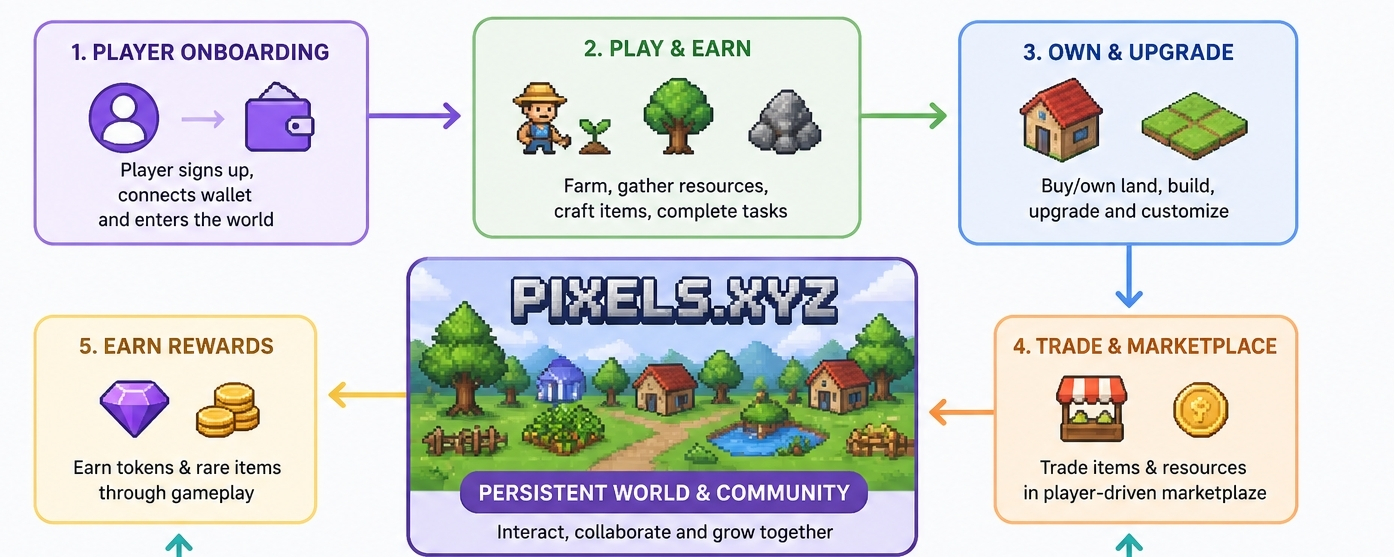

I’ve been thinking about Pixels.xyz way more than I expected to, and honestly, it’s not even because it’s the “best” game out there or anything like that. It’s not. Not even close. But it sticks in your head. Like one of those ideas that feels a bit clunky at first, then slowly starts making too much sense. And that’s what’s bothering me, in a good way.
So here’s the thing. When people talk about Web3 games, especially back in like 2021–2023, it was mostly hype. Pure hype. You had all these “play-to-earn” projects promising people they could quit their jobs, farm tokens, live off digital chickens or whatever. And yeah… that didn’t age well. Most of it collapsed. Tokens crashed, economies broke, and suddenly everyone realized you can’t just print money inside a game and expect it to hold up.
Pixels feels like someone actually learned from that mess. Not perfectly. Not even cleanly. But enough.
At first glance, it looks almost stupidly simple. Like a retro farming game. Pixel art, basic mechanics, walk around, plant stuff, harvest stuff. If you showed it to someone without context, they’d probably say, “This is it?” And yeah, fair reaction. But that simplicity is kind of the point. It lowers the barrier. You don’t need to be some hardcore gamer or crypto wizard to figure out what’s going on.
Actually, wait… that’s not entirely true. You still kind of need to understand wallets, tokens, and all that nonsense. That part is still messy. But compared to older blockchain games? It’s way less painful.
What really pulls you in isn’t the farming itself. It’s the weird realization that the stuff you’re doing actually connects to a real economy. Not “real” in the traditional sense, but real enough that people care. Prices fluctuate. Resources matter. And suddenly you’re not just playing a game—you’re thinking like a trader, or a small business owner, or honestly, like someone trying to survive in a tiny digital town.
And that’s where it gets interesting.
Because once you start thinking that way, you stop playing casually. You start planning. You notice patterns. You’re like, “Okay, this crop is selling better today, why?” Or “Why is everyone suddenly crafting this item?” And then you adjust. It’s subtle, but it hooks you.
Let’z be honest here… most games fake their economies. They look complex, but they’re scripted. Controlled. Developers can tweak numbers anytime. In Pixels, there’s still control, obviously, but the player-driven part is way more visible. You feel it. Sometimes it’s smooth. Sometimes it’s chaotic. Sometimes it’s straight-up broken.
And that’s part of the charm. Or the problem. Depends on your mood that day.
I almost forgot to mention the land aspect, which is honestly one of the more controversial pieces. Owning land in Pixels isn’t just cosmetic. It matters. It changes how you play. And yeah, people who got in early have an advantage. No way around that. That’s one of those uncomfortable truths people don’t like talking about.Because on one hand, it’s cool. Digital ownership. You actually have something that’s yours. You can build on it, use it, maybe even profit from it. But on the other hand… it creates this subtle divide. New players vs early adopters. And if you’ve been around crypto long enough, you know how that story usually goes.Still, Pixels handles it better than most. Not perfectly, but better.There’s also this social layer that sneaks up on you. You’ll start recognizing usernames. You’ll trade with the same people. Maybe join a group. And suddenly it doesn’t feel like a solo grind anymore. It feels like a small community. Not huge, not overwhelming, just… there.
And that’s rare these days. Especially in online games where everything feels disposable.
Now, I’m not going to pretend it’s all great. Because it’s not. There are days when it feels repetitive. Like, painfully repetitive. You log in, do your tasks, check prices, log out. Rinse and repeat. If you’re not careful, it turns into a chore.
And then there’s the token side of things. Yeah, we have to talk about it. Prices go up, prices go down. People get excited, then disappointed. It’s crypto. It’s always like that. If you’re expecting stability, you’re in the wrong place.
Honestly, this is where a lot of people mess up. They treat it like a guaranteed income stream. It’s not. It never was. It’s a game with an economy, not a job with a salary. Big difference.
But here’s the weird part… even knowing all that, people still come back. Daily. They keep playing. And I think it’s because Pixels doesn’t rely purely on the “earn” part anymore. It leans into the “play” more. Slowly. Quietly. But it’s happening.
Actually, wait, let me rephrase that. It’s trying to balance both, which is way harder than it sounds.
Because if you push too hard on earning, the game breaks. If you ignore it, you lose what makes it unique. So you end up in this constant tug-of-war between fun and value. And Pixels is basically living inside that tension.
Another thing I find interesting is how it reflects real-world behavior in a weirdly accurate way. You get speculation. You get hoarding. You get people trying to game the system. It’s like a mini version of an economy, just wrapped in pixel art.
And sometimes it gets messy. Like really messy.
You’ll see sudden spikes in item prices because someone figured out a strategy and everyone copied it. Or crashes because supply went out of control. It’s chaotic. But it’s also kind of fascinating to watch.
It makes you realize how fragile these systems are.
And yeah, there’s still that underlying question that nobody can fully answer yet… is this sustainable? Like, long-term sustainable?
I don’t think anyone knows. Not really.
But maybe that’s not the point. Maybe the point is that it’s trying something different. It’s experimenting. And unlike a lot of projects that disappeared after the hype died, Pixels is still here, still adjusting, still kind of figuring itself out in public.
That counts for something.
Also, January 2026 feels like a weird time for all this. The crypto space isn’t as loud as it used to be, but it’s not dead either. It’s quieter. More cautious. People aren’t throwing money around blindly anymore. They’re paying attention. Asking questions.
And in that environment, something like Pixels actually has a chance. Because it’s not screaming for attention. It’s just… running.
You log in. You play. You trade. You leave. Then you come back the next day and do it again.
It’s simple. Almost boring on the surface. But underneath, there’s this constant movement. Small shifts. Tiny decisions that add up.
And yeah, sometimes I sit there thinking, “Why am I still playing this?” And I don’t always have a clean answer.
Maybe it’s the economy. Maybe it’s the ownership angle. Maybe it’s just habit.
Or maybe it’s because, deep down, it feels like a preview of something bigger. Not fully formed, not polished, definitely not perfect… but close enough that you can start to see where this whole thing might be going and that’s the part I can’t quite shake off
