
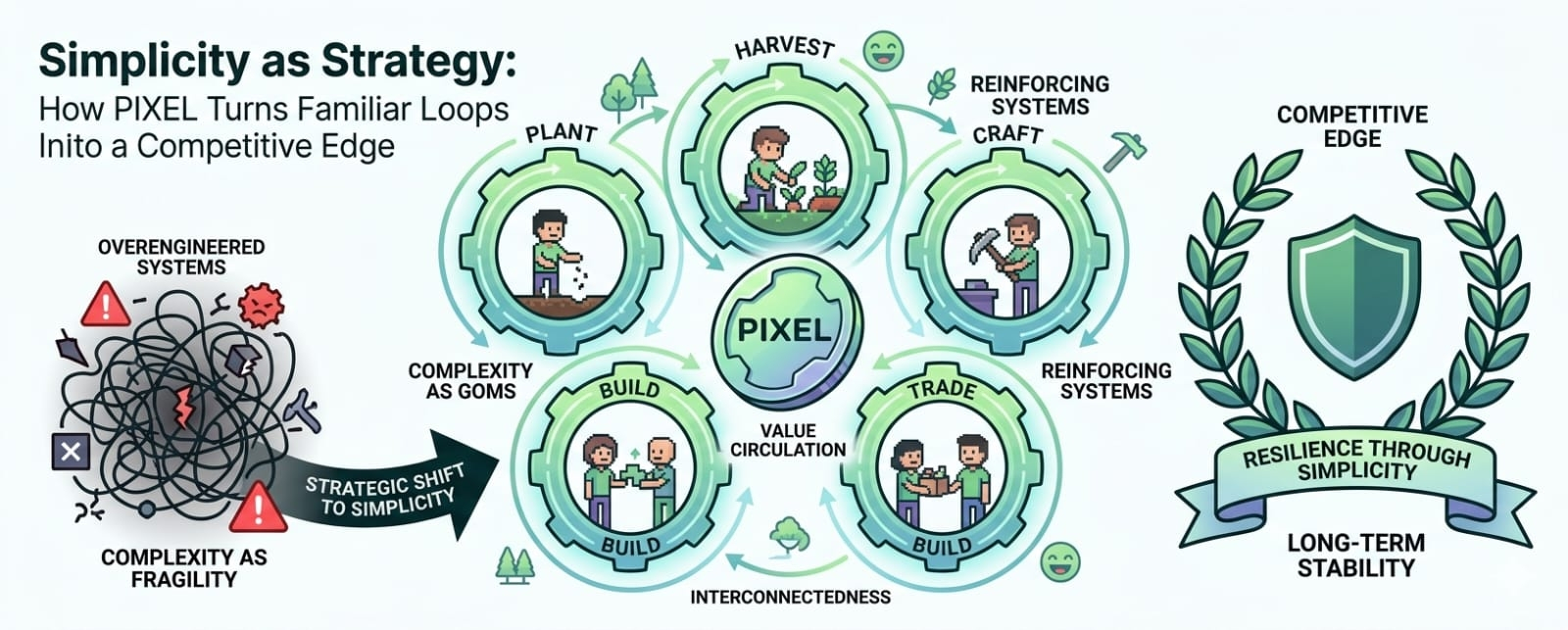
I keep noticing how often complexity gets mistaken for depth in digital economies A game introduces multiple tokens, layered mechanics and intricate reward structures, and for a moment it feels sophisticated. But after spending time inside these systems that complexity often reveals itself as fragile. It doesn’t deepen the experience it just makes it harder to see where things are breakingThat’s been a recurring issue in blockchain games. In trying to build something economically interesting, many projects end up @Pixels overengineering their systems Players are asked to manage too many variables, track too many incentives, and adapt to mechanics that shift constantly. At some point, the experience stops feeling like a game and starts feeling like a system you have to keep up with. And when that happens, most people disengage not because it’s difficult, but because it’s exhausting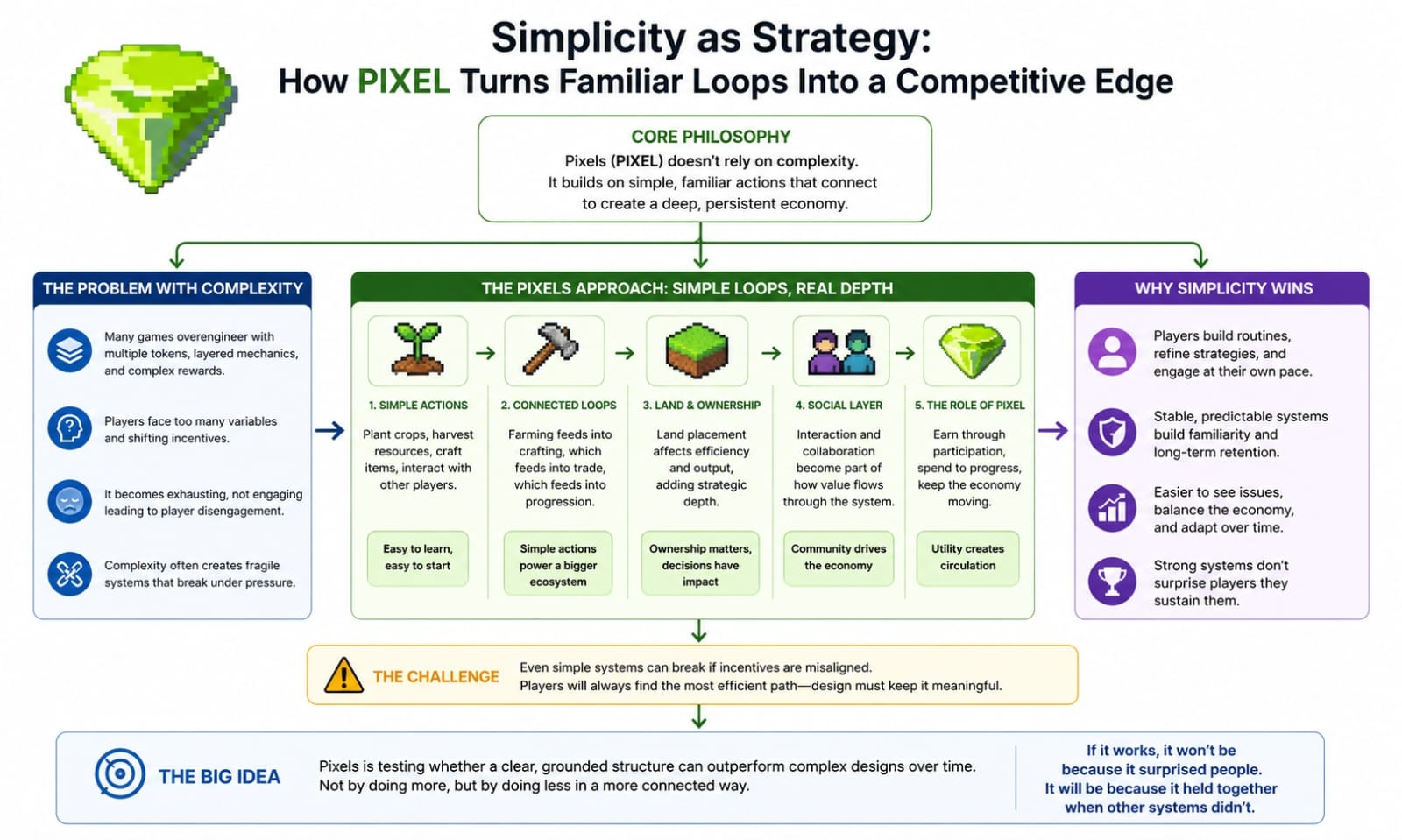
Pixels (PIXEL) takes a noticeably different route. It doesn’t try to impress through complexity. Instead, it builds around loops that are immediately understandable planting crops, harvesting resources, crafting items, interacting with other players None of this is new, and that seems to be the point. The simplicity isn’t a limitation it’s a design decisionBut what makes it interesting is how those simple actions connect over time. Farming isn’t just about producing resources it feeds into crafting, which feeds into trade, which feeds into progression. Land systems introduce another layer, where ownership and placement influence efficiency and output. Social interaction isn’t optional either it becomes part of how value moves through the system. The mechanics are simple individually, but together they create a structure that feels more persistent than reactiveThis is where simplicity becomes an advantage. Players don’t need to constantly relearn the system or chase new mechanics. They can settle into routines, refine their approach, and engage at their own pace. That kind of stability is rare in tokenized environments, where systems often change too quickly to build any real familiarity.The role of $PIXEL inside this ecosystem reflects that same philosophy It’s not positioned as a standalone incentivei t’s tied to activity. You earn through participation, but you’re also expected to spend in order to continue progressing efficiently That circulation is essential, because without it, the economy would stall or inflate Of course keeping that balance is where things become difficult. Even simple systems can break under pressure if the incentives aren’t aligned. Players will always look for the most efficient path, and if that path bypasses meaningful interaction, the system starts to degrade. Simplicity doesn’t remove that risk—it just makes it easier to seeWhat Pixels seems to be testing is whether a clear, grounded structure can outperform more complex designs over time. Not by doing more, but by doing less in a more connected way. If it works it won’t be because it surprised people. It will be because it held together when other systems didn’t#pixel