
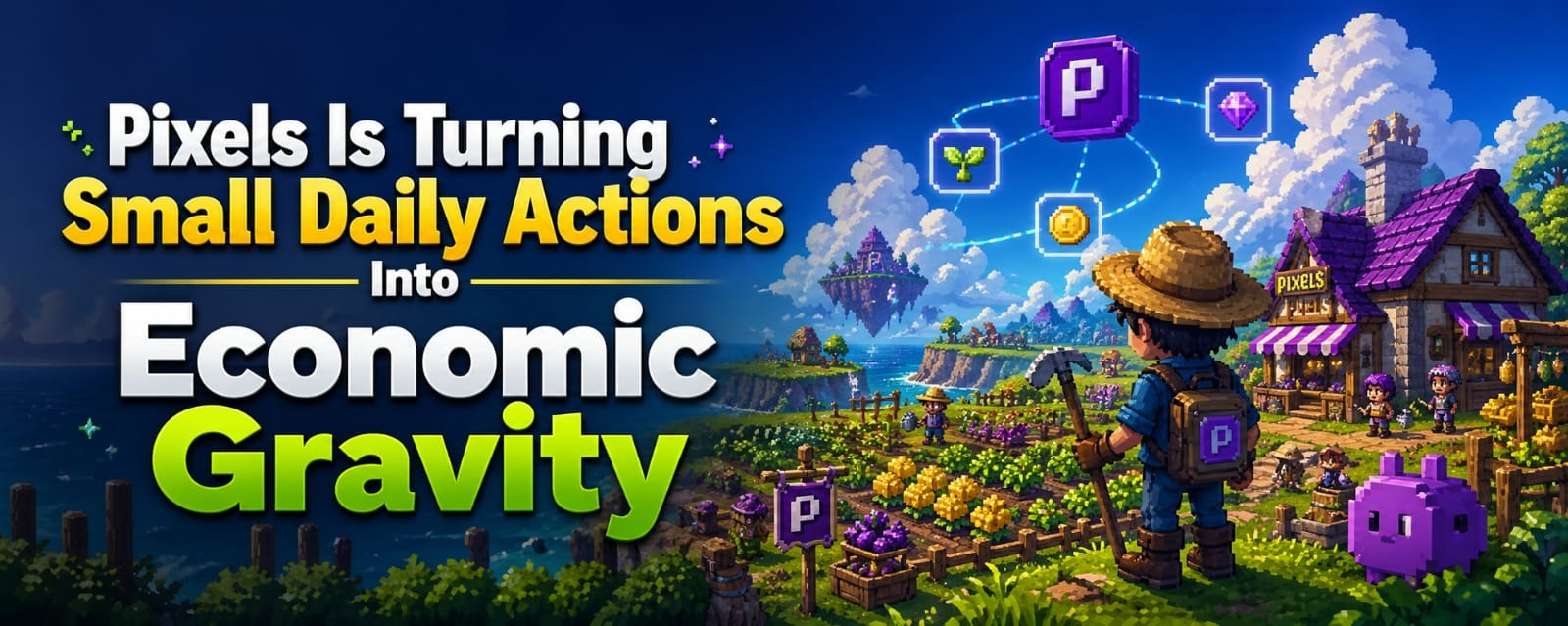

I have learned to be suspicious of Web3 games that introduce themselves through the economy first. When the first thing a game wants me to understand is the token, the marketplace, or the earning model, I usually feel like the play has already been pushed into second place. It becomes a financial interface wearing a game costume. Pixels stands out to me because it does not feel strongest when it is shouting about ownership or rewards. It feels strongest in the quiet parts, the repeated parts, the parts that look almost too ordinary to analyze.
You farm. You collect. You return. You improve something small. Then you do it again.
That sounds basic, but I think that basicness is exactly where Pixels becomes interesting. In crypto, we often overvalue complexity because complexity looks intelligent. Pixels seems to understand that retention does not always begin with complexity. Sometimes it begins with a simple reason to come back tomorrow. The game’s farming loop works because it feels familiar before it feels financial. A new player does not need to arrive with a thesis about tokenized economies. They can simply enter the world, complete a task, notice progress, and slowly develop a rhythm.
That rhythm is where I think Pixels’ real edge lives.
To me, Pixels is not just building a game economy. It is building a habit market. The valuable asset is not only land, resources, or PIXEL. The valuable asset is repeated attention that does not feel forced. Most Web3 projects rent attention through rewards. Pixels is trying to domesticate attention through routine. That is a much harder thing to do, but also much more durable if it works.
The recent CreatorPad activity makes more sense through this lens. On the surface, it can be read as another incentive program. But I see it as something more subtle: Pixels is expanding the definition of participation. The game is not only rewarding people who click, farm, and optimize inside the world. It is also pulling in people who explain, interpret, debate, and package the game for others. That matters because every lasting ecosystem needs more than users. It needs translators.
A player inside Pixels produces activity. A creator outside Pixels produces meaning. Both are forms of distribution.
That is a distinction many projects miss. They assume community growth is about announcements, campaigns, and numbers moving upward. But real community growth often comes from people making a project legible to others. Someone writes a thread, makes a guide, records a video, compares strategies, or explains why a change matters. Suddenly the game is not just being played. It is being processed publicly. That kind of attention is more valuable than empty hype because it gives people a reason to understand the world, not just enter it.
This is also why Chapter 3: Bountyfall feels important to me. The introduction of Unions, shared objectives, Hearth contributions, Yieldstones, sabotage, and seasonal competition changes the emotional weight of the game. It takes Pixels from “my farm, my task, my reward” toward “my action inside a group outcome.” That shift is small on paper, but large in behavior. A solo reward loop can become lonely very quickly. A shared objective gives the same action a social shadow.
When your farming, timing, or contribution affects a Union, the game stops being purely personal. You begin to think about coordination. You begin to notice other players as more than background characters. You are not just optimizing your own route. You are participating in a living schedule where other people’s actions matter too. That is the moment a Web3 game starts feeling less like a product and more like a place.
I think this is where Pixels has a more interesting thesis than many people give it credit for. A lot of Web3 gaming still behaves as if ownership automatically creates loyalty. Own the asset, love the game. Hold the token, support the ecosystem. But human behavior is messier than that. Ownership can attract people, but it does not always keep them. People stay when they build routines, memories, relationships, status, and small unfinished goals.
Pixels seems to be testing that softer truth. Maybe the best Web3 game economy is not the one that makes players think about finance every second. Maybe it is the one where finance sits in the background while the player feels busy, useful, and socially connected in the foreground.
Even staking in Pixels fits this idea. What interests me is not simply that staking exists, but that it does not feel entirely detached from activity. In many crypto systems, staking becomes a way to disappear. You lock tokens, leave, and hope time does the work. Pixels appears to push in the opposite direction. It treats participation as something that should remain connected to presence. That changes the emotional role of the token. It is not just a parked asset. It becomes a kind of membership signal, a sign that the player is still around.
Ronin’s broader direction makes this even more relevant. As Ronin continues moving toward rewarding real usage, distribution, and ecosystem contribution, Pixels becomes one of its clearest behavioral case studies. It is not only bringing users onto a chain. It is showing what those users might do when the experience is built around routine instead of speculation alone. That distinction matters. Wallets are easy to count. Habits are harder to create.
Still, I do not think Pixels’ path is risk-free. In fact, its biggest risk comes from the same systems that make it compelling. The more a game rewards routine, the more routine can turn into labor. The more players optimize, the more imagination can shrink. The more creators are incentivized, the more insight can be replaced by noise. A world built on daily return can become powerful, but it can also become mechanical if every action starts feeling like a checklist.
That is the line Pixels has to protect.
For me, the most important question is not whether Pixels can design better rewards. It is whether Pixels can keep its world feeling human while the economy becomes more sophisticated. Can it let different kinds of players matter without forcing them all into the same efficient behavior? Can it reward commitment without turning the game into work? Can it grow distribution without making every voice sound like a campaign?
If Pixels gets that balance right, it will prove something deeper than play-to-earn ever did. It will show that Web3 gaming does not need to put finance at the center of the player’s mind to make finance useful. The strongest version of Pixels is not a game where people return because they are calculating every move. It is a world where people return because the small things feel worth continuing.
That is why I find Pixels interesting. Not because it is loud, but because it understands something quiet: in games, as in markets, the most valuable behavior is not always the first click. It is the decision to come back when nobody is forcing you.