
The First Impression: Everything Looks Like Growth
When you first enter Pixels, nothing feels unusual. In fact, it feels exactly like what you expect from a game that’s doing well. There are players everywhere. Farms are constantly active. The Task Board keeps refreshing without pause. Every few seconds, something is happening—someone planting, someone harvesting, someone crafting, someone running loops. The entire environment gives off one clear signal: this system is growing. And you accept that immediately, almost without thinking, because that’s how games work. When more people join, more activity appears. When more activity appears, more value is created. Growth feeds itself. That’s the mental model you bring in, and at first Pixels fits it perfectly.
The Slow Shift: When Observation Replaces Assumption
But something changes when you stop rushing. Not when you play more, but when you watch more. When you repeat the same routes long enough, when you sit on the Task Board instead of instantly clearing it, when you stop reacting and start observing, that’s when the illusion begins to crack. Because you start noticing something subtle but deeply important: nothing actually expands. It doesn’t stretch outward the way growth should. Instead, it rearranges itself.
The Off-Chain Illusion: Infinite Activity Without Resistance
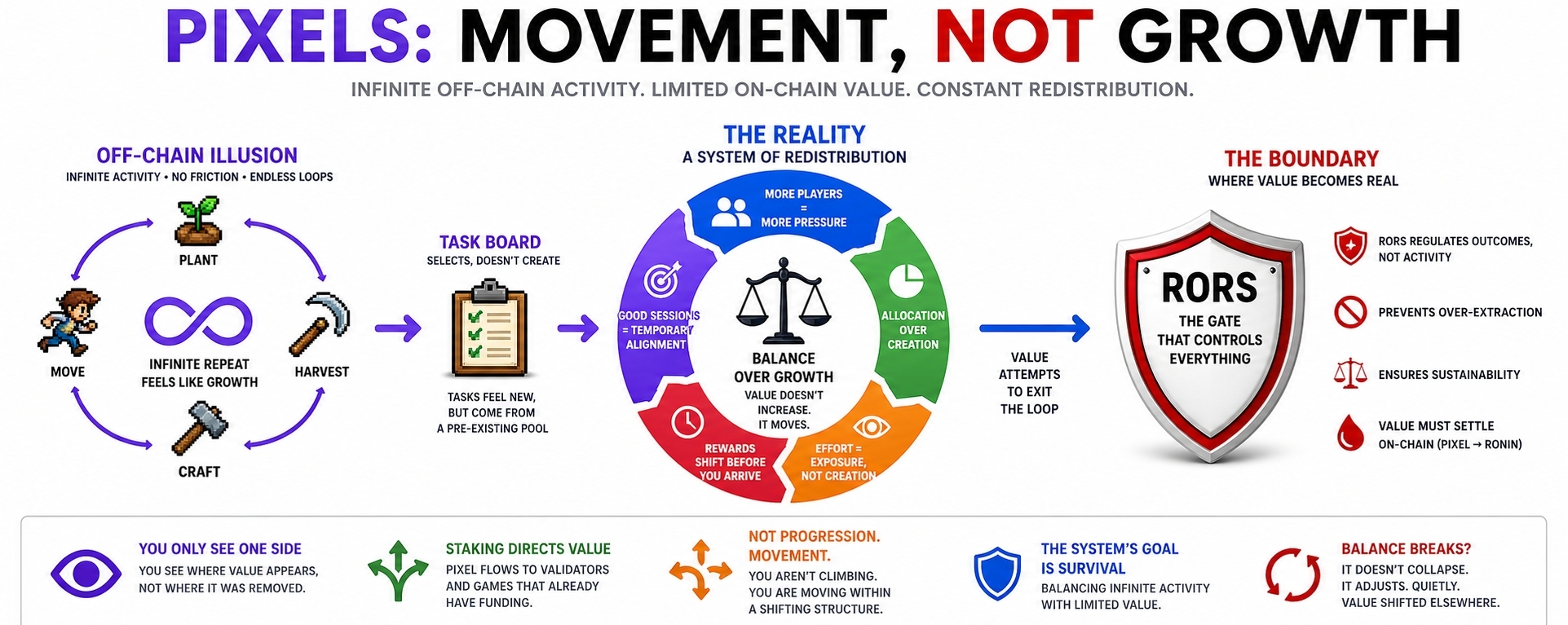
To understand why, you have to look at the foundation of Pixels—the off-chain layer. This is where most gameplay happens: planting, harvesting, crafting, moving, repeating. And this layer behaves in a very specific way. It has no visible limits, no friction, allows infinite repetition, and absorbs every action instantly. There are no gas fees, no waiting times, no delays between effort and result. Everything feels smooth—too smooth. And because of that, it creates a powerful psychological effect: it makes activity feel like value creation. You’re doing more, so it feels like more is being generated. But in reality, nothing here is forced to prove its value outside of itself. Coins can loop endlessly, actions can repeat forever, and the system keeps running without needing to justify what any of it is worth. That’s where the illusion begins.
The First Crack: The Task Board Feels Off
The moment this illusion starts breaking is almost always the same—you spend time on the Task Board. At first, it feels dynamic, alive, responsive. Tasks refresh constantly, appearing and disappearing in a steady rhythm, giving the impression that new opportunities are being created in real time. But if you stay long enough, you notice something strange. The tasks don’t feel new. They feel pre-existing. It’s subtle, but once you feel it, you can’t ignore it. Instead of being created in the moment, tasks feel like they are being selected from a pool that already exists. Like the board isn’t generating value—it’s revealing it.
The Weight Difference: When Value Feels Real or Doesn’t
This is where perception sharpens. Because not all sessions feel the same. Some days, the Task Board feels heavy. The rewards feel meaningful, grounded, as if they’re backed by something real. Not just Coins looping internally, but PIXEL—value that eventually has to leave the game and settle on something external like Ronin Network. That kind of value has weight because it cannot be created infinitely, it must be accounted for, and it exists beyond the loop. Other days feel different. The same actions produce lighter outcomes—not empty, just thinner. You’re still doing everything the same: same farm, same crops, same routes, same effort, but something is missing, and you feel it even if you can’t fully explain it.
The Critical Question: Where Did the Weight Go?
This is the turning point. Because now you’re forced to ask: if nothing changed in what I’m doing, what changed in the system? At first, it seems like the value disappeared. But the longer you observe, the less that explanation holds. Because it doesn’t feel like disappearance—it feels like movement.
The Core Realization: This Isn’t Growth, It’s Redistribution
Pixels doesn’t behave like a traditional growing system. It behaves like a balancing system. Gameplay itself doesn’t create pressure—it’s too cheap, too infinite, too flexible. The system can support endless activity without breaking. The real pressure exists at the boundary.
The Boundary: Where Value Becomes Real
The moment something tries to leave the loop—when Coins attempt to become PIXEL, when in-game effort becomes extractable value, when actions turn into something that must settle externally—that’s when constraints appear. That’s where the system makes decisions, and where mechanisms like RORS operate—not inside gameplay, but at the edge of it.
RORS: The Gate That Controls Everything
RORS doesn’t reward activity—it regulates outcomes. Its role is to prevent the system from giving out more value than it can sustain. Early play-to-earn systems failed because they allowed unlimited extraction. Pixels is designed to avoid that, which means it must enforce balance. And balance comes with a cost: nothing is allowed to grow freely.
More Players Means More Pressure
This flips the idea of growth. More players don’t mean more rewards, and more activity doesn’t mean more value. Instead, more players mean more competition for limited value. So the system doesn’t expand—it redistributes.
The Hidden System: Allocation Over Creation
What you are experiencing isn’t growth—it’s allocation. A controlled reward budget is being distributed across different games, loops, validators, and behaviors. And this allocation is constantly shifting.
Staking: The Invisible Direction of Value
Staking doesn’t create value—it directs it. PIXEL flows toward specific validators and sub-games that already have funding. This means some areas feel alive not because players made them active, but because value was already placed there before players arrived.
The Blind Spot: You Only See One Side
From inside Pixels, you only see where value appears. You never see where it was removed from. So when something feels strong, you assume it improved, but in reality something else may have weakened—you just didn’t see it happen.
Effort Redefined: Exposure Instead of Creation
Effort doesn’t create value here—it increases your exposure to where value already exists. This shifts the model completely. It’s no longer “do more, earn more.” It becomes “be present where rewards exist.”
A Predictive System: Movement Before You Arrive
The system doesn’t just react—it often feels like it moves ahead of players. Rewards shift before you arrive, allocation changes before you notice, and sometimes it feels like you’re always slightly late.
The Nature of Good Sessions: Temporary Alignment
This explains why good sessions feel rare. They don’t feel stable—they feel like alignment. Moments where activity, allocation, and constraints line up just enough for value to pass through, and then it shifts again.
The Final Truth: This Is Not Progression
You are not experiencing growth—you are experiencing movement. Movement of reward, movement of opportunity, movement of system focus. You are not climbing—you are moving within a shifting structure.
The System’s True Goal: Survival
Pixels is not trying to grow endlessly—it is trying to survive. It balances infinite off-chain activity with limited on-chain value, ensuring that outflow never exceeds sustainability.
What Happens When Balance Breaks
It doesn’t collapse dramatically. It quietly adjusts. Value is reduced somewhere else, rewards thin out, opportunities shift, and you only notice when you arrive there.
The Final Feeling: Why Nothing Feels Consistent
This is why nothing feels stable. Not because you’re doing something wrong, but because the system is constantly rebalancing itself. Consistency is not the goal—balance is. And you are inside that balance. You don’t see the decisions, the shifts, or the allocations. You only feel them after they’ve already happened.
