
Here’s a more human, natural, and engaging version of your articleless robotic, more story-driven, and easier to connect with:
Most Web3 games promise a lot ownership, earnings, freedomnbut very few actually feel fun. That’s where Pixels (PIXEL) quietly changed the narrative.
Built on the Ronin Network, Pixels doesn’t try to overwhelm you with complexity. Instead, it pulls you into a simple, colorful world where you can farm, explore, craft, and just… exist. And surprisingly, that’s exactly why it works.
🌱 It Starts Simple And That’s the Point
When you first step into Pixels, it doesn’t feel like a “crypto game.”
There are no complicated wallets to figure out (at least not upfront), no pressure to invest money.
You plant crops.
You gather resources.
You talk to other players.
It feels closer to relaxing games like Stardew Valley than anything in the blockchain space and that’s intentional.
But beneath that simplicity? There’s a real economy running in the background.
The Growth Nobody Saw Coming
Pixels didn’t explode overnight it grew. And when it did, it caught everyone’s attention.
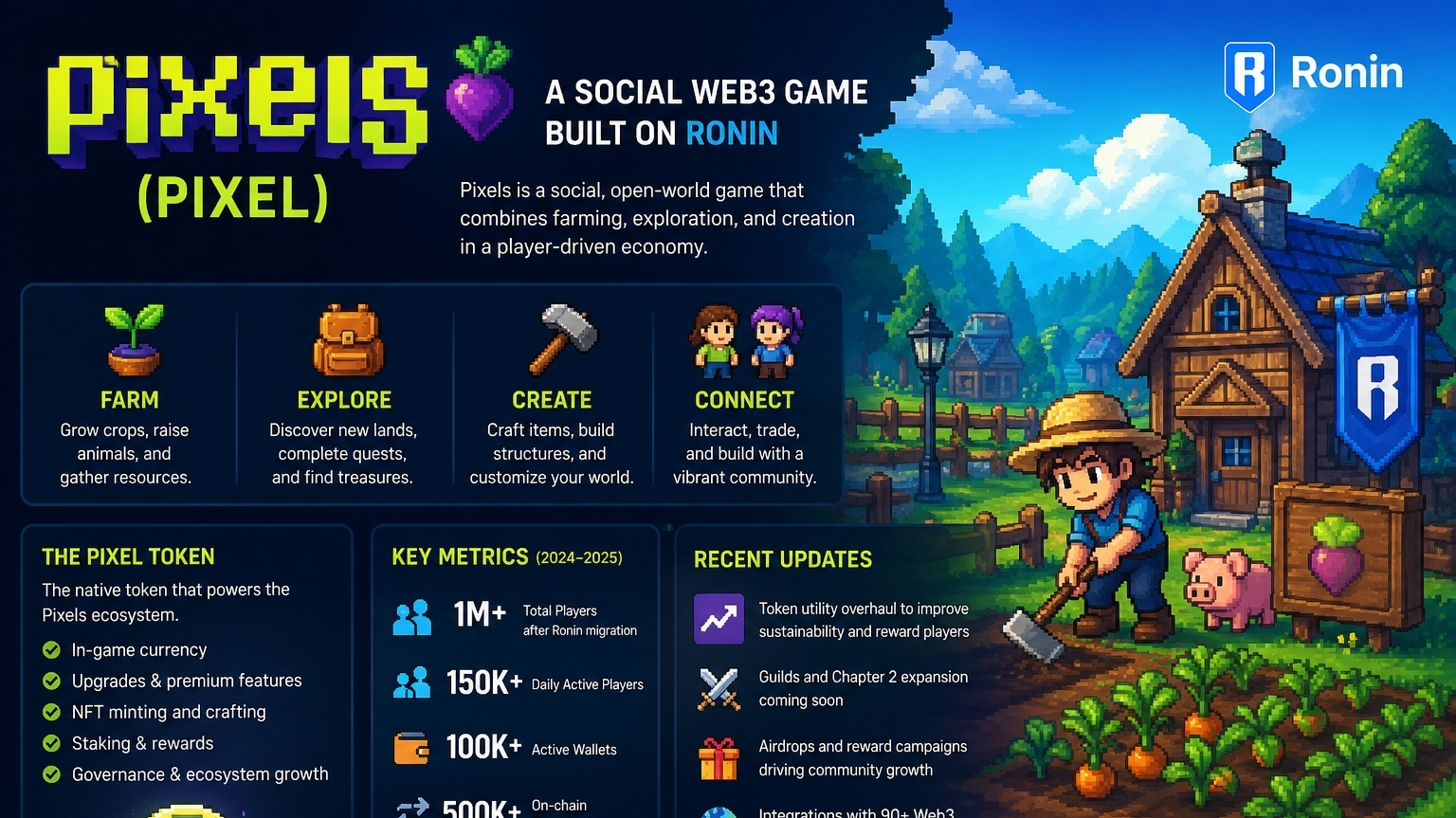
After moving to Ronin, the game crossed over 1 million players. Daily activity surged, with thousands of players logging in consistently not just to earn, but to actually play.
That’s rare in Web3.
Most blockchain games struggle to retain users. Pixels did the opposite it built a world people wanted to return to.
PIXEL Token — More Than Just a Coin
At the center of everything is the PIXEL token.
Now, let’s be honest most game tokens exist purely for speculation. Prices pump, people trade, and the “game” becomes secondary.
Pixels is trying to do it differently.
The PIXEL token is used for:
Upgrading items and assets
Accessing premium features
Participating in the game’s long-term economy
Alongside it, there’s another in-game currency called BERRY, which handles everyday transactions. This dual system helps balance things so not everything depends on one token’s price.
The Reality Check (And Why It Matters)
Like many Web3 tokens, PIXEL had its hype moment.
It reached an all-time high of over $1 in early 2024… and then dropped significantly.
At first glance, that looks like a failure.
But here’s the more interesting part:
the game didn’t die.
Players stayed.
Developers kept building.
Updates kept rolling out.
That’s usually the real test and Pixels passed it.
Recent Updates Are Changing Everything
Instead of ignoring the drop, the Pixels team leaned into it and started fixing what matters most: the economy and player experience.
Smarter Token Utility
They reworked how PIXEL is used, focusing on:
Reducing unnecessary inflation
Rewarding active players instead of passive farming
Making the token actually useful inside the game
What’s Coming Next Feels Bigger
The roadmap isn’t slowing down. If anything, it’s getting more ambitious:
Guild systems to bring players together
New chapters expanding the world and gameplay
More social features that make the game feel alive
This isn’t just about farming anymore it’s becoming a community-driven world.
Airdrops & Rewards That Actually Worked
Pixels also nailed something most projects struggle with: incentives.
Their airdrops and reward campaigns didn’t just attract users—they converted them into active players. That’s a big difference.
Why Pixels Feels Different
There’s a subtle shift happening here.
Pixels isn’t trying to be:
The most complex
The most technical
Or even the most profitable
It’s trying to be enjoyable first.
And ironically, that’s what gives it long-term potential.
Because when people stay for the experiencenot just the money the ecosystem becomes stronger.
It’s Not Perfect (And That’s Okay)
Let’s keep it real:
The token is still far from its peak
The economy is still evolving
Competition in Web3 gaming is growing fast
But unlike many projects that disappear after hype fades, Pixels is still here building, adjusting, improving.
So… Where Is It Headed?
Pixels feels like it’s in a transition phase.
From: 👉 A hype-driven Web3 game
To: 👉 A sustainable, player-focused ecosystem
If the team keeps refining the economy and expanding gameplay, Pixels could become more than just a game it could be a template for how Web3 games should be built.
Final Thought
Pixels (PIXEL) doesn’t try to impress you with complexity.
It wins you over with simplicity land then slowly reveals its depth.
And in a space full of noise, that might be its biggest strength.
If you want, I can also turn this into:
A **viral X (Twitter) thread**
A **short professional post**
Or a **high-energy promo version**
