

Pixels turns guesswork into a measurable growth system powered by data, testing, and smart rewards. PIXEL is at the center of this engine.
Most games launch events and rewards based on instinct. Pixels is building a model where every action can be measured, improved, and scaled.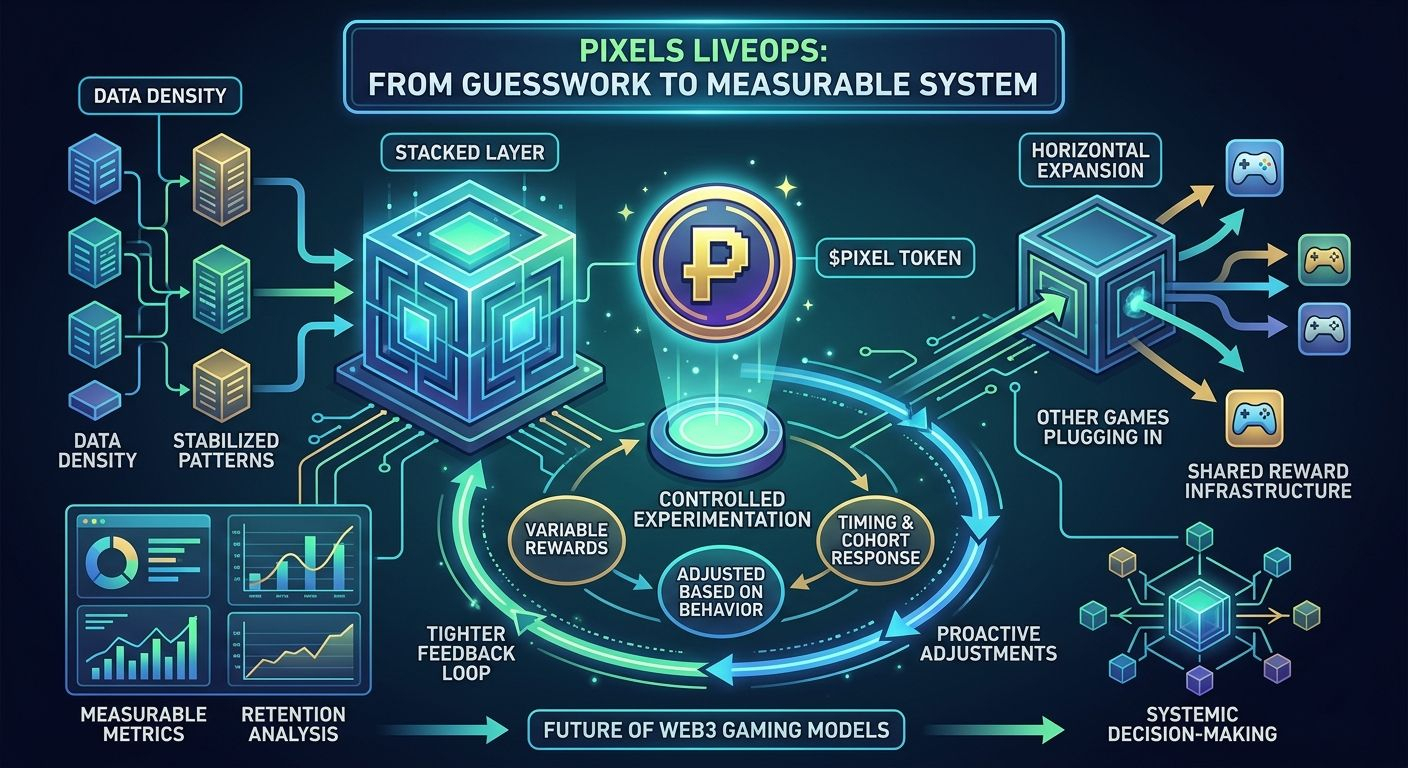
What makes this powerful?
• Data density. Every player action creates insight. Sessions, upgrades, quests, spending patterns, retention signals, and social behavior all become usable inputs.
• Stabilized patterns. Raw data alone creates noise. Pixels converts activity into repeatable patterns that help teams understand what players actually value.
• Stacked layers. Systems are built in layers, not isolated features. Economy, rewards, gameplay loops, and progression can improve together.
• Controlled experimentation. Instead of guessing, Pixels can test reward timing, event structure, quest pacing, and incentive design in live conditions.
• Variable rewards. Different users respond to different incentives. Some want competition. Some want progression. Some want collectibles. Dynamic rewards increase relevance.
• Behavior based adjustments. The system can react to churn risk, inactivity, or high engagement. This helps keep players active longer.
• Timing and cohort response. New players need different experiences than veterans. Regional groups and seasonal cohorts also behave differently.
• Tighter feedback loop. Faster data means faster improvement. Teams learn quickly, then ship smarter updates.
• Horizontal expansion. Once the LiveOps engine works, other games can plug into the same infrastructure.
• Shared reward infrastructure. Cross game incentives can create stronger ecosystems and deeper token utility.
Why this matters for PIXEL?
PIXEL can become more than a token tied to one game. It can power incentives across multiple connected experiences.
That creates several advantages.
• More demand sources.
• More reasons to hold and use the token.
• Better alignment between players and ecosystem growth.
• Stronger network effects as more games integrate.
• Higher lifetime value per user.
This is where many projects fail. They focus on hype first and systems later. Pixels appears to be doing the opposite. Build the operating system first. Let growth follow.
For investors, LiveOps matters because retention matters. Retention often decides revenue, token velocity, and community strength.
For players, LiveOps matters because the game can improve faster and feel more responsive.
For builders, LiveOps matters because reusable infrastructure lowers the cost of launching new experiences.
Imagine a future where one reward engine powers farming games, strategy games, social worlds, and mobile experiences. Progress, rewards, and token utility can move across titles.
That is bigger than one game.
That is platform logic.
Pixels may be positioning itself as a Web3 gaming network instead of a single product.
If execution stays strong, PIXEL could benefit from every new title connected to the ecosystem.
Watch these signals next.
• Daily active users.
• Retention trends.
• New game integrations.
• Token sinks and spending loops.
• Reward efficiency.
• Ecosystem partnerships.
• Revenue per active user.
The market often prices narratives first. Real value usually comes from systems that scale.
Pixels LiveOps looks like a system built to scale.