
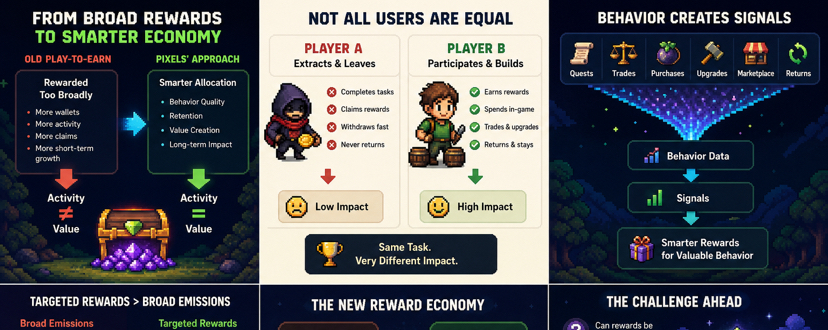

Old play-to-earn models had one big problem that many people only noticed after the excitement faded.They rewarded too broadly.At first, that looked like growth. More wallets. More activity. More claims. More people doing tasks because rewards were available. On the surface, the numbers looked alive.But the real question was always harder: did that activity create value, or did it only create motion?That is where I think Pixels becomes interesting.My read is that Pixels may not be trying to build another simple reward machine where every action gets paid in the same blunt way. It seems to be moving toward something more difficult: a smarter reward economy where incentives follow behavior quality, retention, and value creation.#pixel $PIXEL @Pixels
That is a very different idea from traditional play-to-earn.In the old model, the system often cared most about whether a user completed an action. Did they farm? Did they finish the task? Did they claim the reward? Did they show up during the campaign?Pixels seems to be asking a deeper question: what happened after the reward?Did the player stay?Did they spend inside the ecosystem?Did they trade, upgrade, reinvest, participate, and keep value circulating?Or did they extract immediately and disappear?That difference matters because not all users are equal for a game economy. Two wallets can complete the same task, but their impact on the ecosystem can be completely different.One user may farm only for the reward, withdraw as fast as possible, and never return. Another user may earn rewards, use them in-game, buy items, trade with other players, upgrade assets, and continue participating.If both users receive the same reward forever, the system is not rewarding value. It is rewarding activity.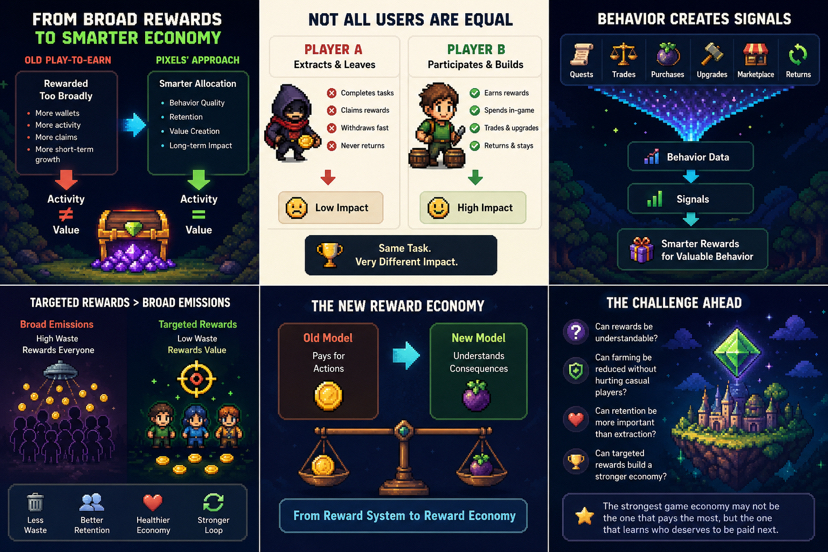
That is the practical friction Pixels appears to be dealing with.A game economy cannot become healthier just by paying people to click buttons. It needs to understand which behavior actually strengthens the loop.
My thesis is simple: Pixels may be trying to turn rewards from a broad emission tool into a smarter allocation system.That does not mean every reward becomes perfect. It does not mean farming disappears. It does not mean the economy becomes immune to sell pressure. But it does suggest a more mature direction.Rewards become less about “who did something?” and more about “who added something?”The mechanism behind this is important.Pixels can look at player behavior across different parts of the economy. Quests, trades, purchases, withdrawals, upgrades, marketplace actions, and repeat participation are not just gameplay events. They can become signals.A player who only appears during reward windows and exits immediately sends one kind of signal.A player who keeps returning, spends inside the game, interacts with the economy, and contributes to real activity sends another.Over time, those signals can help the system decide where incentives are more productive.This is where targeted rewards become more interesting than simple emissions.Instead of distributing rewards blindly across all active wallets, the system can gradually favor behavior that supports retention, liquidity, in-game demand, and healthier participation.
That is not just a token design issue. It is an economic design issue.The proof points I am watching are fairly clear.
First, Pixels seems focused on targeted rewards rather than unlimited broad distribution. That matters because targeted rewards can reduce waste. If incentives go mostly to extractive users, the economy pays for activity that does not stay.
Second, user behavior tracking becomes important. In a game economy, actions create data. The system can learn from who stays, who spends, who withdraws, who repeats, and who only appears when rewards are available.
Third, retention appears to matter more than shallow onboarding. Many crypto games can attract users during incentive campaigns. The harder part is keeping users after the easy rewards are gone.
Fourth, anti-farming logic is a necessary part of the design. A reward system that cannot separate productive users from pure farmers will eventually subsidize extraction.
Fifth, token economy design matters because rewards are not isolated. Every token paid out affects sell pressure, user psychology, in-game demand, and long-term sustainability.
Here is the simple scenario.Imagine two players enter the Pixels economy during the same campaign.Player A completes tasks quickly, claims rewards, withdraws, and leaves. From a surface-level dashboard, this player may look active. They completed actions. They touched the system. They increased short-term numbers.Player B also earns rewards. But then they use part of those rewards inside the game. They upgrade, trade, participate in events, return the next day, and keep interacting with the ecosystem.If Pixels treats both players the same forever, it risks paying for extraction and calling it growth.But if the system can slowly identify the difference, rewards become smarter.Player B may deserve more incentive because their behavior creates a stronger loop. Player A may still be allowed to participate, but the system does not need to overpay them forever.That is the difference between a reward system and a reward economy.A reward system pays for actions.A reward economy tries to understand consequences.Why does this matter for crypto gaming?Because crypto gaming has often confused activity with value. Wallet count became a shortcut for adoption. Reward claims became a shortcut for engagement. Short-term volume became a shortcut for product-market fit.But games are not healthy just because people arrive. They are healthy when people stay, participate, spend, trade, build habits, and create reasons for others to stay too.For Pixels, the bigger opportunity may be building an economy where rewards support productive users instead of simply attracting temporary wallets.
That could make incentives more efficient. It could help reduce blind emissions. It could improve retention. It could also make the token feel more connected to real in-game behavior instead of only campaign farming.But there is a tradeoff.The smarter the reward system becomes, the more users may ask how decisions are being made.If rewards become selective, people will want clarity. Why did one user receive more than another? Which actions matter most? Are rewards based on spending, retention, loyalty, skill, time, or something else? Can users understand the rules, or does the system feel like a black box?
That is a real risk.A smarter economy can become more efficient, but if users do not understand it, they may call it unfair. In gaming, perception matters almost as much as the mechanism itself.So the challenge for Pixels is not only building better targeting. It is making smarter rewards feel understandable.
That is what I am watching next.Can Pixels consistently reward valuable behavior without making normal users feel confused?Can it reduce pure farming without punishing casual players?Can it make retention more important than extraction while still keeping the game fun?And most importantly, can it prove that targeted rewards create a stronger economy than broad emissions? I am not sure yet. But I think this is the right question to ask
Pixels becomes more interesting if rewards are not just a cost to attract users, but a tool to shape better behavior.Because in the long run, the strongest game economy may not be the one that pays the most.It may be the one that learns who deserves to be paid next.
Is Pixels building a better reward machine, or a truly smarter game economy?#pixel @Pixels $PIXEL
