
I wasn’t even trying to look into Pixels at first. It started from somewhere completely different a casual thread where people were debating which narratives are actually holding attention in this cycle, and which ones are just short-lived hype that fades within weeks. 🫠
That question slowly turned into something else: where do people actually keep coming back to now?
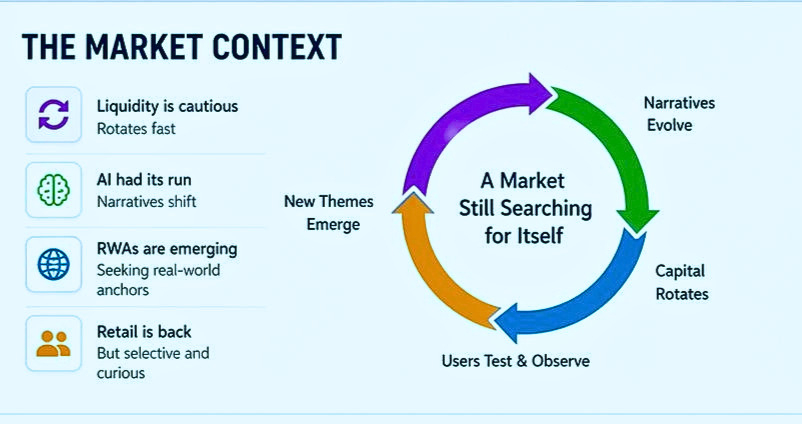
Because the market today doesn’t feel like it used to. On one side you have AI infrastructure, on another RWAs, and in between constant new narratives all trying to position themselves as long-term value. But in reality, attention keeps shifting very quickly from one theme to another, with very little stability.
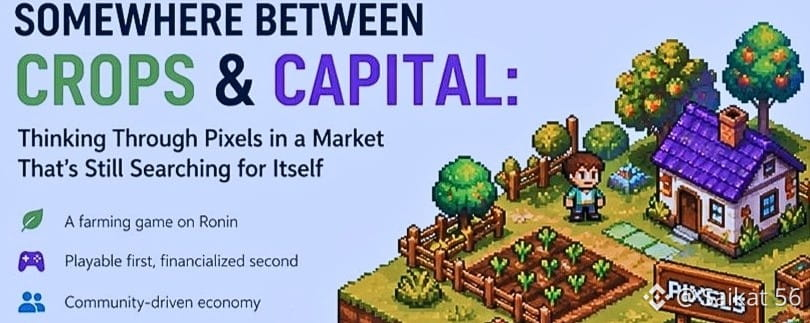
Somewhere in that flow, a farming game built on the Ronin network Pixels kept coming up.
At first glance, it looks extremely simple. Pixel art visuals, farming loops, resource gathering, light social interaction. No heavy complexity, no aggressive positioning. In a space where most crypto games try too hard to present themselves as “big innovations,” this one feels intentionally quiet.
And maybe that’s the first difference.
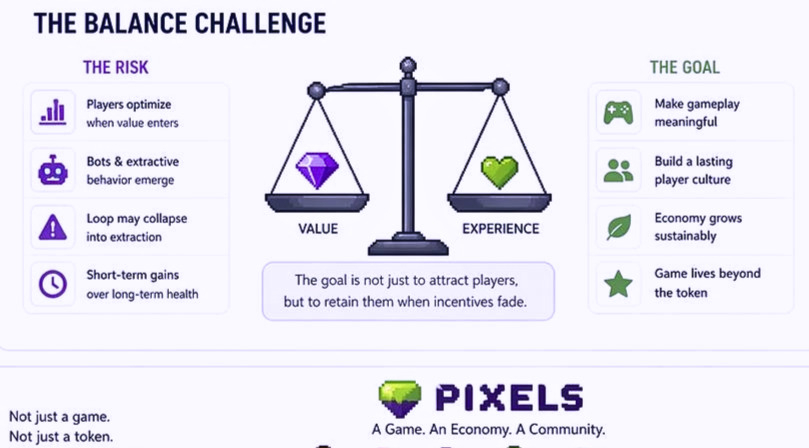
The long-standing issue with crypto gaming is that most games behave more like financial experiments than actual games. Users arrive, optimize rewards, extract value, and leave. There’s activity, but no real experience just extraction loops.
@Pixels tries to flip that pattern. Game first, economy second.
The choice of Ronin matters here. It’s already an ecosystem shaped by gaming wallet users, asset ownership, onboarding flows that aren’t foreign to non-technical players. So Pixels isn’t starting from scratch; it’s building on an environment that already understands game-based economies.
What stands out most is how softly the blockchain layer is integrated. Ownership exists, trading exists, but it’s not constantly pushed in your face. You play the game without being reminded at every step that you’re inside a financial system.
That subtlety matters.
The less visible the tech layer is, the more the experience feels like a game rather than a dashboard.
The incentive design also unfolds gradually. It doesn’t start with “optimize this system.” Instead, you farm, build, return, interact and only over time you realize there’s an economy forming around your actions.
It feels closer to early MMO economies, where players didn’t come for token rewards they came for the game, and the economy emerged naturally from that behavior.
But this is also where pressure builds.
Because once real value enters the system, player behavior changes. Optimization begins, bots appear, and the loop risks shifting back toward extraction dynamics.
What Pixels shows so far is mixed but interesting. Some users are genuinely playing not just for rewards, but for the experience itself. That signal is rare in crypto gaming.
Still, it’s early. The real test begins when easy incentives stop being attractive.
Will people still return then?
Zooming out, the broader market is fragmented. Attention rotates fast. AI, infra, RWAs all competing for long-term narrative dominance. A small farming game sits outside that gravity.
Which might actually be its advantage.
Not everything needs to compete in the same narrative lane. Some systems can survive simply by being places people return to, not assets they trade.
If Pixels succeeds at anything, it may not be about becoming a major financial primitive. It may simply be about becoming a place where people show up without thinking about tokens first.
But uncertainty remains.
If spotlight eventually shifts harder toward it, will it stay true to its nature or gradually turn into another optimized extraction loop?
Because in this cycle, what changes the fastest isn’t price it’s attention.
And the final question remains:
In a world where attention moves this quickly, can something this quiet actually hold its place long enough to matter? 🤔
