
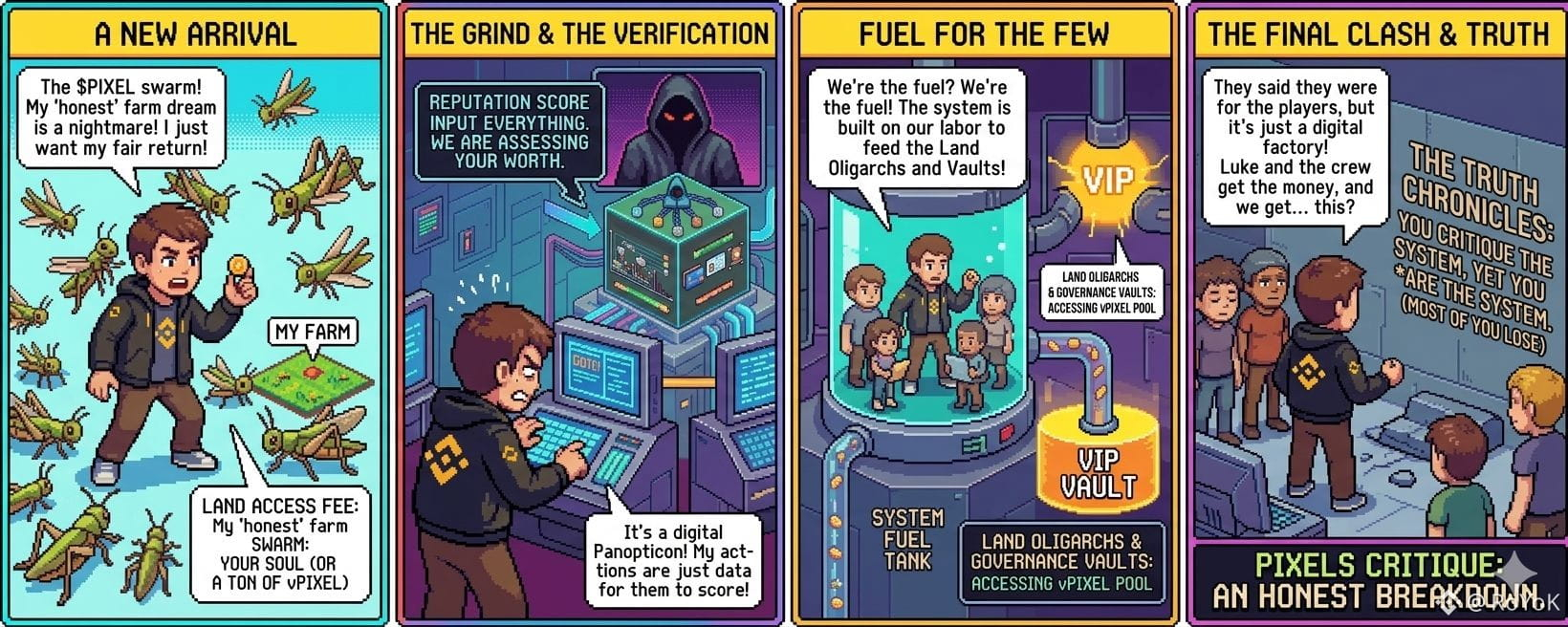


Alright, grab your popcorn and settle in, cause this one's a wild ride 🚜🎬
First month in, I've thought @Pixels was just a chill farming game on Ronin where you plant carrots and zone out. Boy, was I wrong. Months later, I realized it wasn't a game at all. It's a slow‑motion socioeconomic experiment wrapped in retro graphics, where every click is a tiny war over virtual class struggle.
The peaceful farm? Just a stage for brutal economic survival 🌾
Back in 2025, on Ronin, Pixels was flexing a million daily users and a ton of wallets, and $PIXEL was all the hype. But being a veteran who's lost money to more low‑grade scams than I can count, I learned one thing: you don't judge a project by its volume. You look at how tight the team keeps the economic valves when the party gets out of hand.
That's where Pixels' dark metric comes in: ROR, Return on Rewards. Basically, out of every 100 tokens the system gives out, how many actually flow back into the game instead of getting dumped on the market? In November 2025, ROR was an ugly 0.5. For every dollar in rewards, only fifty cents came back. A straight‑up bleed.
To stop the bleeding, Pixels rolled out a quiet but deadly weapon: a reputation engine that runs off‑chain, secretive as Video Social Media algorithm. It scores every move you make trades, social interactions, even if you're suspected of running scripts. If your score sucks, you get hit with a nasty "withdrawal tax." The worse your rep, the more they take when you cash out. And here's the kicker: that confiscated tax doesn't disappear. It gets redistributed to the people who stake the most and engage the most.
So high‑reputation players get almost tax‑free exits. It's a money loop cruel, but effective. It weeds out the parasites with surgical precision. It's like a purge, but in a carrot‑farming simulator. 🥕
And don't get me started on guilds. They're not brotherhoods they're land ⁰ owning corporations. If you're a landless peasant, you pay rent just to farm on their plots. In return, they get an 18% annual yield. Forget "digital ownership." Pixels looks more like a medieval feudal system than a digital democracy. A few land barons rule over a sea of virtual serfs.
So here's the big question: is Pixels just a game that takes itself too seriously, or a mirror of what's coming? Because the CEO, Luke Barwikowski, straight‑up admitted in an interview: "People who don't own land are surplus economy. They go into the city to work and earn money… they're guest workers or something." I froze. They didn't even hide it. The little farmer is the "migrant worker" of cyberspace.
Efficiency over gameplay, asset ownership over cooperation, algorithms replacing central banks. I admire the brutal honesty, but this farm is starting to look more like a cricket cage. Everyone can chirp the question is who gets the crumbs and who holds the controller.
His exact words (so you can judge for yourself):
"I guess it depends on who you ask. If you're a landowner, maybe you'll complain… But the genuine reality is you're contributing to the surplus economy. People who are non‑landowners basically go to the city to work and earn money… they're basically like guest workers or something"
👨⚖️ You decide
--