
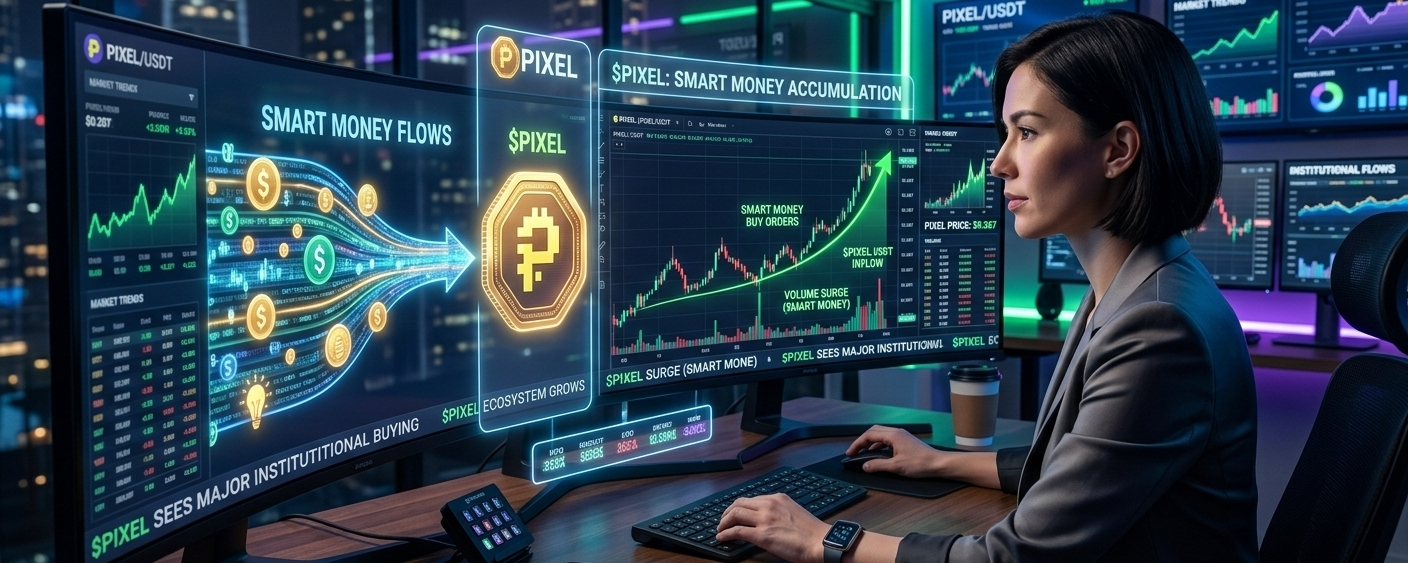
I've been watching $PIXEL closely for a while now... Not the price — the behavior underneath it.
Because smart money doesn't announce itself. It doesn't post conviction threads or drop alpha in telegram groups. It moves quietly, and you only notice it if you're looking at the right signals. So the question worth asking right now isn't whether $PIXEL is undervalued on a price chart. It's whether the hands holding it are changing.
I observed the volume data from the recent march rally suggested the move attracted attention from larger participants — though whether that qualifies as true smart money or coordinated groups remains an open question. What matters is that on-chain flow over the following 72-hour window became the real tell: Large transfers to private wallets typically signal conviction holds, while sustained transfers back to exchanges tend to precede selling pressure. That's the framework i'm applying here.
$PIXEL is currently sitting at a market cap of around $5.8 million with a fully diluted valuation near $37.8 million. That gap is significant. it tells you the majority of supply hasn't hit the market yet — and smart money knows that. Low-cap gaming tokens with strong daily active user bases and honest burn mechanics don't attract institutional desks. but they do attract early allocators who understand what a small-cap floor looks like before a narrative cycle begins.
What separates pixels from earlier play-to-earn experiments is the free-to-play approach with optional on-chain participation. That model matters because it removes the entry barrier that destroyed similar projects in 2024-2025. When play-to-earn collapsed 90%+ across the board once token incentives dried up. The ones that survived were the ones where people were playing first and earning second. Pixels was built that way from the start.
I noticed there's also a token unlock coming in may — 91 million PIXEL tokens, roughly 1.8% of supply — releasing across multiple stakeholders. That's the kind of event where you can observe real conviction. If price holds or tightens during that unlock window, it means demand is absorbing supply. If it doesn't, it means the hands weren't as strong as the chart suggested.
The pixels market is relatively small compared to traditional markets, which means large holders can single-handedly influence price movement. That cuts both ways. It creates volatility risk. But it also means a modest shift in wallet concentration — a few major holders quietly accumulating rather than rotating out — shows up clearly in the data if you know how to read it.
I'm not calling a breakout. What i'm saying is this: at $5.8 million market cap, with an active game sitting on ronin, a burn mechanism on treasury proceeds, and real daily users who aren't just yield farmers — the cost of being early here is low. The cost of missing the moment when smart money finishes its positioning is much higher. Always watch the wallets, not the price.