


Pixels is one of those projects I can’t ignore, even when I’m tired of looking at gaming tokens.
And honestly, I am tired.
I’ve watched too many Web3 games come in with clean trailers, loud communities, reward promises, and big words that usually end the same way. Early users farm. Token pressure builds. The game gets quieter. Then everyone starts pretending they were never that serious about it.
Same cycle. Same noise. Same recycling.
Pixels feels different, but I’m careful saying that because this market has punished people for believing too early.
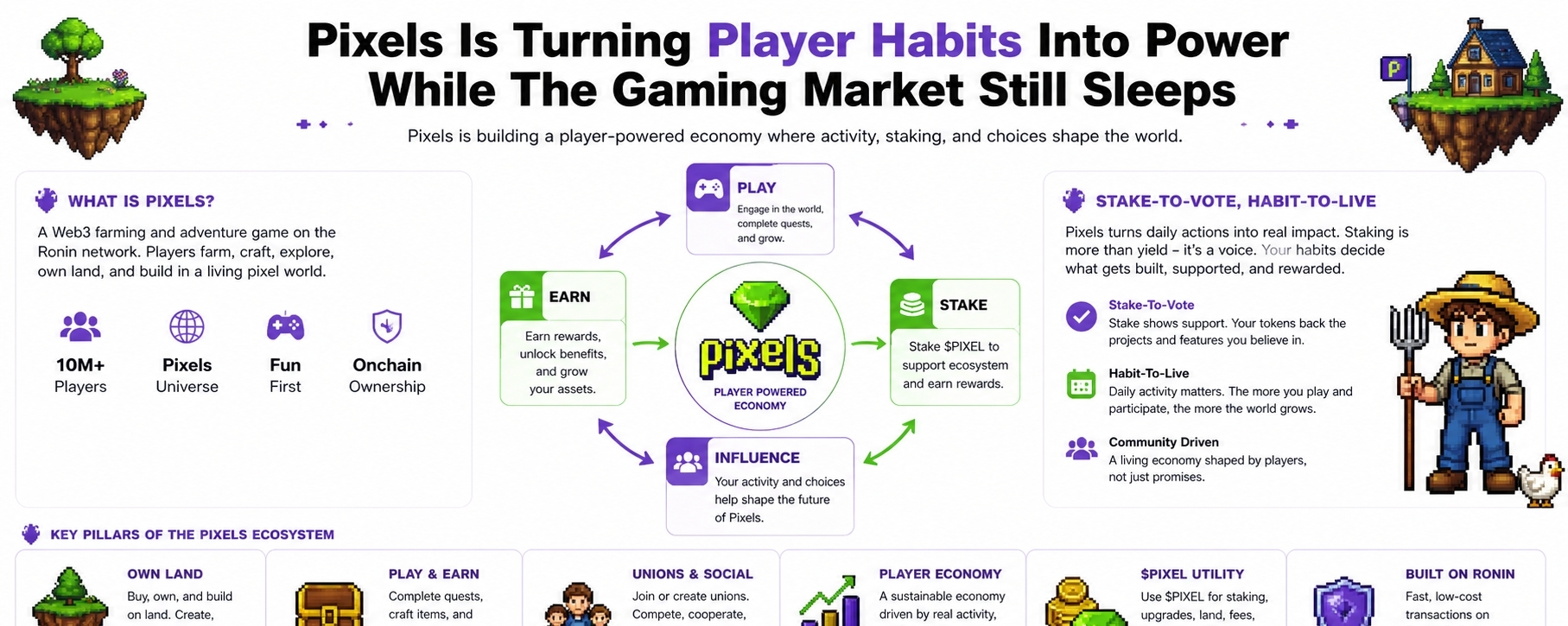
What I like here is not some fancy pitch. It is the way Pixels is trying to make players matter inside the system. Not just as wallets. Not just as reward hunters. Not just as people clicking daily tasks until the next token unlock hits.
The project is trying to connect gameplay, staking, land, activity, and user behavior into one live economy.
That sounds simple, but it is not.
Most projects never get past the reward layer. They talk about community, but the community has no real weight. They talk about ownership, but the only thing users really own is risk. They talk about gameplay, but the whole thing depends on whether the token is green that week.
Pixels is trying to build around habit.
That matters.
Because in gaming, habit is stronger than hype. A player who comes back again and again is worth more than a thousand wallets chasing a quick farm. The grind is what keeps a world alive. Not one campaign. Not one announcement. Not one clean chart.
Just people returning.
That is where the “habit-to-live” idea actually makes sense to me.
If players keep showing up, the world breathes. If they stop, no amount of branding saves it.
The staking part is also worth watching.
I don’t see it as just yield. Yield is cheap. Everyone has yield. Most of it is fake comfort wrapped around future sell pressure.
What matters is whether staking becomes a real signal inside Pixels.
When someone stakes, they are saying something. They are choosing to back the ecosystem instead of sitting outside it. They are adding weight to a direction. That is more interesting than a normal farm because it gives the player some kind of role, even if the system still has to prove how deep that role really goes.
That is the line I’m watching.
Does staking become meaningful participation, or does it slowly become another dashboard people forget about?
Because that is where many projects break.
They start with strong ideas, then friction builds. The casual user gets confused. The reward hunter gets bored. The loyal player gets tired of waiting. Suddenly the clean loop is not so clean anymore.
Pixels has to avoid that.
The project cannot become too heavy for normal players. It cannot turn into a system where only the most active crypto-native users understand what is going on. Gaming should feel natural. Web3 should add depth, not become homework.
That is the real test, though.
Can Pixels make staking, playing, owning, and supporting feel like one connected experience instead of separate crypto tasks?
If yes, then Pixels has a better reason to exist.
And that is important because I’ve seen too many gaming tokens with no real purpose beyond being earned and sold. That model always looks fine at the start. Then the chart starts absorbing everyone’s rewards, and suddenly the “economy” was just a slow exit door.
Pixels seems aware of that problem.
The project is trying to give Pixels more weight inside the ecosystem. Access. Staking. Support. Utility. Participation. That is the direction it needs to take, because a token in a game cannot survive on speculation forever.
Speculation can light the fire.
It cannot keep the room warm.
I’m also paying attention to the social side. This part does not get enough respect. People stay in games because they feel attached. They want progress. They want identity. They want other people around them. They want a reason to care when rewards are not exciting.
A lonely farm dies fast.
A world with groups, land, goals, small rivalries, ownership, and daily rhythm has a better chance.
Pixels is trying to move toward that kind of world.
Not perfectly. Not cleanly. Not without risk.
But there is a real attempt here.
And in this market, sometimes an honest attempt to fix the broken parts is already more than what most projects are doing.
Still, I’m not giving it a free pass.
The project needs retention. Real retention. Not campaign traffic. Not temporary farming. Not wallets showing up because the reward looks decent for a week.
I want to see whether people keep returning when the noise drops.
I want to see whether staking feels useful after the first wave of attention fades.
I want to see whether Pixels becomes something players actually need inside the world, not something they only think about when checking price.
That is where the truth usually appears.
Not in the announcement.
In the quiet weeks.
Pixels has the base. It has the identity. It has enough moving parts to become something more serious than a basic Web3 farming game. But moving parts can create power or mess. I’ve seen both.
Right now, I’m interested because the project is focusing on behavior, and behavior is harder to fake than hype.
People can fake excitement.
They cannot fake months of returning.
That is why I’m watching Pixels from a different angle. Not as a quick gaming trade. Not as another token trying to catch a narrative rotation. More like a project trying to turn players into actual participants, slowly, through staking, habits, and daily choices.
Maybe the market catches it later.
Maybe the grind exposes the weak spots first.
For now, I’m still watching, because Pixels is doing something rare in a tired sector : it is trying to make the player matter before the chart makes everyone care.