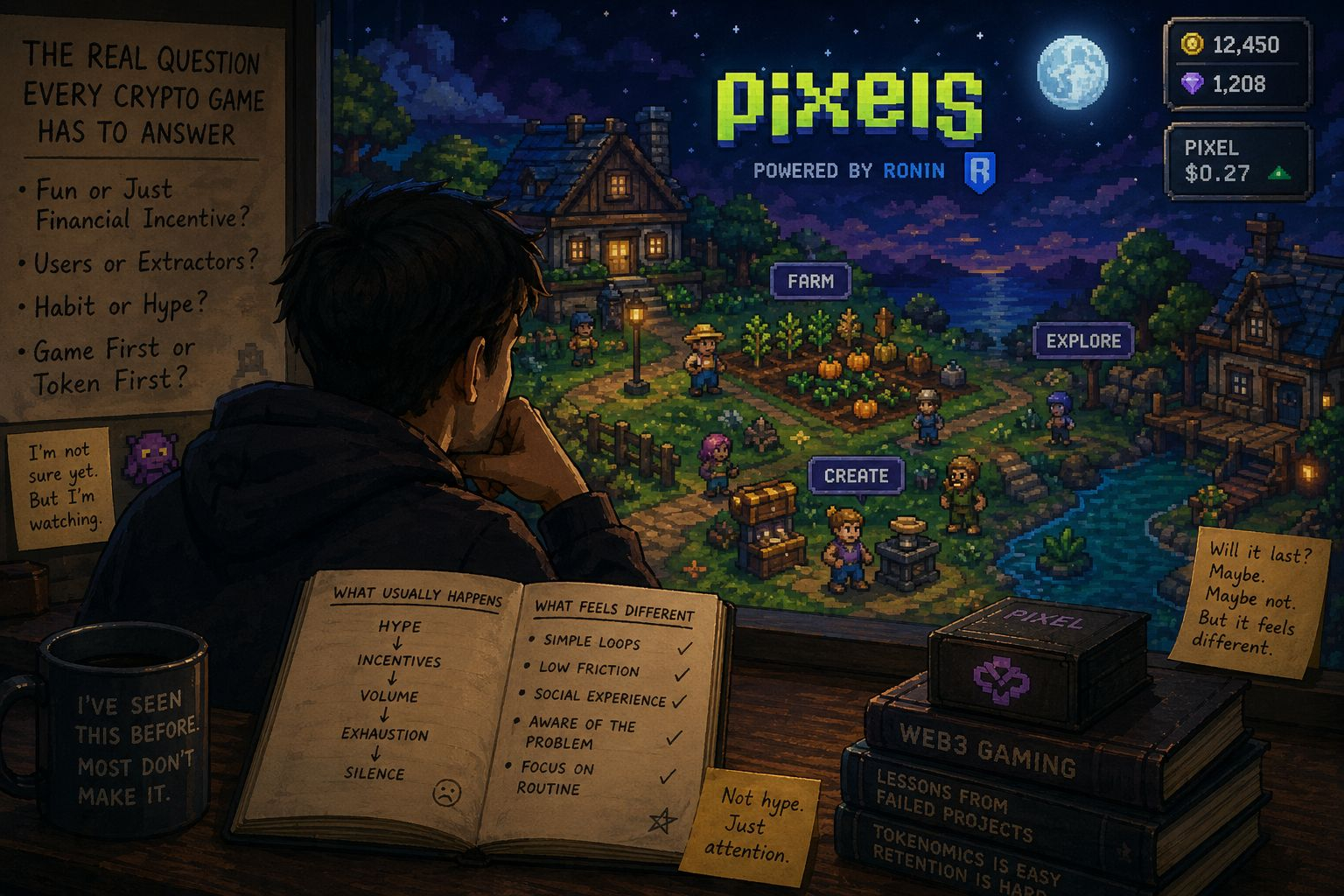
I’ve been watching crypto long enough to know how these stories usually go.
A new project appears, the community gets loud, influencers start calling it “the future,” and for a few weeks or months everyone pretends the industry has finally solved whatever problem it failed to solve in the last cycle. Then reality shows up. The numbers start slipping, the excitement fades, liquidity dries up, and what looked like innovation turns out to be another incentive machine held together by temporary optimism.
I’ve seen that happen with DeFi. I’ve seen it with NFTs. And I’ve definitely seen it with Web3 gaming.
That’s why I usually ignore the noise when another blockchain game starts getting attention. The narrative is almost always the same: ownership, rewards, community, digital economies, player empowerment. The words change, the branding changes, but underneath it’s often the same formula—financial incentives first, gameplay second.
And that formula almost never holds.
That’s what makes Pixels interesting to me.
Not because I think it has “figured it out.” I don’t think anyone has figured it out yet. But after watching so many crypto games rise on hype and fall under the weight of their own design, something about Pixels feels quieter, more grounded, and strangely more aware of the problems that usually get ignored.
That doesn’t mean it will succeed.
It just means it feels different enough to pay attention.
The first thing I noticed is that Pixels doesn’t try too hard to impress.
That might sound like a small thing, but in crypto it matters. Most projects in this space are built around spectacle. They promise giant virtual economies, player-owned worlds, endless earning opportunities, and some vague vision of gaming being “transformed forever.” The ambition is always massive, but the actual product usually feels thin.
Pixels, on the other hand, looks almost simple.
At first glance, it’s just farming, gathering, crafting, trading, and moving through a pixelated world that feels familiar. There’s no grand cinematic presentation. No overdesigned economic theory pretending to reinvent digital labor. No dramatic claim that this is where the future of gaming begins.
And honestly, that simplicity might be the smartest thing about it.
Because after years of watching crypto projects overcomplicate themselves, I’ve started to believe that the simpler the loop, the better the chance of survival.
The crypto industry has a habit of confusing complexity with value. Teams design token systems layered with staking rewards, utility mechanics, burn systems, governance rights, and emission schedules, then act like the complexity itself is proof of innovation.
But complexity usually creates fragility.
The more moving parts an economy has, the easier it is for the whole thing to break. One imbalance leads to another. One incentive gets exploited. One reward loop becomes unsustainable. Before long, the project is spending more time managing its own token economy than improving the game.
I’ve seen this pattern enough times that whenever I hear a project describe its “robust tokenomics,” my skepticism immediately goes up.
Pixels doesn’t completely escape that problem, but it seems to understand that the game loop has to come first.
That’s where many Web3 games failed.
They were never really games. They were economic systems disguised as games. Players weren’t there because the gameplay was compelling—they were there because the token rewards justified the boredom.
As long as rewards were high, people tolerated repetitive gameplay, weak mechanics, and clunky systems. But once the economics weakened, users disappeared.
That’s when you realize the game never had real retention.
It only had incentives.
That’s the real question hanging over Pixels too.
Not whether it has users right now. Not whether the token has value right now. Not whether the community looks active right now.
The real question is whether people would still show up if the financial incentive faded.
Because that’s where crypto games are exposed.
In normal gaming, players stay because they enjoy the experience. In Web3 gaming, players often stay because the math still works.
That difference changes everything.
It changes user behavior. It changes loyalty. It changes what “growth” actually means.
I’ve watched projects celebrate massive wallet activity as proof they were building something meaningful, when in reality they were just distributing rewards people wanted to extract. High user numbers can look impressive, but in crypto, engagement metrics are often reflections of incentives, not attachment.
That’s why I don’t get excited when a blockchain game posts huge activity stats.
I’ve seen this before.
Wallets can be active without users being loyal. Communities can be loud without communities being durable. Tokens can be in demand without products being loved.
Those distinctions matter, especially in gaming.
And Pixels still lives inside that same reality.
The fact that it runs on Ronin, the fact that onboarding feels smoother, the fact that the gameplay loop is more accessible—those are all meaningful improvements. Infrastructure matters. Reduced friction matters.
But infrastructure doesn’t solve the core issue.
The moment a game introduces real money into the loop, the player relationship changes.
That’s something the industry still underestimates.
Once players can earn, sell, optimize, and extract value, the game stops being just a game. It becomes a system to be exploited as efficiently as possible.
That’s not criticism—it’s just human behavior.
If rewards exist, people will optimize for rewards.
That means the social experience changes. The pacing changes. The purpose changes.
People stop asking, “What’s fun?” They start asking, “What’s profitable?”
And that shift is where so many Web3 games quietly lose their soul.
The world might look playful on the surface, but underneath, everyone is running calculations.
That’s why I remain cautious with Pixels.
Because no matter how polished the world looks, no matter how engaged the community seems, the economy underneath still carries the same structural pressure every tokenized game faces.
Players earn tokens. Earned tokens create sell pressure. Sell pressure requires new demand. New demand depends on growth. Growth slows eventually.
That cycle is brutal.
It doesn’t matter how attractive the game is—if the economic balance depends too heavily on continuous expansion, the pressure builds over time.
I’ve seen projects try to solve this with “utility.” They create token sinks, upgrade systems, premium features, governance rights—anything to keep demand alive.
Sometimes it works for a while.
But eventually the market tests whether that utility is strong enough to offset extraction.
Usually it isn’t.
That’s why I don’t fully trust any Web3 game economy, including Pixels.
Not because I think the team is dishonest.
Because the system itself is difficult.
Building a game is already hard. Building an in-game economy is harder. Building a tokenized in-game economy that survives speculation might be one of the hardest things in crypto.
That’s the challenge Pixels is facing, whether people admit it or not.
And yet, despite all of that skepticism, I keep watching it.
That’s what stands out to me.
I’m not emotionally invested in the token. I’m not convinced the economics will last. I’m not ready to call it the future.
But I keep noticing that Pixels feels less obsessed with fantasy than most projects in this sector.
It doesn’t feel like it’s trying to convince everyone that gaming is being reinvented overnight.
Instead, it seems to focus on something much less glamorous: giving players a routine.
That sounds almost too simple, but routine is what builds real retention.
Not hype. Not token rewards. Not promises.
Routine.
People return to games because they become part of habit. They return because the world feels familiar, because progress feels steady, because interacting with the system becomes natural.
That kind of retention is hard to fake.
And if Pixels has any real edge, it might be there.
Not in the token. Not in the narrative. Not in the economy.
In the possibility that it understands users need a reason to return beyond extraction.
That doesn’t mean the token won’t distort everything eventually. It might.
In fact, I’d say there’s a good chance the same economic pressures that broke earlier Web3 games will test Pixels just as hard. Speculation can overwhelm design faster than teams expect. Financial incentives can attract the wrong behaviors. A healthy-looking economy can weaken quietly before the market notices.
I’ve watched that happen too many times to pretend it won’t happen again.
But for once, I’m looking at a crypto game and thinking the people behind it might actually understand what usually goes wrong.
That alone makes it worth paying attention to.
Not because success is guaranteed.
Because awareness is rare.
The crypto market has spent years pretending that ownership and incentives are enough to create engagement. Pixels seems to hint at a more uncomfortable truth: that ownership means very little if the underlying experience doesn’t build habit.
That’s not a revolutionary insight, but in this space it almost feels like one.
Maybe Pixels becomes one of the few projects that manages to hold that balance.
Or maybe it becomes another example of how hard that balance really is.
Right now, I honestly don’t know.
And after years of watching the market repeat the same mistakes, uncertainty like that feels strangely refreshing.
For the first time in a while, I’m looking at a Web3 game without either blind optimism or instant dismissal.
Just cautious attention.
That may not sound exciting, but after everything this market has cycled through, cautious attention might be the most honest kind of optimism left.