
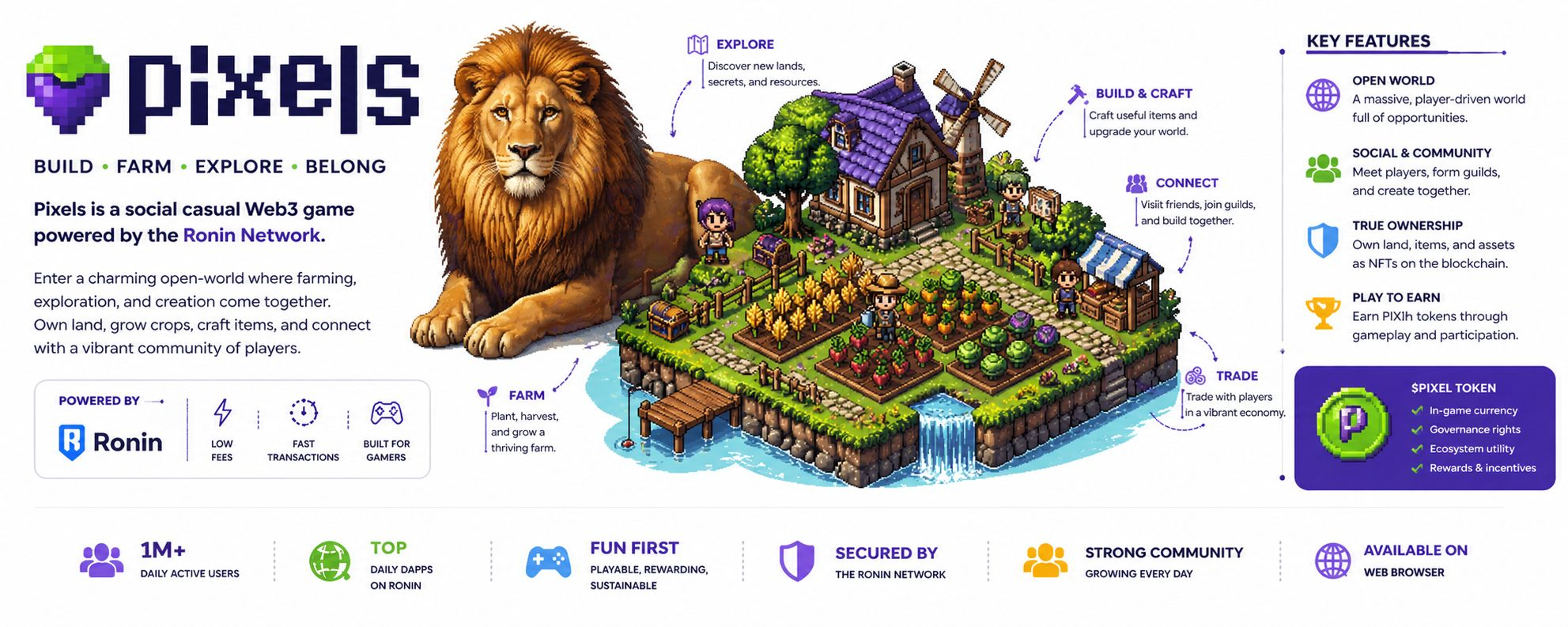
Pixels is one of those rare digital worlds that doesn’t try to impress you immediately. At first glance, it feels soft, almost understated—a place where you plant crops, wander through simple landscapes, and interact with others at your own pace. There’s no overwhelming sense of urgency, no aggressive push toward competition or profit. And yet, the longer you stay, the more it becomes clear that this quiet surface is hiding something far more ambitious.
What Pixels is really doing is reworking the relationship between players and the worlds they inhabit. It takes something deeply familiar—farming, crafting, gradual progress—and gently fuses it with the infrastructure of Web3. Not in a loud, disruptive way, but in a way that feels almost natural. You don’t log in thinking about blockchain mechanics. You log in to tend your land, to check what has grown, to decide what comes next. The technology fades into the background, which is precisely why it works.
There is something deeply human about the rhythm the game creates. You plant, you wait, you return. That cycle, simple as it is, taps into an instinct older than games themselves. Pixels understands that progress does not always need to be fast to feel meaningful. In fact, its slower pace becomes its strength. It encourages a kind of digital patience that most modern online experiences have abandoned. Instead of chasing constant stimulation, it builds attachment through repetition and care.
The decision to build on the Ronin Network plays into this philosophy more than it might seem. In many blockchain environments, every action feels heavy, as if the system itself is reminding you of its complexity. Pixels avoids that friction. Actions feel light, immediate, almost invisible in their technical execution. This allows the player to stay immersed in the world rather than being pulled out of it by the mechanics underneath. In a space where usability often determines survival, this detail is not minor—it is foundational.
But Pixels is not just about individual experience. Its social layer is where the world begins to feel alive in a different way. Visiting other players’ lands, collaborating through guilds, participating in shared activities—these are not just features; they are the glue that holds the experience together. Over time, these interactions begin to form patterns. Familiar names, recurring exchanges, small acts of cooperation. The game slowly transforms from a collection of mechanics into something that resembles a community.
Ownership sits quietly at the center of all this. In traditional games, everything you build is ultimately temporary, locked inside systems you do not control. Pixels offers a different proposition. Your land, your items, your progress—they carry a sense of persistence that extends beyond the immediate session. This does not always manifest as something dramatic. It’s subtle. A feeling that what you are doing is not just passing time, but adding to something that belongs, in some way, to you.
That sense of ownership changes behavior. When players feel that their actions have continuity, they engage differently. They invest not just time, but intention. A plot of land becomes more than a resource generator; it becomes a reflection of identity. A well-organized farm, a carefully planned layout, a space that others visit—these are expressions, not just optimizations. The game begins to shift from a system to be solved into a place to be shaped.
At the same time, Pixels exists within the unpredictable currents of the crypto economy. The PIXEL token introduces a layer of real-world value that complicates everything. Suddenly, the crops you grow, the resources you gather, the time you spend can carry financial implications. This is where the balance becomes delicate. Too much emphasis on earning, and the game risks turning into labor. Too little, and it loses one of its defining features. Pixels navigates this tension by keeping the core experience grounded. The economy is present, but it does not completely dominate the emotional tone of the world.
This balance is not accidental. It reflects a broader shift in how Web3 games are being designed. Early experiments in the space often leaned heavily into financial incentives, assuming that players would stay if the rewards were high enough. What they discovered instead was that without genuine engagement, those systems collapse. Pixels seems to have absorbed that lesson. It does not try to replace fun with profit. It tries to let the two coexist, even if imperfectly.
There is also something quietly experimental about how Pixels treats time. In most games, time is something you spend. In Pixels, time begins to feel more like something you cultivate. The longer you stay, the more the world unfolds, not through dramatic changes but through accumulation. Relationships deepen, routines form, spaces evolve. It mirrors, in a simplified way, how real environments gain meaning—not through isolated events, but through sustained presence.
This is where the game starts to hint at something larger than itself. It suggests a future where digital spaces are not just entertainment, but extensions of everyday life. Places where people return not for bursts of excitement, but for continuity. Where value is not only measured in tokens or achievements, but in familiarity and connection. Pixels does not fully arrive at that future, but it gestures toward it in a way that feels tangible.
The aesthetic plays an important role in this. The pixel-art style is not just a nostalgic choice; it lowers expectations in a clever way. It signals simplicity, accessibility, a lack of pretension. But beneath that visual language is a system dealing with complex questions about ownership, economy, and social interaction. The contrast is part of the experience. It allows the game to explore serious ideas without feeling heavy or intimidating.
Over time, what emerges is not just a game, but a kind of living structure. One that is shaped as much by its players as by its design. Every farm, every interaction, every small decision contributes to a larger pattern that no single player fully controls. This is where Pixels begins to resemble something closer to a society than a traditional game environment. Not in a grand or dramatic sense, but in the quiet accumulation of shared activity.
What makes it compelling is that it does not try to force this realization. You arrive at it gradually. First through routine, then through familiarity, and eventually through a subtle awareness that what you are participating in has weight. Not necessarily in a financial sense, but in a personal one. The world starts to matter because you have been part of it long enough for it to feel real in its own way.
Pixels may not look revolutionary, and that is precisely why it has a chance to be. It does not rely on spectacle or bold promises. It builds slowly, almost patiently, trusting that if the foundations are right, the meaning will follow. In a space often driven by hype and rapid cycles, that kind of restraint is unusual.
What it ultimately offers is a different vision of what Web3 gaming can be. Not a marketplace disguised as a game, but a world where economic systems exist alongside human ones. Not a place defined by extraction, but one shaped by presence. It suggests that the future of digital environments might not be louder or faster, but quieter, deeper, and more connected to the rhythms people already understand.
And that is where Pixels leaves its strongest impression. Not as a finished idea, but as an evolving one. A world that is still figuring itself out, alongside the people who inhabit it.
