
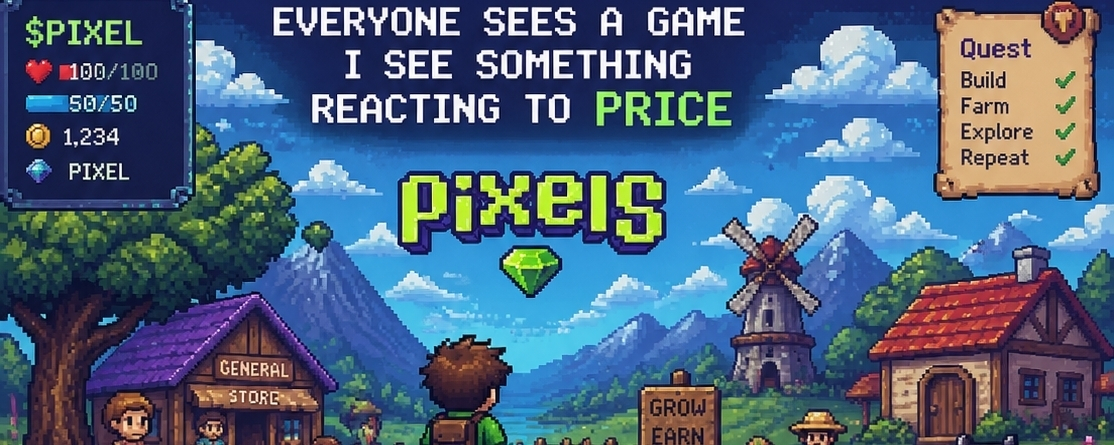
@Pixels When I first looked at Pixels, I thought I already understood it. It had that familiar free-to-play farming structure most people have seen before: plant crops, wait for timers, harvest rewards, reinvest resources, repeat the cycle. Add a token on top of that loop and it feels like another version of the same GameFi formula we’ve watched play out again and again. Nothing about it initially felt surprising. But the longer I watched how players actually interacted with the game, the more I realized the obvious surface explanation misses something important. Pixels may not be built around selling progress in the way most people assume. It may be built around selling relief from waiting.
That difference sounds subtle, but it changes how the entire economy should be understood. In most tokenized games, the token usually exists to accelerate growth, improve efficiency, unlock stronger tools, or multiply earnings. The value proposition is straightforward: spend now to advance faster. Pixels has parts of that logic too, but it feels like the real pressure point is elsewhere. The game constantly places small amounts of time between the player and what they want to do next. Sometimes it is crop timers. Sometimes it is energy limitations. Sometimes it is repetitive loops that become slower the longer you stay inside them. None of these mechanics feel aggressive on their own. In fact, they often feel normal. But when layered together, they create a system where delay becomes one of the most important resources in the game.
That is where starts to look different. It doesn’t always feel like a traditional currency used to buy items or status. It feels more like a tool players reach for when their patience starts carrying a cost. In many cases, the decision is not “Do I need this upgrade?” It is “Do I really want to wait for this?” That creates a very different kind of demand. Instead of being driven purely by ambition or greed, it can be driven by convenience, routine, mood, and the desire to keep momentum alive. Those forms of demand are harder to measure because they happen quietly, through repeated micro-decisions rather than dramatic purchases.
What makes this interesting is that players do not need to be highly strategic for the token to matter. In many GameFi systems, token utility depends heavily on users trying to maximize returns. But in Pixels, even casual players may use simply because friction becomes tiring over time. Someone may not care about optimizing output or chasing leaderboard status, yet still spend just to smooth out the experience. That shifts the token’s role from being an elite optimization asset to something tied to everyday comfort. If enough players repeatedly make those small choices, it can matter more than one-time speculative interest.
There also seems to be a deliberate separation between participation and control. Basic in-game coins handle much of the normal economy. They support routine actions, keep activity flowing, and allow players to remain active without immediately needing the premium layer. That design matters because it preserves accessibility. Players can stay inside the game world for quite a while without feeling forced into token usage. But once someone wants greater control over pacing, efficiency, or convenience, the path gradually leads toward $PIXEL. It becomes less about entering the game and more about reshaping how the game feels.
That reminds me of how many digital platforms separate standard access from priority access. Everyone technically uses the same service, but not everyone experiences the same level of speed, convenience, or flexibility. Pixels seems to operate in a similar way, except the premium layer is expressed through a token economy. The player who waits and the player who pays may be in the same world, but they are not experiencing time in the same way. One accepts the system’s pace. The other modifies it.
This is why I think many people may be analyzing the project through the wrong lens. The common conversation usually revolves around user growth, token supply, unlock schedules, and whether new players continue entering the ecosystem. Those are useful metrics, but they may not explain the most important behavior. With Pixels, recurring usage might matter more than rapid expansion. If the existing player base repeatedly encounters moments where spending feels worthwhile, then demand does not need to rely entirely on constant new inflows. It can come from habit, from routine friction, from the desire to preserve flow. That kind of demand rarely looks dramatic on charts, but it can be more resilient than hype-driven spikes.
At the same time, this model is delicate. If the game becomes too efficient and friction disappears, then the token loses part of its purpose. If nothing meaningful feels slow, then there is less reason to pay for speed. But if delays become too obvious or feel intentionally frustrating, players notice quickly. Gamers are usually very sensitive to systems that feel manipulative. Once users begin to believe that inconvenience was designed purely to extract spending, trust weakens fast. And in gaming, losing trust often means losing attention.
That creates a narrow path Pixels has to walk. Friction must exist, but it must feel natural. Waiting must be noticeable, but not insulting. Spending must feel optional, not mandatory. The strongest monetization systems are often the ones players barely think about, because they feel like personal choices rather than forced decisions. If Pixels can maintain that balance, $PIXEL may continue to function as more than just another game token. If it loses that balance, the same mechanics that support demand could start pushing people away.
There is also a behavioral reality that should not be ignored: players always have another option. Sometimes they pay to save time. Sometimes they accept the grind. But sometimes they simply close the app. Every game built around convenience spending competes not only with impatience, but with indifference. If the player no longer cares enough to skip the delay, then the economy weakens immediately. That is why retention and emotional engagement matter just as much as tokenomics.
So I’m not fully convinced this model guarantees long-term success, but I do think it is often misunderstood. Pixels may look like a game selling progress, yet beneath the surface it appears to be monetizing something less obvious and potentially more powerful: the player’s relationship with time. It slows certain moments, smooths others, and places at the exact point where patience can be exchanged for momentum. Whether that becomes durable value or a temporary habit depends on how carefully the system is managed. But subtle models like this are easy to underestimate, especially when everyone is still looking only at the visible numbers.