
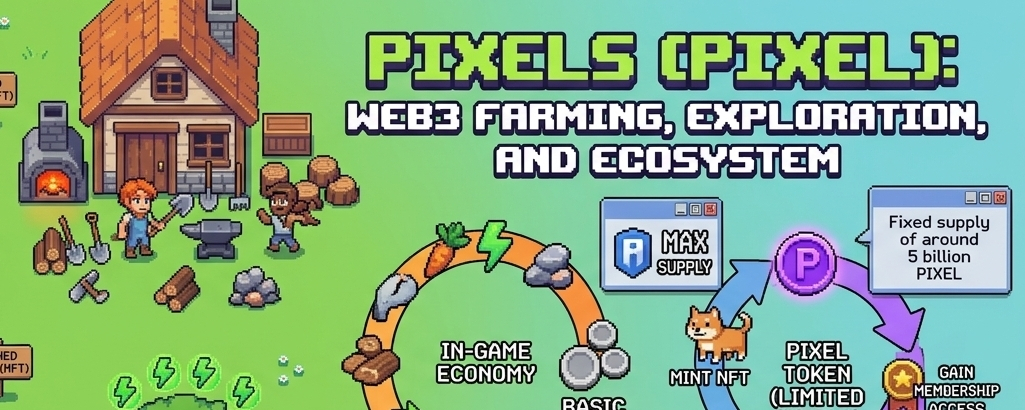
Most deeper you look, the more interesting it becomes. On the surface, it’s a casual farming and exploration game where players grow crops, collect resources, craft items, and interact with others in a colorful pixel-style world. It looks similar to classic farming games, but the difference is that everything inside it is connected to blockchain technology, which means players can actually own parts of the game and use a real token called PIXEL.
What makes Pixels stand out is that it doesn’t try to push crypto first. Instead, it focuses on gameplay. Many earlier Web3 games failed because they were too focused on earning money rather than being fun. Players would join, farm rewards, and leave. Pixels takes a different path. It tries to feel like a normal game where you play because you enjoy it, and the earning aspect comes naturally as part of the experience rather than the main goal.
Deen game runs on the Ronin Network, which is known for supporting blockchain games with fast and cheap transactions. This is important because games need smooth performance. If every action was slow or expensive, players would quit quickly. Ronin solves this problem and allows Pixels to scale to a large number of users without friction.
Inside the game, everything revolves around a simple loop. You have energy, and you use that energy to perform actions like farming, chopping trees, mining, or crafting items. These actions give you resources, which you can either use yourself or trade with other players. Over time, you improve your efficiency, unlock new tools, and gain access to better opportunities. It’s a slow progression system, but that’s what makes it engaging. You’re not rushing to finish something — you’re building over time.
And ’s also a strong social layer in Pixels. You’re not just playing alone. Players interact, form groups, compete on leaderboards, and sometimes collaborate. This social aspect is one of the reasons the game has been able to grow so quickly. It feels alive, not empty.
Now when it comes to the economy, Pixels uses a smart structure. There isn’t just one currency. There’s a basic in-game currency used for everyday actions, and then there’s the PIXEL token, which is more valuable and limited. This separation is very important. It keeps the game balanced and prevents the main token from being overused or inflated.
PIXEL token has a fixed maximum supply of around 5 billion. It’s not something you need for basic gameplay, which is actually a good thing. Instead, it’s used for more important and premium actions. For example, players use PIXEL to mint NFTs, access special features, unlock memberships, and participate in higher-level parts of the ecosystem. This creates demand for the token without forcing every player to constantly spend it.
Another interesting part of the design is how the game controls inflation. In many Web3 games, tokens lose value quickly because too many are distributed and not enough are used. Pixels tries to solve this by creating “token sinks.” This means there are many ways to spend PIXEL, which removes it from circulation. When players are spending as much as they are earning, the system becomes more stable.
You ecosystem around Pixels is also growing. Players can own land as NFTs, which allows them to build, farm, and even host other players. There are also pets and other digital assets that provide utility inside the game. All of these elements create a player-driven economy where value is not just given by the developers but also shaped by the community.
Looking at its direction, Pixels is clearly trying to become more than just a simple farming game. It’s slowly evolving into a social MMO-style experience where players spend long periods of time building their progress, interacting with others, and participating in a shared world. Future updates are expected to expand guild systems, add more features, and increase the utility of the PIXEL token.
However, it’s important to stay realistic. Pixels still faces challenges. Web3 gaming is a difficult space, and many projects struggle to keep players engaged long-term. Farming-based gameplay can become repetitive if not updated regularly. There is also always some level of selling pressure on tokens as players take profits. Balancing fun and earnings is not easy, and even small mistakes can affect the economy.
Another challenge is competition. More Web3 games are entering the market, and not all of them will survive. Pixels has an advantage right now because of its strong community and early momentum, but maintaining that position will require continuous improvement.
In the end, Pixels feels like a step in the right direction for Web3 gaming. It doesn’t promise unrealistic rewards, and it doesn’t rely only on hype. Instead, it builds slowly, focusing on gameplay, community, and a more sustainable economy. Whether it becomes a long-term success or not will depend on how well it continues to balance these elements.
But one thing is clear — Pixels is not just trying to be another crypto game. It’s trying to prove that a game can be enjoyable first, and still have a working economy behind it.
