
Crypto is not screaming “bull market” yet. It is doing something more interesting.
The market looks mixed on the surface. Global crypto market cap is sitting around $2.59T, slightly down on the day. Bitcoin is still hovering near the $77K–$78K zone, and many large-cap coins are moving without much drama. For a casual trader, this may look like a slow market.
But underneath the price action, the structure is changing.
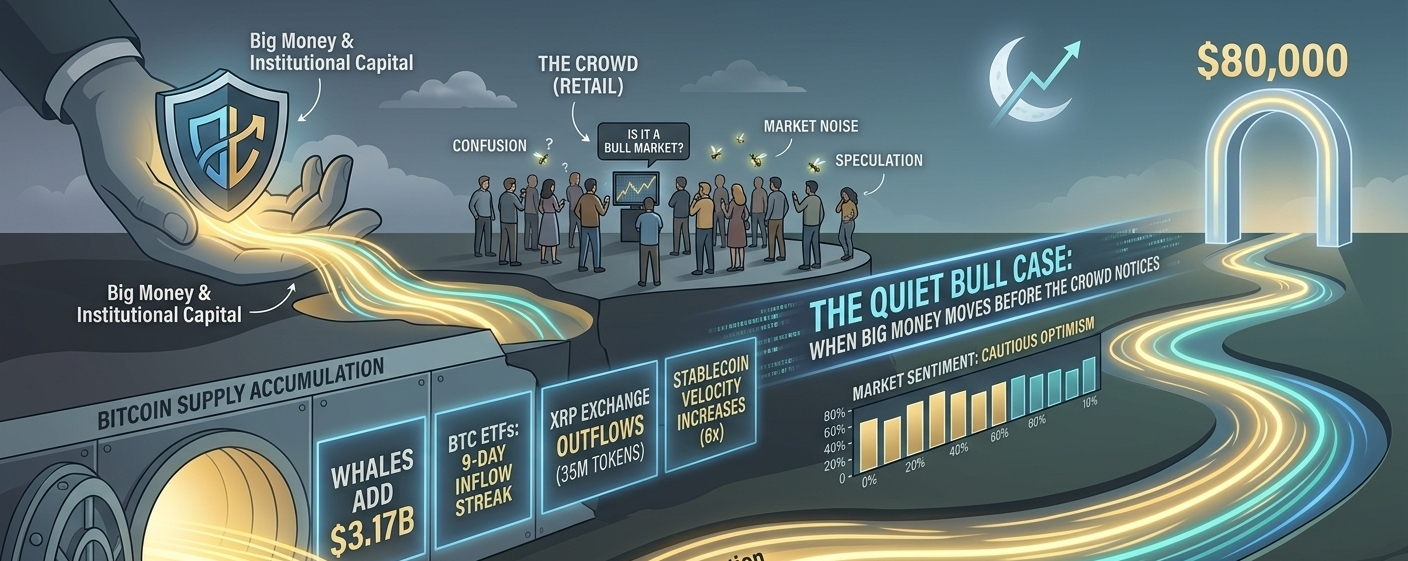
The strongest signal right now is not coming from hype. It is coming from whales, ETFs, exchange outflows, and stablecoin usage all pointing in the same direction: serious capital is positioning before retail fully wakes up.
Bitcoin is the clearest example. Large holders have reportedly accumulated more than $3.17B worth of BTC since April 10. At the same time, spot Bitcoin ETFs have recorded a nine-day inflow streak worth $2.12B. That combination matters because it shows demand from two different sides: on-chain whales and regulated investment products.
The key level is simple: $80,000.
If Bitcoin breaks and holds above that zone, it could shift the market from cautious accumulation into a broader momentum phase. Right now, sentiment is improving, but it does not look overheated yet. That is usually where strong moves begin — not when everyone is already euphoric, but when smart money is buying while the crowd is still unsure.
XRP is also showing an unusual setup. Around 35 million XRP left exchanges in 24 hours, one of the largest daily outflows of 2026. Exchange outflows often suggest holders are moving coins away from selling venues, which can reduce immediate sell pressure. Add whale accumulation and three weeks of ETF inflows, and XRP suddenly has a much stronger story than just a chart pattern.
Technically, XRP’s falling wedge structure points toward a possible move into the $1.87–$1.89 range by June if buyers maintain control. But this is not a guaranteed breakout. If the structure fails, the downside risk remains serious, with lower levels near $0.98 still possible.
The more important shift may be happening in stablecoins.
Stablecoin transaction volume reportedly reached around $4.5T in Q1 2026, and the interesting part is not just the size. It is the behavior. Stablecoins are moving from being “crypto casino chips” into payment rails for real-world transactions. Consumer-to-business activity is rising, card collateral is growing, and velocity is increasing.
That means stablecoins are being used more, not just parked.
This is a major difference from previous cycles. In older bull markets, the main story was speculation. Now, part of the crypto economy is slowly becoming financial infrastructure, especially in regions like Asia and Brazil where payment friction is still a real problem.
Ethereum’s NFT market is also showing signs of life, with trading volume jumping over 72% in 24 hours. BAYC led the move, but the bigger point is that risk appetite may be returning to non-token sectors of crypto. NFT volume is still far below mania levels, but a sharp increase after months of weakness shows that speculative energy is not dead — it is just more selective.
Not everything is bullish, though.
Aave’s bad debt issue from the rsETH incident is a reminder that DeFi still carries structural risk. The community rescue effort is impressive, but needing a rescue fund after absorbing tens of millions in bad debt shows that decentralized finance is still stress-testing its own safety systems in real time.
So the market is giving two messages at once.
On one side, whales are accumulating, ETFs are absorbing supply, XRP is seeing strong outflows, stablecoins are becoming more useful, and NFTs are warming up again.
On the other side, DeFi risk, failed breakouts, and sudden liquidity shifts can still punish overconfident traders.
The cleanest read is this: crypto is not in full euphoria mode yet, but the foundation for a stronger upside move is forming. Bitcoin above $80K could be the trigger that turns quiet accumulation into visible market momentum.
Strong takeaway: The next crypto move may not come from louder hype, but from the silent alignment of whales, institutions, and real on-chain demand.


