
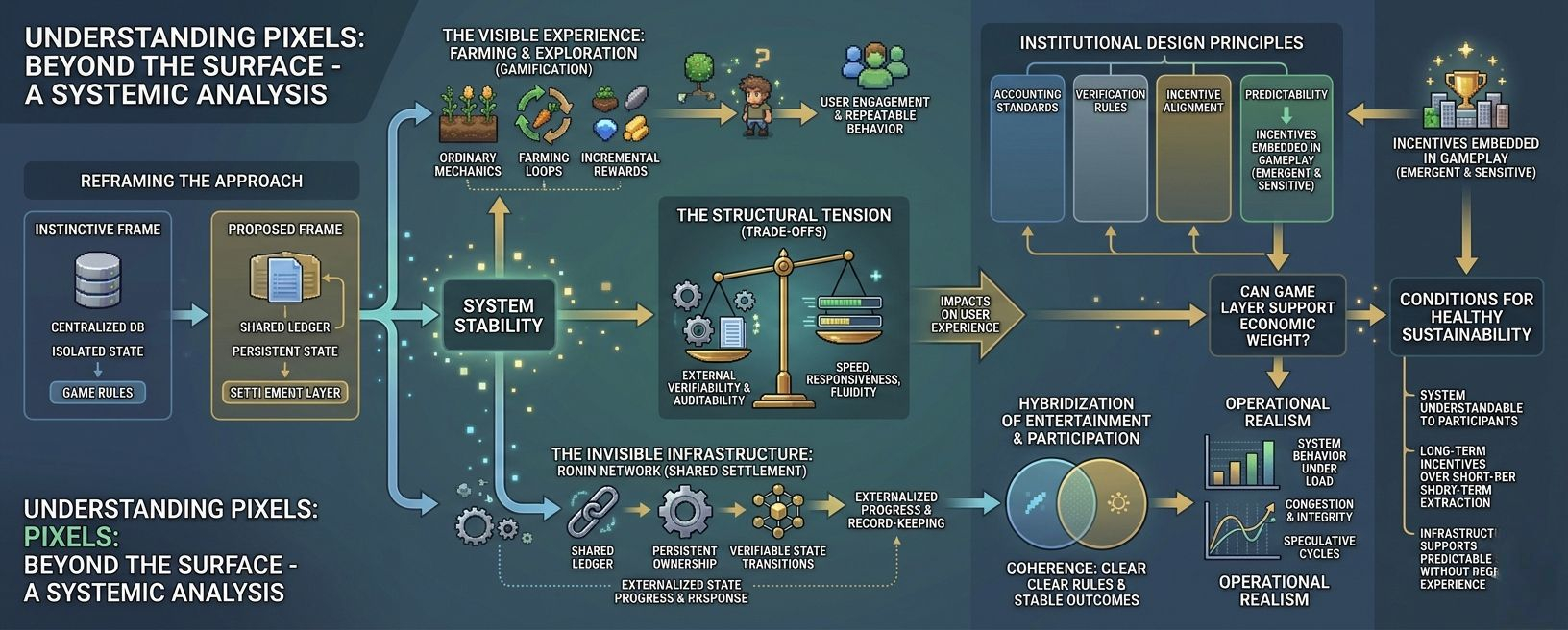
When I look at Pixels, I try not to start from the usual framing people reach for when they talk about Web3 games. That framing tends to jump quickly toward ownership, tokens, and digital economies, as if those are the primary story. But my instinct is to begin somewhere more familiar: with how long-running systems actually survive in the real world.
In most durable systems I can think of—banks, public infrastructure, even large-scale online platforms—the interesting part is rarely the visible interface. It is the settlement layer underneath. The rules that determine how state changes are recorded, how consistency is maintained across participants, and how trust is enforced when no single actor can see the entire system at once. Those parts are not exciting in themselves, but they quietly decide whether anything built on top will last.
Pixels presents itself as a casual farming and exploration game, and on the surface that framing is almost intentionally ordinary. Farming loops, resource collection, gradual progression—these are not novel mechanics. They are among the oldest tools in game design because they map cleanly onto human behavior. People understand repetition and incremental reward. That familiarity is not accidental; it is a way of stabilizing engagement without requiring explanation.
But what interests me is that this familiar structure is being placed on top of an infrastructure layer that behaves more like a financial or institutional system than a traditional game server. The Ronin Network underneath is not just hosting data; it is maintaining a shared ledger of ownership and state transitions. That distinction matters more than it first appears, because it changes what “progress” actually means. In a traditional game, progress is local and revocable by the operator. In a system with externalized state, progress begins to resemble something closer to record-keeping in an economic system—persistent, transferable, and potentially visible outside the game environment itself.
When I think about why this architecture exists, I try to avoid the temptation to describe it as innovation for its own sake. Instead, I see it as a response to a set of practical constraints. If you want players to meaningfully own in-game assets across time and potentially across applications, you cannot rely on a single centralized database controlled entirely by the game developer. You need a shared settlement mechanism that multiple parties can verify independently. That is not a philosophical choice as much as it is a structural one.
But structural choices always introduce trade-offs. In traditional systems, if a bank ledger is slow or expensive to update, it is because the system is prioritizing auditability, reconciliation, and consistency over speed. Nobody designing core financial infrastructure optimizes purely for responsiveness in the way a video game would. Pixels inherits a similar tension. The more it leans into external verifiability and persistent ownership, the more it has to respect the constraints of the underlying settlement layer. That inevitably shapes how fluid or immediate the experience can feel, even if the gameplay itself is designed to be lightweight.
I find it useful to think of this in terms of institutional design rather than game design. In a well-functioning institution, most of the visible experience is supported by invisible processes: accounting standards, verification rules, and incentive alignment mechanisms that prevent abuse while still allowing participation at scale. These are not glamorous features, but they are the reason the system does not collapse under its own activity. Pixels, in its own way, is trying to assemble a similar stack—just applied to a virtual world where users are also participants in the underlying economy.
The farming and exploration mechanics then become less about novelty and more about generating structured activity within that system. They are predictable by design. Predictability is often underrated in these discussions, but in real-world systems it is essential. A financial institution does not want unpredictable flows of value; it wants patterns it can model, verify, and reconcile. Likewise, a persistent game economy needs repeatable behaviors so that state changes remain legible and controllable over time.
That said, predictability alone is not enough. Real systems also depend on incentive design—how participants are encouraged to behave in ways that keep the system stable rather than extractive. In traditional finance, this is handled through regulation, capital requirements, and institutional penalties for misalignment. In a game-like system such as Pixels, those controls are looser and more emergent. Incentives are embedded in gameplay loops and asset structures rather than enforced through legal frameworks. That shift makes the system more open, but also more sensitive to unintended behavior.
One of the questions I keep returning to is whether the game layer is strong enough to carry the weight of the economic layer beneath it. If participation is primarily driven by external value expectations, then gameplay risks becoming secondary—a means to an end rather than an experience in itself. That is not necessarily a failure, but it changes what kind of system it is. It moves it closer to a hybrid between entertainment and economic participation infrastructure, rather than a pure game.
At the same time, I do not think it is useful to dismiss that hybridization too quickly. Many real-world systems already operate in similar blended states. Consider marketplaces or platforms where users both consume and generate value. The distinction between “playing” and “participating in an economy” is not always clean even outside of blockchain contexts. What matters is whether the system maintains coherence—whether the rules governing participation remain understandable and whether outcomes remain sufficiently stable that users can form reasonable expectations over time.
There is also the question of operational realism, which often gets overlooked in more narrative-driven discussions. Systems like this are not just defined by their conceptual design but by how they behave under load: how they handle congestion, how they respond to speculative cycles, how they maintain integrity when usage spikes or attention shifts. In traditional infrastructure, these are the problems that determine longevity. A system that works elegantly in theory but fails under real-world stress rarely survives long enough to matter.
Pixels, sitting on a blockchain-based foundation, inherits both the promise and the constraint of that environment. Transparency and auditability are built in, which is a meaningful advantage in terms of trust. But scalability, user experience consistency, and economic stability become ongoing design challenges rather than solved problems. There is no final state where these tensions disappear; they are continuously managed.
As I think about all of this together, I find myself less interested in whether Pixels succeeds as a game in the conventional sense, and more interested in whether it can maintain internal coherence as a system that combines entertainment, ownership, and economic participation. Those are not naturally aligned goals. Each one pulls the design in a different direction.
So my current view is not a conclusion so much as a set of conditions I keep in mind. If the system remains understandable to participants without requiring constant translation into financial reasoning, that is a sign of healthy design. If incentives stay aligned with long-term participation rather than short-term extraction, that is another. And if the underlying infrastructure continues to support predictable and verifiable state changes without degrading the experience layer on top, that is perhaps the most important condition of all.
What remains open is whether systems like this can sustain that balance once they move beyond early adoption and into more complex, less predictable usage patterns. Whether the “boring” parts—settlement, structure, incentive stability—can quietly hold everything together without needing to dominate the user’s attention. And whether people ultimately experience it as a game, a platform, or something closer to an evolving institutional layer built into a digital world they occasionally step into.
