
There’s a certain point in every crypto cycle where I stop listening to what projects say and start watching what users actually do. That shift usually comes right after the excitement phase—when the dashboards still look busy, the announcements keep flowing, but something underneath begins to thin out. I’ve seen it happen too many times with GameFi.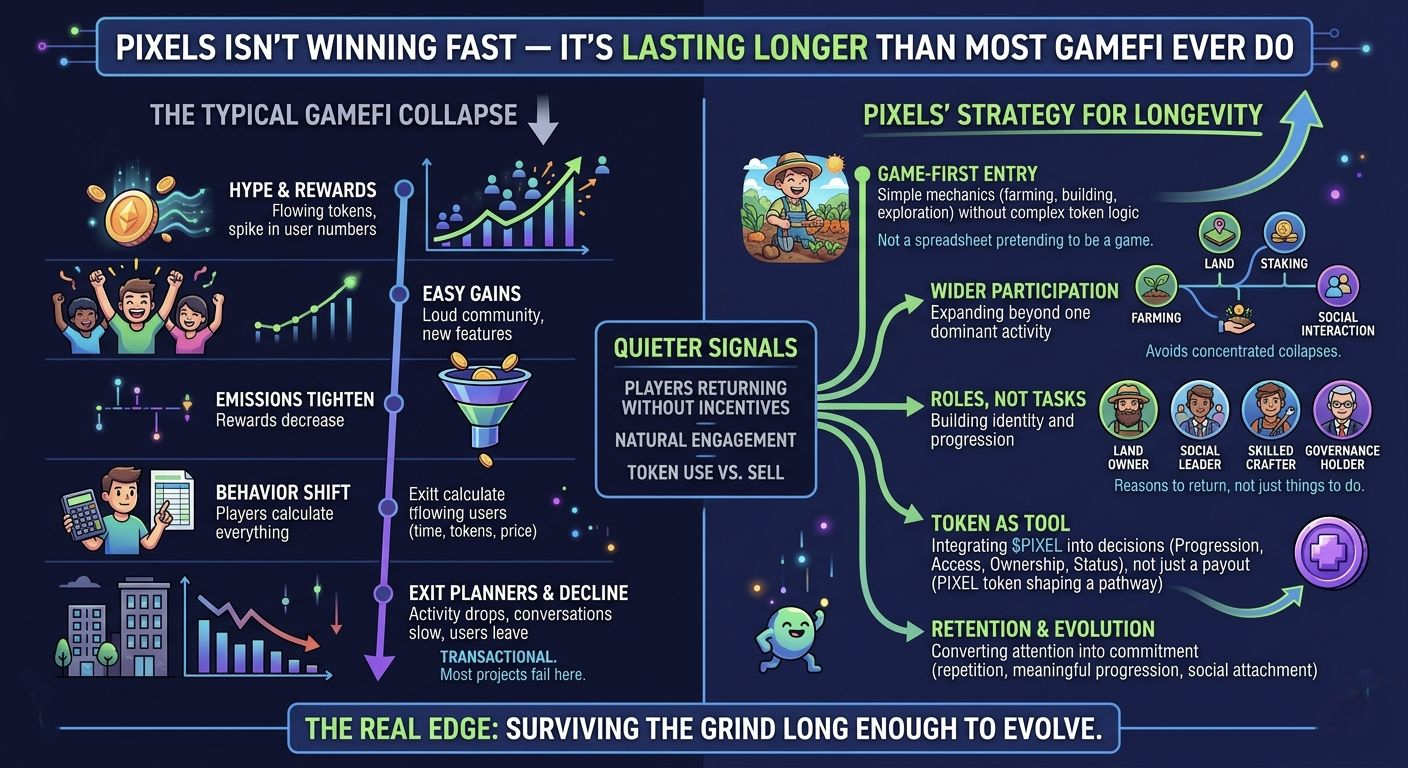
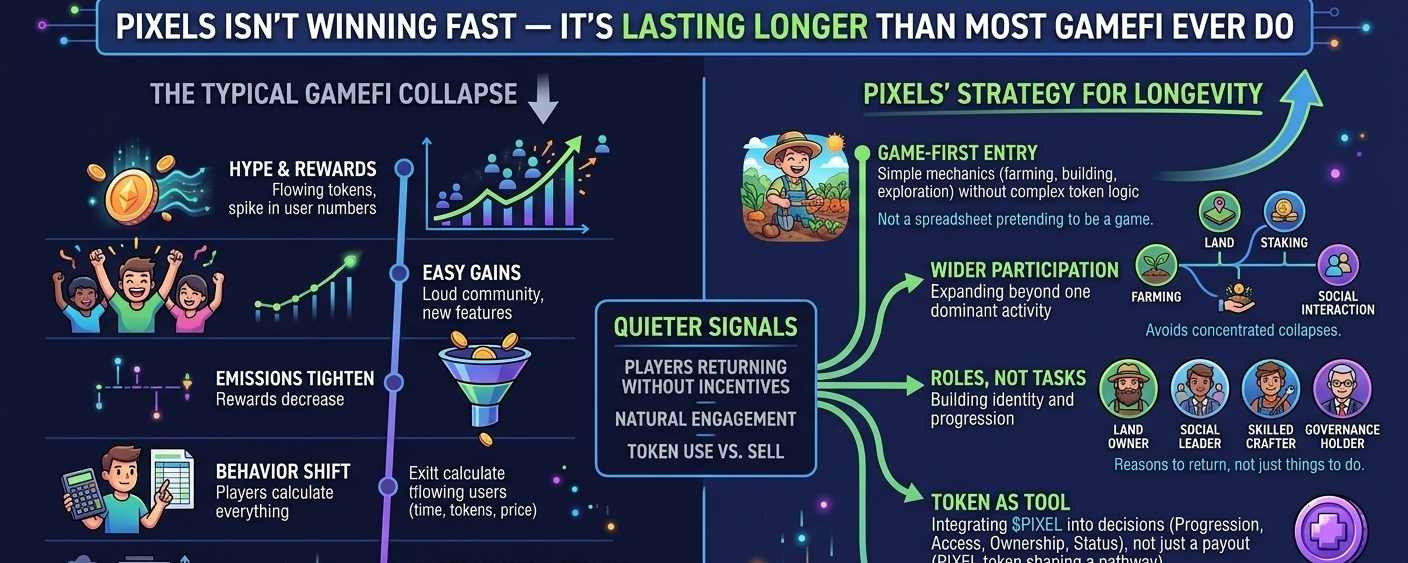
At the start, everything feels alive. Rewards are flowing, user numbers spike, communities are loud, and every new feature gets treated like progress. But then emissions tighten, the easy gains disappear, and suddenly the same system that attracted users starts exposing them. Activity drops, conversations slow, and the players who were “early believers” start acting more like careful exit planners. That’s the moment most projects fail, and that’s exactly why I don’t look at Pixels the same way most people do right now.
When people say Pixels is growing, I don’t disagree. The numbers are there. The visibility is there. The recognition is already ahead of most crypto games. But growth in GameFi has never been the hard part. You can manufacture growth with rewards, rent attention with campaigns, and inflate activity with incentives that look good on paper but don’t hold up under pressure. What I care about is something much less visible—what happens to user behavior when the reward loop starts tightening. That’s where the truth always shows up first.
Pixels didn’t start like a spreadsheet pretending to be a game, and that matters more than it looks. Most Web3 games make a critical mistake early by designing systems that feel like financial tools first and games second. You open them and immediately feel like you’re managing positions, not playing. Pixels avoided that, at least on the surface. It feels simple when you enter. You farm, build, explore, and interact without needing to decode layers of token logic. That softer entry point is one of the reasons it reached a broader audience.
But the real test always comes later. Every GameFi system eventually runs into the same structural issue: the moment you reward users, you also train them to optimize their exit. It doesn’t happen instantly. At first, people play casually. But over time, behavior shifts. Players start calculating everything—time spent, tokens earned, price movement, and opportunity cost. The game slowly turns into a spreadsheet. Once that happens, the emotional layer weakens, and the world starts feeling transactional. Most projects never recover from that transition.
This is where Pixels becomes interesting. Not because it has solved the problem—it hasn’t—but because it’s responding to it. Instead of pushing all rewards into one predictable loop, the system is gradually spreading incentives across different types of participation. Farming still exists, but it’s no longer the only center of gravity. There’s land, staking, social interaction, and multiple ways for users to position themselves inside the ecosystem. That doesn’t fix everything, but it changes how users behave.
What kills most GameFi economies is concentration. If one activity dominates, the entire user base collapses into that behavior. Farmers arrive, optimize, extract, and leave. Pixels is trying to avoid that by expanding participation. Not making it cleaner—making it wider. Different types of users are starting to form: players, land-focused participants, social users, capital-driven holders, and of course, reward farmers. The real question is whether enough of them stay.
The difference between a task and a role becomes critical here. A task gives users something to do. A role gives them a reason to return. Tasks end when rewards end. Roles build identity, attachment, and friction against leaving. Pixels feels like it’s slowly moving toward creating roles rather than just tasks. Not perfectly, but intentionally.
The staking layer highlights this shift. It’s not just about locking tokens and walking away. There’s an emphasis on participation still mattering, which signals that being present has value. But this also introduces risk. Some users don’t want to play. Some players don’t care about staking. New users may not understand the system. Depth can easily turn into confusion if not handled carefully.
There’s also a bigger issue at play—fatigue. Crypto users are tired. Too many campaigns, too many reward systems, too many loops that all start to feel the same. At some point, people stop getting excited and start filtering aggressively. Pixels isn’t just competing with other games—it’s competing with user exhaustion.
Recognition helps, but it doesn’t protect anything. Pixels has already achieved familiarity, which is rare. People know it, and it doesn’t feel hostile to new users. But being known is not the same as being durable. A project can stay visible while its actual user base quietly weakens underneath. That’s the part I always watch.
Strip away the campaigns, reduce the rewards, and let the noise fade—then look at what remains. Are players still showing up? Are interactions still happening naturally? Does the world feel alive without being pushed? That’s where real signal exists.
The token itself faces the same challenge every GameFi asset does. If users see it as a reward, they treat it like an exit. If they feel it as a tool, they integrate it into their behavior. Pixels needs PIXEL to feel less like a payout and more like something that shapes decisions—progression, access, ownership, and status. That shift is not easy, but it’s necessary.
Pixels still has a real chance because it didn’t start from pure financial aggression. It has a playable world, multiple layers of participation, and a user base that hasn’t disappeared after initial hype. That combination gives it room. But room is not victory—it’s just time.
The real test has already started. Pixels is past the phase where attention is enough. Now it has to convert attention into commitment. And commitment is much harder to earn. It comes from repetition, meaningful progression, social attachment, and systems that don’t constantly push users toward the exit.
What I’m watching now isn’t louder announcements or bigger campaigns. It’s quieter signals—players returning without incentives, social systems creating natural engagement, tokens being used instead of sold, and roles becoming more meaningful over time. Most importantly, I’m watching for retention without pressure.
Pixels isn’t proving itself through explosive growth. It’s proving itself by not collapsing under the same reward pressure that has already broken most GameFi systems. That doesn’t mean it succeeds. It means it’s still in the fight. And in this space, surviving the grind long enough to evolve might be the only real edge that matters.
