
Spent more time inside @Pixels recently, and I’ll be honest, it doesn’t feel like the same game anymore.
Not in a bad way. Just… different.
At the beginning, everything was simple. You plant, you harvest, you craft, you earn. That loop was familiar. Almost every Web3 game trains you to think like that. Do more actions, get more rewards, repeat until you extract enough value.
But somewhere along the way, Pixels started shifting that behavior without making a big announcement about it.
And that’s what makes it interesting.
You don’t notice it immediately. You feel it.
You start realizing that doing more doesn’t always mean progressing more. That’s where most players get confused. You can stay active all day, keep your farm running, keep crafting, and still feel like you’re not really moving forward in a meaningful way.
That’s not a bug. That’s the system working exactly how it’s designed now.
Pixels is no longer rewarding activity the way people expect. It’s filtering it.
There’s a big difference.
The biggest shift, in my opinion, came with how progression is now tied to access instead of just effort.
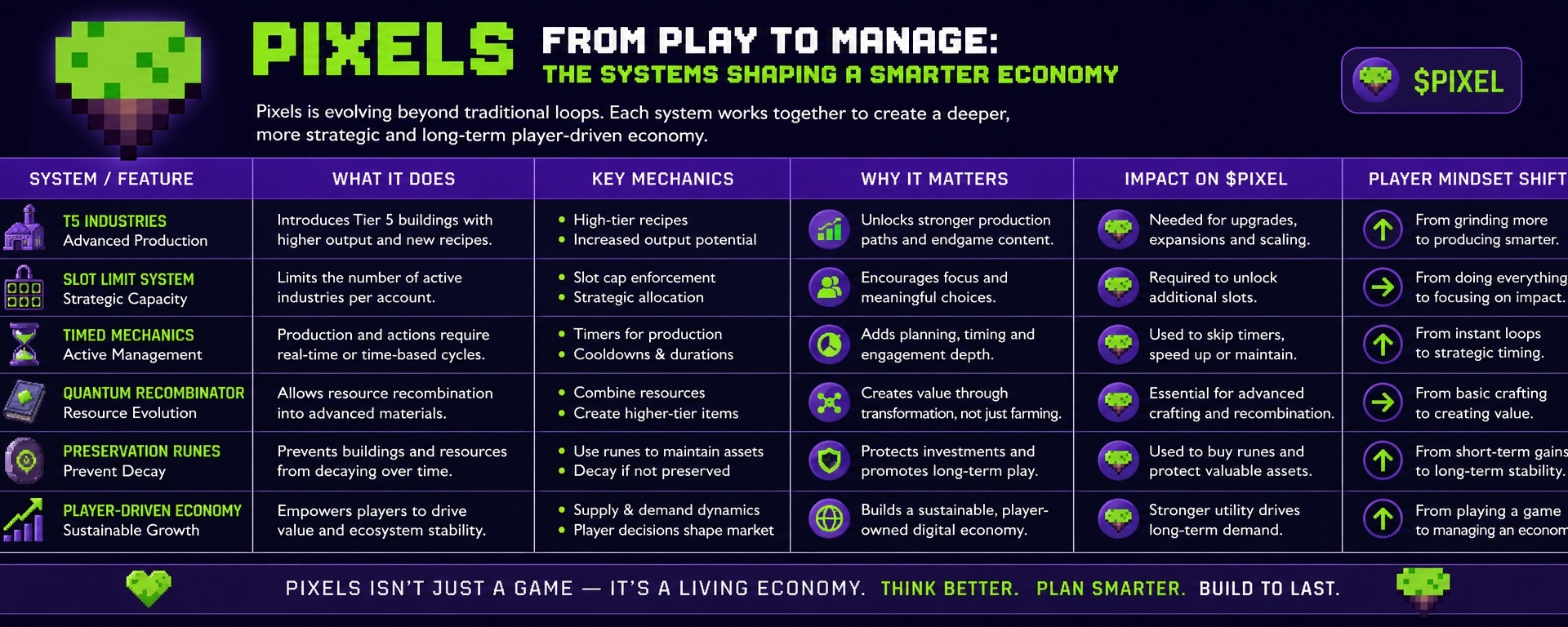
With T5 industries entering the system, everything started to feel more structured. These aren’t just upgrades. They introduce a completely different layer of gameplay where production is no longer unlimited or equal for everyone.
Now you have slot limitations. You have capacity constraints. You have timed mechanics.
And suddenly, the question is no longer “how much can I grind?”
It becomes “what do I actually have access to?”
That changes everything.
Not every player can run the same setup anymore. Not every player can scale at the same speed. And that naturally slows down the kind of behavior that used to dominate Web3 games, where players rush in, extract value, and move on.
Here, you actually have to think before you act.
Another thing that stood out to me is how time is now a real factor.
Before, you could treat most actions like instant loops. Now, with timed production and management systems, you have to plan around availability, efficiency, and scheduling.
It sounds simple, but it changes how you engage with the game.
You’re not just playing when you feel like it. You’re checking in with a system that continues moving even when you’re offline.
That creates a different kind of attachment.
It feels less like a game session and more like maintaining something over time.
Then there’s the part most people overlook… the role of $PIXEL.
Early on, a lot of players treated $PIXEL like any other in-game reward token. Earn it, maybe use a bit, and eventually sell.
That mindset doesn’t really work the same way anymore.
Now, pixel is tied to actual operational decisions.
You need it to expand. You need it to maintain certain advantages. You need it to stay competitive, especially as the system becomes more layered.
It’s not just something you farm. It’s something you allocate.
That shift alone moves the game away from short-term thinking and into something that feels a lot more strategic.
The introduction of systems like the Quantum Recombinator adds even more depth.
Instead of just producing and consuming resources, you now have ways to transform them into something more valuable. That adds another layer of decision-making.
Do you sell what you have now?
Or do you hold, recombine, and potentially create something more valuable later?
There’s no obvious answer, and that’s the point.
The game is forcing players to think in terms of trade-offs instead of simple loops.
And then you have Preservation Runes.
At first glance, they seem like a small feature. But when you look closer, they play a huge role in shaping behavior.
They introduce the concept of decay.
Not everything you build or own stays valuable forever unless you actively maintain it.
That one idea changes the entire mindset.
You’re not just growing anymore. You’re sustaining.
And sustaining requires planning, not just effort.
What’s interesting is how all these systems connect back to one core idea.
Pixels is trying to control how value is created and retained inside the ecosystem.
In most Web3 games, value is everywhere. Every action produces something. And because of that, inflation becomes inevitable. Players extract more than the system can handle, and everything eventually loses meaning.
Pixels is pushing in the opposite direction.
It’s limiting access. It’s introducing friction. It’s making rewards more conditional.
At first, that might feel restrictive.
But over time, it actually creates a more stable environment where decisions matter more than activity.
Another subtle shift I’ve noticed is how player behavior is evolving.
People are no longer just asking “what’s the fastest way to earn?”
They’re starting to ask “what’s the smartest way to position myself?”
That’s a completely different mindset.
It’s closer to managing an economy than playing a game.
And honestly, that’s where Pixels starts to stand out.
If you step back and look at the bigger picture, it feels like Pixels is slowly building something that sits between a game and an economic system.
It still looks casual on the surface. Farming, crafting, exploring. But underneath, there’s a structure forming that rewards patience, planning, and positioning.
Not just grinding.
Not just speed.
Understanding.
That doesn’t mean the system is perfect. It’s still evolving. There are still parts that feel experimental.
But the direction is clear.
Pixels is moving away from “play-to-earn” and toward something that feels more like “play-and-manage.”
And whether people realize it or not, that shift is going to define how the ecosystem grows from here.
For me personally, that’s what keeps it interesting.
Because now, every decision feels like it carries weight.
Do I expand now or wait?
Do I use my resources or convert them?
Do I focus on short-term gains or build something that lasts longer?
Those questions didn’t really exist before.
Now they’re everywhere.
And that’s probably the biggest change of all.
Pixels is no longer about doing more.
It’s about thinking better.