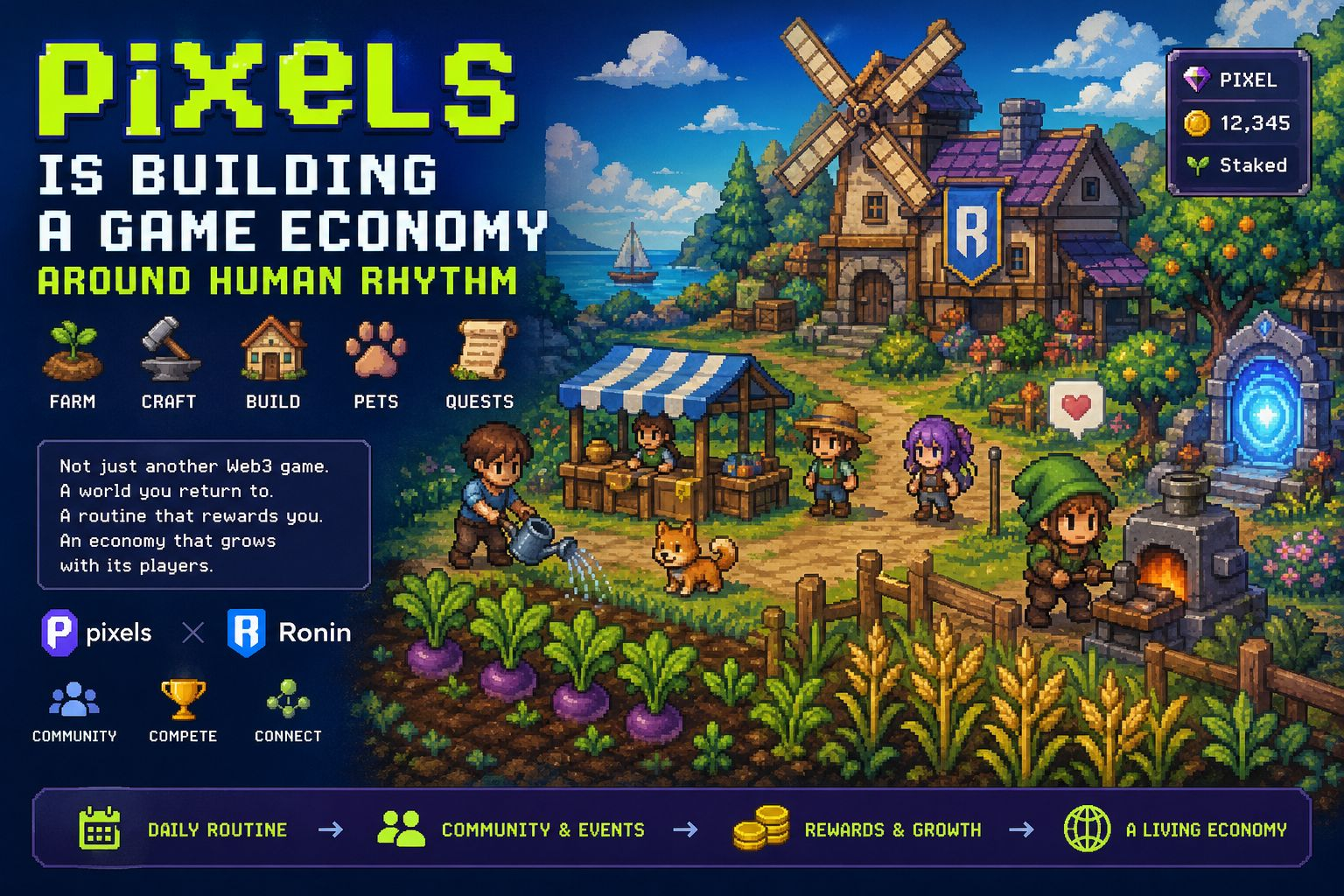
I do not think Pixels should be judged like a typical Web3 game. The mistake is looking at it and asking whether farming, crafting, land, pets, and quests are exciting enough on their own. That misses the point. Pixels is not trying to win by being the loudest game in crypto. It is trying to win by becoming part of a player’s routine.
That is a much more interesting ambition.
When I look at most Web3 games, I see projects trying to turn speculation into entertainment. The token is placed at the front of the experience, and the game is built around it like decoration. Players arrive already thinking like investors. They ask what the asset is worth, how fast they can recover capital, and when the reward curve starts to weaken. At that point, the magic is already damaged. The world becomes a dashboard.
Pixels feels different because it does not need the player to start there. Its strength is ordinary behavior. You plant something. You harvest something. You craft something. You check what is happening. You return the next day. None of this sounds revolutionary, but that is exactly why it matters. The best consumer products often do not feel like technology after a while. They feel like habits.
My view is that Pixels’ real asset is not only its token or its land economy. It is the pattern of return it creates. In crypto, attention is usually rented through incentives. Pixels is trying to make attention repeatable through familiarity. That is a quieter form of power, but possibly a more durable one.
This is why recent ecosystem activity matters. Union-style competition, staking across connected experiences, and Ronin’s broader gaming push all point toward the same idea: Pixels is becoming less about isolated farming and more about coordinated participation. The player is not just producing resources inside a game. The player is slowly becoming part of an attention network.
That is the angle I find most important. Pixels may be one of the few Web3 games where the economy works better when the player does not feel forced to think about the economy every minute. The more natural the routine feels, the more meaningful the economic signal becomes. A player who returns only for yield is fragile. A player who returns because the world has become familiar is much harder to replace.
But this also creates the project’s biggest risk. If Pixels becomes too optimized, it could lose the very human texture that makes it interesting. Every open economy eventually attracts people who search for the cleanest strategy. They find the best route, the fastest output, the strongest reward pattern. If that mindset dominates, the world stops feeling alive. It becomes efficient, but thin.
That is why Pixels has to protect difference. It needs the casual farmer, the social player, the trader, the collector, the builder, the guild organizer, the grinder, and the person who logs in just because the place feels comfortable. A healthy game economy is not one where everyone behaves perfectly. It is one where many imperfect behaviors can coexist.
To me, that is where Pixels has a real chance to stand apart. It is not selling a fantasy that every player will become an owner, investor, or strategist. It is building around something more believable: people like places that reward their presence. Not every action has to feel financial. Not every reward has to be maximized. Sometimes the strongest retention comes from the simple feeling that your small daily actions are part of a larger world.
Ronin gives Pixels a useful environment for that experiment. As Ronin continues positioning itself around gaming distribution and ecosystem contribution, Pixels sits in a strong place if it can keep converting casual activity into durable participation. The game does not need to prove that Web3 can make play more financial. It needs to prove that ownership, rewards, and coordination can sit quietly behind play without suffocating it.
That is the personal read I keep coming back to: Pixels is not important because it makes farming onchain. It is important because it understands that the future of Web3 gaming may depend on making crypto feel less like crypto.
The winning game economy will not be the one that screams value at the player. It will be the one that gives players a reason to return before they even calculate the value.
Pixels, at its best, is moving in that direction.