
I’ve spent enough time in this market to know that what draws me in isn’t excitement anymore—it’s restraint. The projects that don’t rush to prove themselves, the ones that feel almost indifferent to attention. That’s usually where I start paying closer attention, even if I don’t fully trust what I’m seeing.
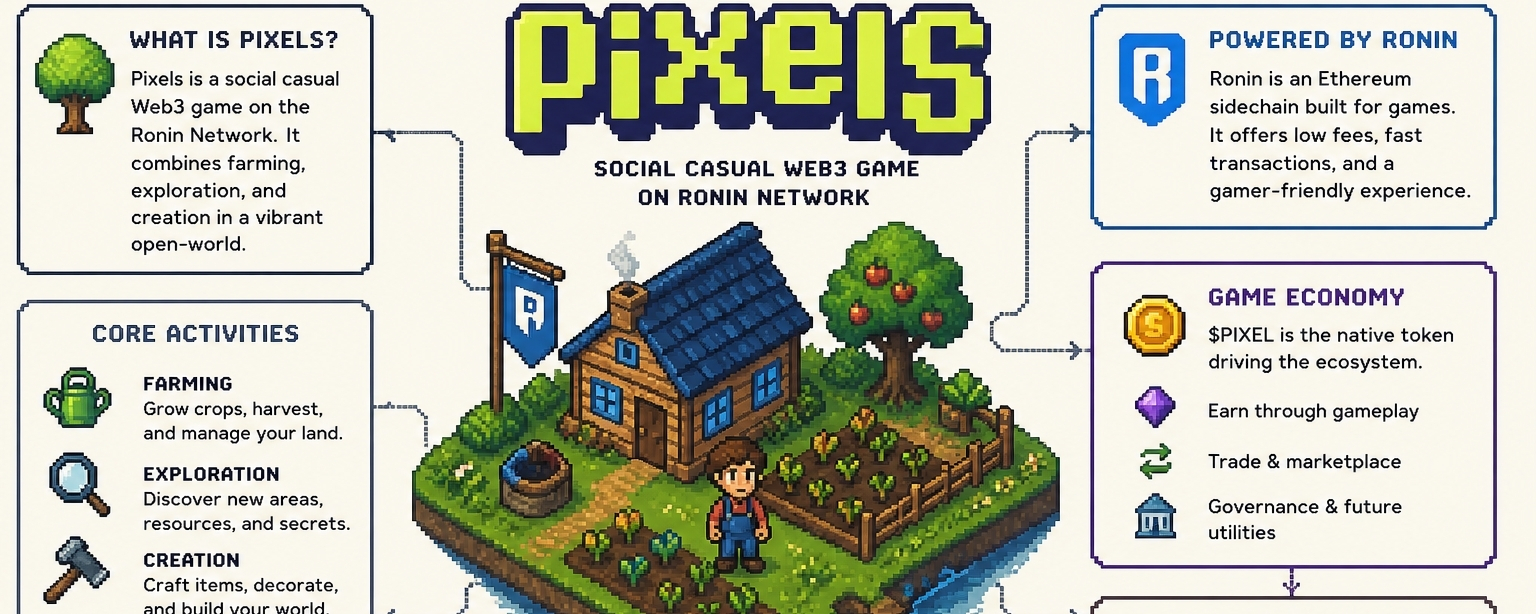
Pixels sits somewhere in that space for me. It doesn’t try too hard. A simple world, familiar mechanics, farming, small interactions, a sense of routine. Nothing about it feels urgent, and that alone makes it stand out more than it probably should. In a market built on speed and noise, something slower can feel almost out of place.
But I’ve learned not to confuse calm with depth.
There’s always a moment, usually after the first wave of curiosity passes, where the real structure begins to show. That’s the part I wait for. Early on, everything feels open. People explore, experiment, engage without thinking too much about outcomes. But over time, behavior starts to settle. Patterns form. And those patterns tell a more honest story than any roadmap ever could.
With Pixels, I find myself watching that shift very closely. Not what the game offers, but how people move inside it. Do they log in out of habit, or out of interest? Do they interact with each other in a way that feels natural, or does everything slowly revolve around efficiency?
Because I’ve seen how quickly things can tilt. A system doesn’t need to push users toward extraction directly. It just needs to make it slightly more rewarding than everything else. From there, the shift happens on its own. The world might still look the same on the surface, but the feeling changes. It becomes tighter, more calculated.
And once that happens, it’s hard to reverse.
There are moments in Pixels where it feels like it might avoid that, or at least delay it. The slower pace, the emphasis on small actions, the idea of just showing up and doing something simple. It creates a kind of quiet rhythm that’s rare in this space. For a brief moment, you can almost forget you’re inside a tokenized environment.
But that feeling is fragile. It depends on balance, and balance is one of the hardest things to maintain in crypto. Incentives have a way of reshaping everything over time, even when they’re introduced carefully. Especially when they’re introduced carefully.
I think about retention more than growth now. Growth is easy to manufacture, at least in the beginning. Retention is where things become real. It’s where you find out if the experience can stand on its own, without constant reinforcement. Whether people come back because they want to, or because they feel like they’re missing something if they don’t.
That difference matters more than anything else, but it’s also harder to measure.
Pixels feels like it’s trying to build around that idea, even if it hasn’t fully proven it yet. There’s an awareness, or at least an attempt, to create something that isn’t purely transactional. But intention doesn’t always survive contact with reality. I’ve seen too many systems slowly drift, not because they were poorly designed, but because the environment around them changed.
Markets get louder. Expectations rise. Users adapt. And eventually, even the most relaxed systems start to bend.
So I don’t look at Pixels as something that will either succeed or fail in a clear way. It’s more gradual than that. It will evolve, like everything else here does. The question is whether it can hold onto that initial feeling—the quiet, the simplicity, the sense that not everything needs to be optimized.
I’m not convinced it can. But I’m not dismissing it either.
For now, I just keep watching. Not the updates, not the token, but the small things. How people behave when there’s nothing forcing them to stay. How long that quiet rhythm lasts before something disrupts it.
That’s usually where the real story begins to show.
And it’s still too early to tell how this one ends.