

I keep coming back to one simple question when looking at Web3 gaming: can incentives make a game stronger, or do they slowly replace the reason people came to play in the first place?
That question feels important for Pixels because the project is not presenting itself as just another farming game with a token attached to it.
Pixels became widely known in Web3 gaming because it gained strong daily active user numbers and built a recognizable game experience around farming, social activity, and progression.
But the bigger idea behind PIXEL appears to be much wider than one game. The whitepaper frames Pixels as an attempt to rethink play-to-earn itself and turn it into a more serious growth and user acquisition model for gaming.
That is a different kind of ambition.
Traditional play-to-earn had a clear problem. It attracted users with rewards, but in many cases, those rewards became the product. When that happens, players stop behaving like players and start behaving like short-term extractors.
The game economy gets pressure, engagement quality becomes weaker, and the publisher ends up rewarding activity that may not actually create long-term value.
Pixels seems to understand this weakness directly. Its strategy is not simply to pay users for showing up. The goal is to identify which player actions genuinely improve the ecosystem and then reward those actions more intelligently.
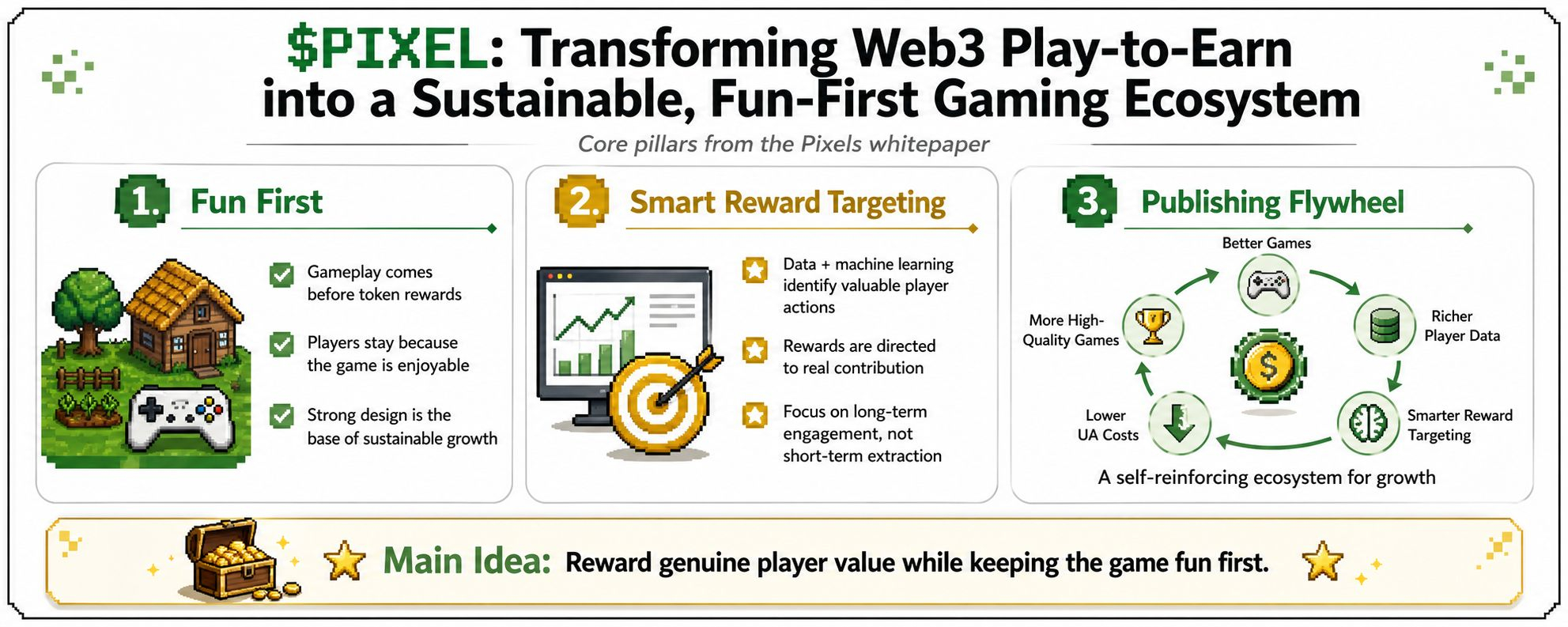
For me, the strongest part of the PIXEL approach is the “fun first” principle. It sounds simple, but in Web3 gaming it is often the part that gets ignored. A game cannot survive only on token mechanics. A player may arrive because of rewards, but they stay because the game gives them a reason to care. Pixels’ whitepaper makes this point clearly: no matter how the application layer is monetized or grown, there must be an intrinsic motivator. In gaming, that motivator is enjoyment.
This matters because Web3 often tries to solve game growth through financial engineering before solving the game itself. Pixels is taking a more grounded view.
The token economy can support growth, but it cannot replace design quality. If the game is not enjoyable, incentives become a temporary patch. If the game is enjoyable, incentives can become a tool for deeper engagement.
The second pillar, smart reward targeting, is where PIXEL becomes more interesting as infrastructure rather than only a game token. Pixels describes its reward system as data-driven, almost like a next-generation ad network.
That comparison is important. In traditional gaming, publishers spend heavily on user acquisition, but not all acquired users create equal value. Some player leave quickly, some engage deeply, and some become part of the game’s social and economic foundation.
Pixels wants to use large-scale data analysis and machine learning to understand these differences. Instead of distributing rewards blindly, the system aims to direct incentives toward actions that support long-term value.
That could mean rewarding behavior connected to retention, contribution, engagement quality, or other signals that show a player is strengthening the ecosystem rather than only extracting from it.
This is where play-to-earn starts looking less like a giveaway model and more like a performance-based growth system. In a healthier version of P2E, rewards are not just expenses.
They become targeted investments. The question is no longer “how much can we pay players?” but “which player actions deserve rewards because they improve the game economy?”
That distinction is very important.
The publishing flywheel adds another layer to the strategy. Pixels is not only thinking about its own farming game.
The whitepaper describes a cycle where better games attract richer player data, richer data improves reward targeting, better targeting reduces user acquisition costs, and lower acquisition costs attract more high-quality games into the ecosystem. If this works, Pixels becomes more than a single title. It becomes a publishing and growth engine for games that want smarter incentive design.
I think this is one of the more practical Web3 gaming angles because it connects token incentives to a real business problem: user acquisition. Gaming companies already spend heavily to attract and retain players.
If Pixels can prove that token-based incentives can lower those costs while improving player quality, then Web3 gaming has a much stronger argument for mainstream relevance.
The important word here is “prove.” Many Web3 gaming projects have spoken about ownership, rewards, and player economies, but the real test is whether those ideas improve the game experience and business model at the same time.
Pixels appears to be positioning PIXEL around that exact test. It is not enough for rewards to be popular. They have to be measurable, targeted, and sustainable.
From a personal perspective, I see PIXEL as a project trying to move play-to-earn away from the old extraction image.
The better version of P2E is not about paying everyone equally for repetitive activity. It is about aligning rewards with behavior that helps the ecosystem grow. That means good players, good data, strong retention, and better game design all become part of the same loop.
There is still uncertainty, of course. Data-driven reward systems depend on execution. Machine learning and analytics can help identify valuable behavior, but the system still has to avoid manipulation, farming abuse, and reward patterns that damage the game economy.
Fun-first design is also easy to state and difficult to maintain over time. A game must keep evolving so that rewards support engagement instead of becoming the only reason to log in.
But the direction is sensible.
Pixels is not treating Web3 gaming as a shortcut. It is treating Web3 as a tool that can improve how games grow, reward users, and build stronger player communities. If the project can keep gameplay enjoyable while making incentives more precise, then $PIXEL may represent a more mature version of play-to-earn.
The real opportunity is not just earning inside a game. The bigger opportunity is building a gaming ecosystem where fun brings players in, smart rewards guide useful behavior, and data helps publishers grow with less waste.
That is why the PIXEL strategy feels worth studying. It is not only about a token economy. It is about whether Web3 can finally make play-to-earn sustainable without forgetting that games must still feel like games.
