
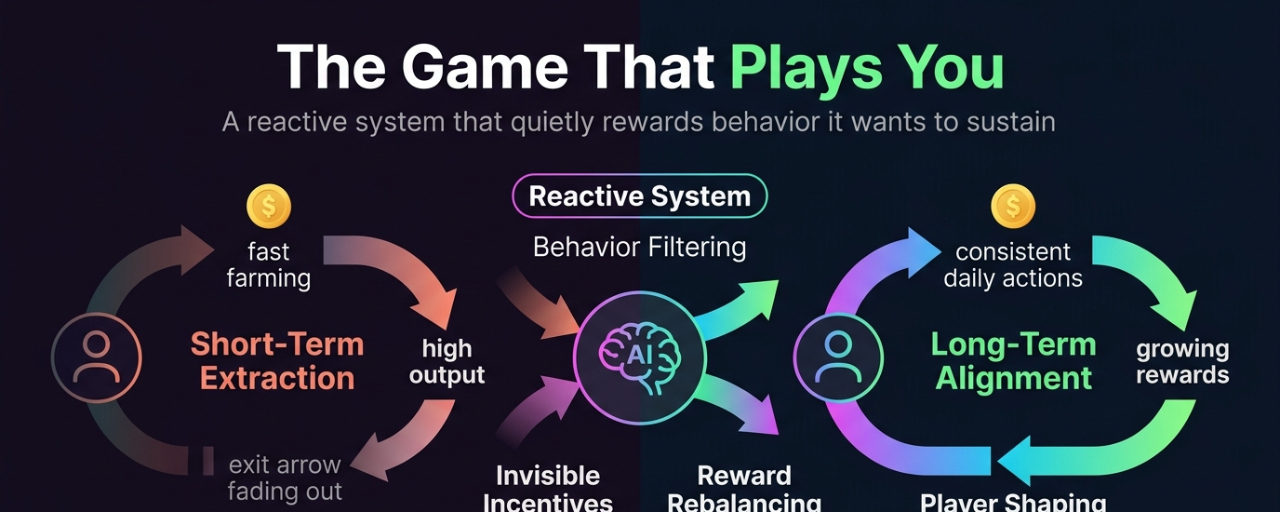
You think you’re playing the game until the game starts quietly choosing who you become.
At first, Pixels feels predictable. Plant, harvest, repeat. It’s the kind of loop you don’t question because you’ve seen it before especially in Web3 games where the goal is simple: optimize early, extract fast, move on.
But something shifts.
Not suddenly. Not dramatically. Just enough to make you pause.
You try the same routine on different days, expecting the same outcome. Sometimes it works. Sometimes it doesn’t. Not in a random way more like the system is nudging things behind the scenes. Adjusting. Rebalancing. Watching.
And that’s when it hits you: this isn’t a fixed system.
It’s reacting.
The moment that realization sets in, the whole idea of “reward” starts to feel unstable. It’s no longer a clean equation of action and outcome. It feels more like the system is asking a quiet question over time: is this behavior worth encouraging?
And the answer isn’t instant.
It builds.
That’s where $PIXEL starts to feel different. On the surface, it still behaves like any other token price swings, sentiment cycles, all the usual noise. But inside the game, it becomes something else. A feedback tool. A way for the system to redistribute attention toward players who don’t just show up but stay.
Take a simple example.
Two players farm.
One logs in, maximizes output for a few days, and disappears. The other returns daily, does less aggressively, but keeps showing up. At first, the first player wins. Better yield. Faster gains.
But over time?
The second player starts to feel favored.
Not obviously. Just enough that their actions seem to matter more. Their loop feels smoother. Their effort compounds differently.
And that’s uncomfortable.
Because it means the game isn’t neutral.
It’s selective.
The more precise the system becomes at rewarding “useful” behavior, the more it quietly filters players. Some patterns get amplified. Others fade not because they’re wrong, but because they don’t fit what the system wants to sustain.
You still have freedom. You can play however you want.
But the outcomes won’t treat you equally.
That’s the tradeoff.
And maybe that’s necessary. Because systems without filters eventually break. If everyone extracts without contributing to continuity, the loop collapses. So instead of blocking behavior, the system just stops feeding it.
No punishment. Just quiet neglect.
That’s the part that sticks with me.
Because it means the real game isn’t farming or earning it’s aligning. Not consciously, but gradually. You adapt. You adjust. You start playing in ways that “feel right,” even if you can’t explain why.
And without realizing it, you’re no longer testing the system.
The system is testing you.
What if the real value in a system like this isn’t what it gives you but what it keeps choosing to give again and again without breaking?
I keep going back and forth on this.
Part of me respects the design it feels smarter than the usual extract-and-dump loops.
But another part of me isn’t fully comfortable with being shaped this quietly.
I’m still not sure if I’m playing the game or slowly learning how to be the kind of player it wants.