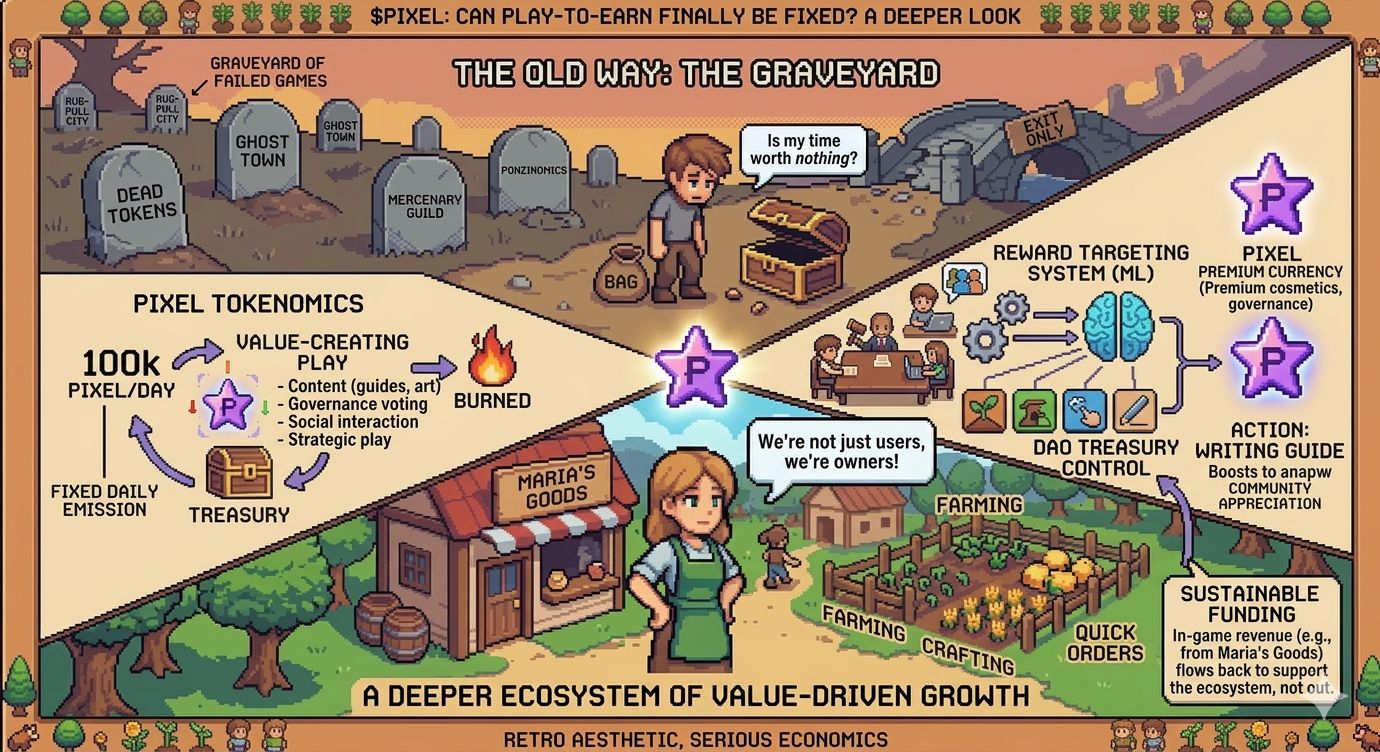
There is a graveyard of games that promised to change everything. They handed players tokens, called it ownership, and watched millions pour in chasing the dream of getting paid to play. Then the tokens inflated, the rewards dried up, and everyone left. The game was never the point the exit was.
Pixels looked at that graveyard and decided to build something different.
It started as a farming game. Simple, pixelated, easy to dismiss. But underneath the retro aesthetic was a more serious question that the founders were genuinely trying to answer: what would it actually take to make play-to-earn work not for a season, not for a bull market, but as a permanent, self-sustaining model for how games grow and reward their players?
The answer they landed on starts not with tokens or economics, but with something the industry had been quietly skipping over. The game has to be fun. Genuinely, intrinsically, stay,up,too,late fun. Not fun,because,you,are,earning,
but fun,because,you,cannot,stop. That sounds obvious until you look at how many Web3 projects built their entire user acquisition strategy around financial incentives and called it a game. Pixels made fun non-negotiable a design principle rather than a nice-to-have.
Maria opened Pixels for the first time when a friend told her he was covering his grocery bill every month just by playing a few hours a day. She did not believe him. She assumed it was the same old scheme play for a few days, collect some tokens, then watch it all collapse. But she made an account anyway, claimed a small piece of land, and started playing...
The first week she just learned farming. Plant seeds, water them, harvest. A simple loop. But then she noticed her neighbor had built a shop on their land. Someone else had decorated their home so beautifully that players came just to look at it. Another person was completing quests for other players and earning PIXEL doing it. This was not just farming. It was an entire world where everyone had chosen their own path through it.
A week in, Maria realized she was staying up late not because she was earning but because her shop had a pending order for the next morning and in her mind that was a responsibility she had taken on...
But fun alone does not solve the economics. That required something more unusual. The team built what they describe as a next-generation advertising network, except instead of serving ads, it serves rewards. Using machine learning across large pools of player behavior data, the system identifies which actions inside the game actually create long-term value for the ecosystem. Not all play is equal. A player who builds, creates, and engages the community is worth more than one who logs in, farms tokens, and sells. The infrastructure is designed to know the difference and to reward accordingly.
This is where the $PIXEL token enters the story. It is not the token you grind for doing daily chores. It is the premium currency that signals status, unlocks the best cosmetics, and sits just out of easy reach. Every day, new PIXEL are minted and distributed to players whose behavior the system has identified as genuinely valuable. No more, no less. The emission is fixed, the supply is predictable, and on the other side of the ledger, the majority of tokens that flow into the treasury through in-game purchases are burned. The design is not hoping for scarcity. It is engineering it.
Maria's PIXEL earnings in her first month were not much. She was farming, completing quests, but her account sat behind the people putting in six hours a day. Then she did something the system valued more than hours she wrote a guide. For new players, explaining how to start, where to go, what to avoid. The guide spread through the community and people kept sharing it weeks after she posted it.
The following week her rewards had quietly increased. She had not asked for it. She had not applied for anything. The system had simply noticed that she had built something which was pulling people in and keeping them there. And that was exactly what it had been waiting for.
What makes the broader vision interesting is the flywheel the team has constructed around all of this. As more games join the Pixels ecosystem, more player data accumulates. As data accumulates, the reward targeting becomes more precise. As targeting becomes more precise, the cost of acquiring a genuinely engaged user falls. As acquisition costs fall, more high-quality games are drawn to build on the platform. Each cycle feeds the next, and the whole system grows denser and more efficient with time.
Maria's friend had chased the price. He had watched numbers, tracked charts, and made his decision based on where the token was going rather than what the game was doing. Maria had never thought about it that way. She was still playing — not because she was protecting anything, but because her shop was still running, her regulars were still showing up, and there was a new quest unlocking tomorrow that she had been looking forward to for three days.
That is the difference. He was in the price. She was in the game.
Everything else the vesting schedules, the burn mechanics, the machine learning is infrastructure waiting for a game worthy of it. If the fun holds, the flywheel spins.
Maria is still playing. And for now, that is enough.#pixel @Pixels