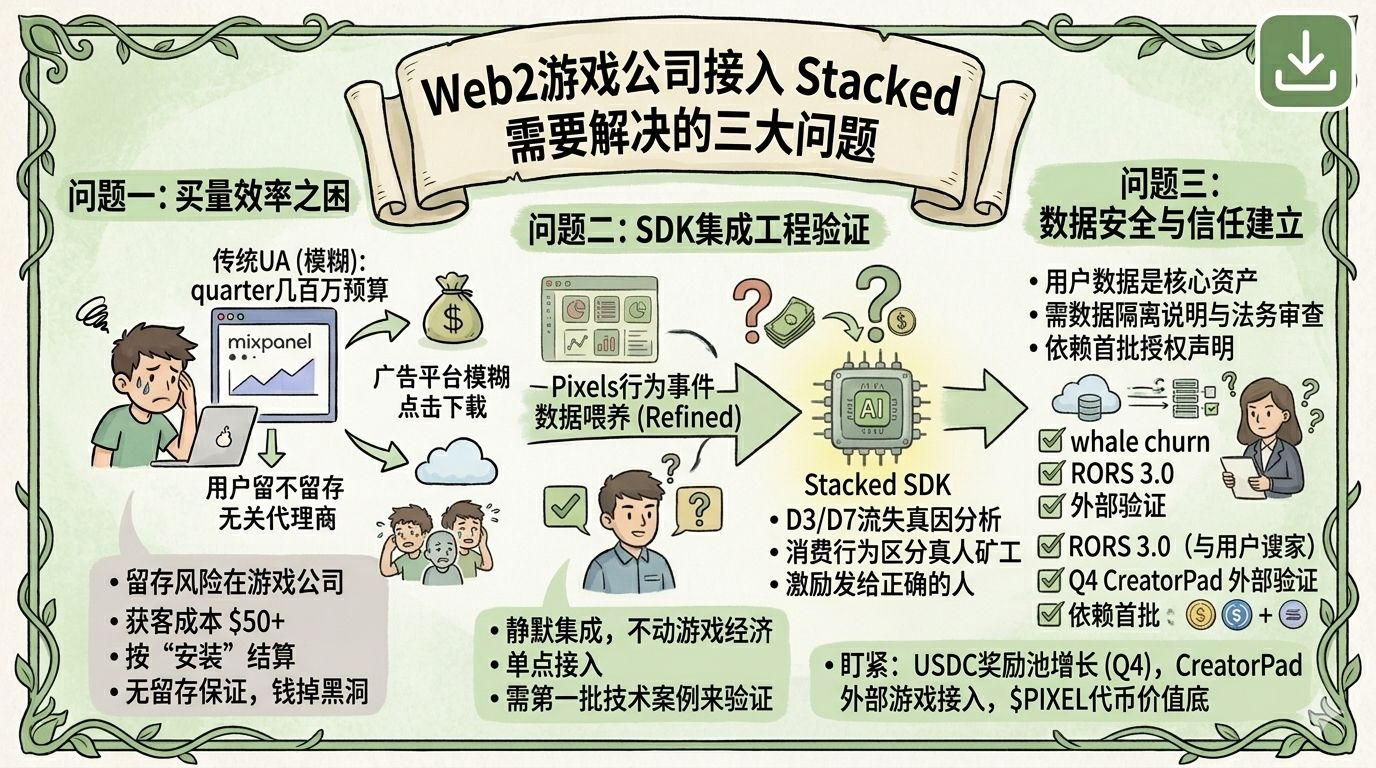

Sometimes I think, if I were the operations head of a mid-sized mobile gaming company and Stacked's sales team approached me, what would I ask?
After thinking it through, I've come up with three questions.
First question: Why change the existing user acquisition strategy?
Gaming companies are buying users on Facebook and Google, and the customer acquisition cost for a user has now exceeded fifty bucks in many cases (this is real industry data, not an exaggeration). Once the money is spent, the user installs the game, and the payout is settled at that moment; whether they stick around is another story. Stacked is stepping in to disrupt this logic: shifting the payout point from 'installation' to 'retention', meaning game companies only pay for users who actually stick around. This logic is sound; any rational operations head can grasp it.
The first issue isn't really a barrier.
The second issue: How much will the SDK integration affect my stuff?
This is the engineering team's concern. The integration with Stacked is a silent one, tracking behavioral events without messing with the game's economic model, relying on a single integration point. This design is clever, but the engineering team needs to validate for themselves the difference between 'clever' and 'can it really be that simple.' Once the contract is signed, the work order comes through, and they start integrating, if they find it more complex than expected, the whole project will start to delay.
The second question needs public technical cases from the first batch of games to answer; this is essentially an engineering validation issue. The answer will be there, but it will take time.
The third issue, and the hardest one: once I give my data away, who can see it, and what can it be used for?
The user behavior data of game companies is a core asset. Where do players drop off, what kind of incentives improve retention, and when are the peak activity periods? This data is accumulated over time and cost, not just something you casually let a third-party platform read. Once Stacked's SDK is plugged in, it starts collecting behavioral events. There's no issue on the product side, but the data clauses in the contract need to be clear: what can be read, where the data is stored, whether it will be used as a reference for other integrated games, and how long before it gets deleted.
Looking at the three issues together: the first is a cognitive issue, which has been resolved; the second is an engineering issue, which will be solved; the third is a trust issue, needing time and cases to establish.
But whether these three issues get solved quickly isn't just some abstract business analysis. It directly determines how high the ceiling is for the USDC split that the $PIXEL stakers can get. The more game companies that integrate with Stacked, and the more genuine retention there is, the bigger the pool the staking pool can distribute. This is what I need to keep an eye on.