
Most people misunderstand projects like Pixels at first glance.
They look at the surface.
They see a simple loop. Farming, crafting, trading.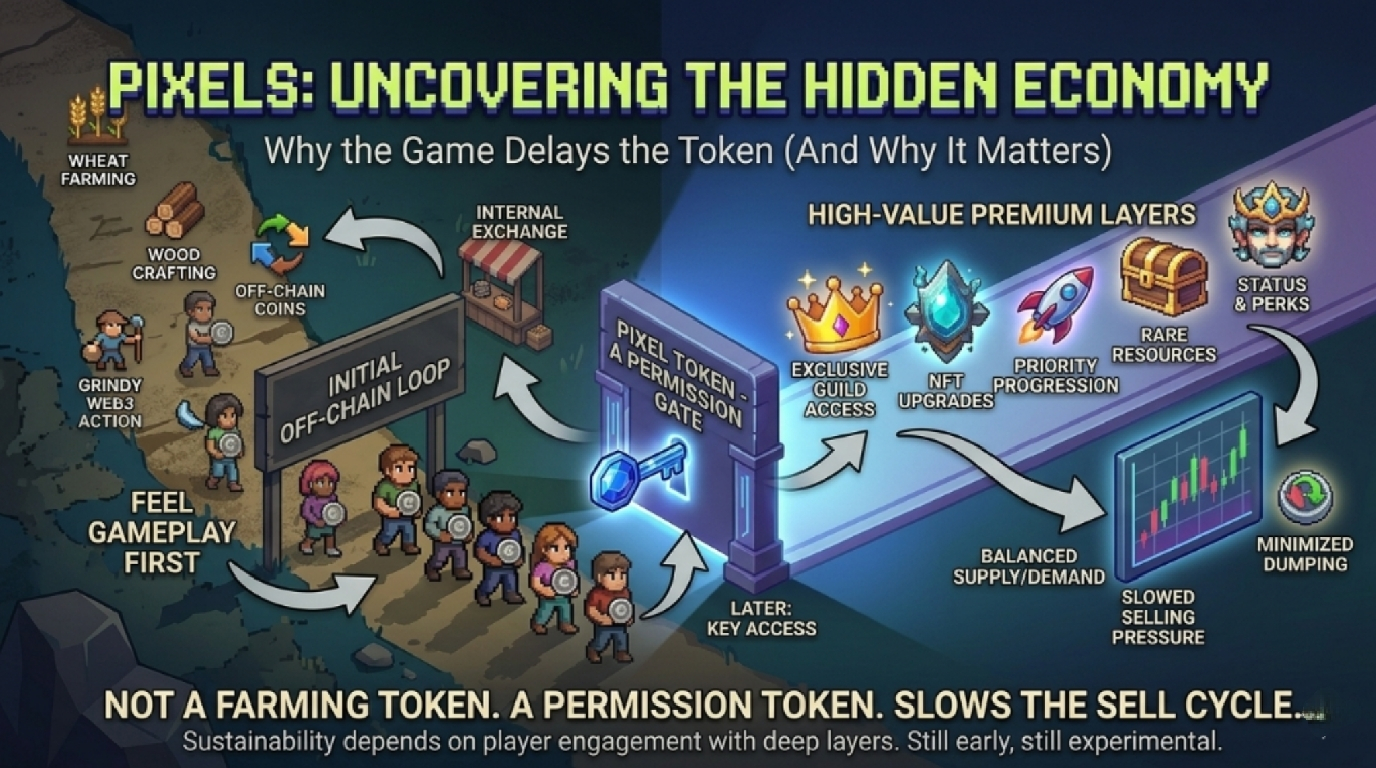
And then they assume it is just another Web3 game built to extract attention until the token loses value.
That assumption is usually correct in this space.
But Pixels does something slightly different, and it is easy to miss if you are only looking for quick signals.
The key idea is that the game does not immediately expose the importance of the PIXEL token.
Instead, it delays it.
When you start playing, you are not thinking about the token at all.
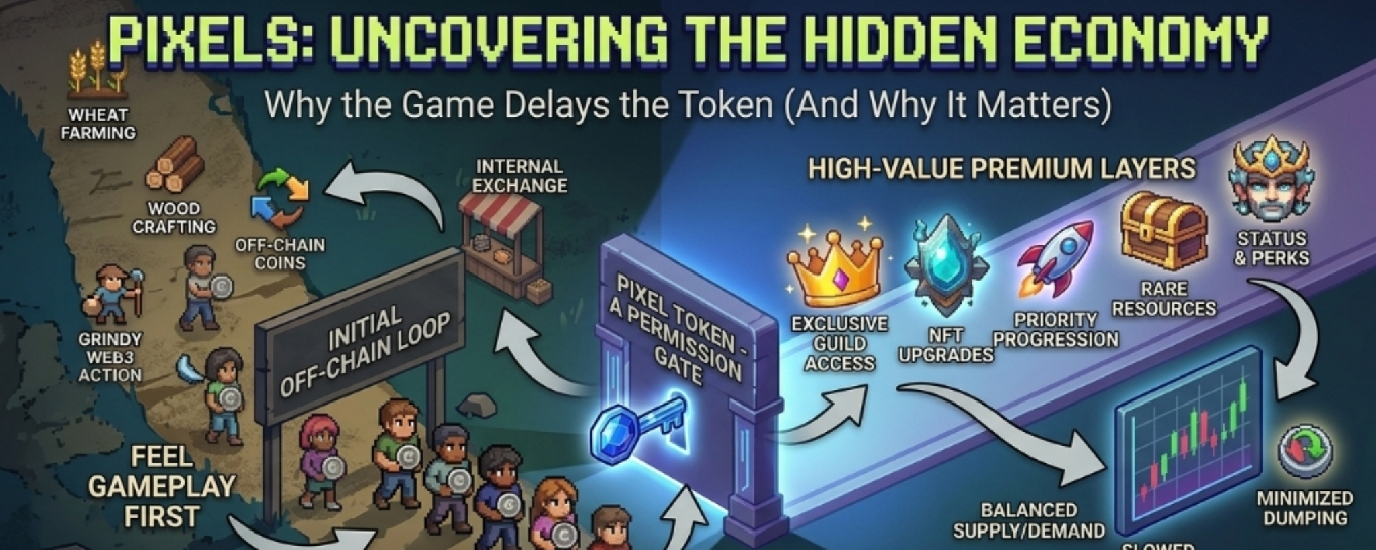
You are interacting with systems that feel familiar. You gather resources, complete tasks, and use in-game currencies that are not directly tied to the blockchain. These off-chain coins handle most of the basic activity inside the game.
That design choice is not accidental.
It creates a separation between everyday gameplay and financial value.
In many earlier Web3 games, this separation did not exist. The token was integrated directly into every action. Players would earn tokens constantly through basic gameplay loops. Over time, this created a predictable pattern. Players farm rewards, convert them into liquid tokens, and then sell them on the market.
The result was constant downward pressure.
No matter how engaging the game was, the economy struggled to sustain itself because the primary behavior it encouraged was extraction.
Pixels tries to break that cycle.
Instead of making PIXEL the default reward for everything, it positions the token as something you encounter later. Something tied to progression rather than repetition.
Basic gameplay remains off-chain.
But meaningful progression starts to introduce the token.
This is where things shift.
PIXEL becomes relevant when players want access to higher-value layers of the system. That includes upgrading NFTs, unlocking premium features, gaining access to certain guild structures, and improving efficiency or status within the ecosystem.
At that point, the token is no longer just a reward.
It becomes a gate.
This changes user behavior in a subtle but important way.
If a token is earned passively and frequently, it is treated as income.
If a token is required for access and upgrades, it is treated as a resource.
Those are two very different mindsets.
Pixels leans toward the second.
By doing this, it reduces the immediate incentive to sell. Not everyone is constantly earning PIXEL, and even those who do may choose to use it within the system rather than exit it.
This naturally slows down inflation and selling pressure.
It also introduces friction, which in this context is not necessarily a bad thing. Friction forces decisions. Players have to choose whether to spend, hold, or exit. That tends to create more stable economic behavior compared to systems where rewards are automatic and continuous.
However, this structure is not a guaranteed solution.
It simply shifts where the pressure appears.
Instead of constant low-level selling, the system risks concentrated selling at higher progression tiers. As more players reach the stage where PIXEL is required, demand increases, but so does the potential for distribution. Early adopters or efficient players may still accumulate and eventually sell.
The difference is timing, not elimination.
Another important factor is whether the gameplay itself can sustain interest without relying on token incentives.
Because Pixels intentionally hides the token early on, it depends heavily on the game being engaging enough on its own. If players lose interest before reaching the deeper layers where PIXEL becomes relevant, the entire structure weakens.
On the other hand, if players stay and progress, the delayed introduction of token utility can feel more natural and less extractive.
This is where Pixels stands apart from many failed Web3 experiments.
Those projects often led with financial incentives and hoped gameplay would catch up later. Pixels does the opposite. It leads with gameplay and introduces financial elements gradually.
It is a more traditional game design philosophy applied to a blockchain environment.
That said, the model still carries risk.
The economy is controlled, but not immune.
The token has utility, but not guaranteed demand.
The system reduces dumping, but does not remove it.
Ultimately, the long-term sustainability depends on balance.
If PIXEL remains useful without becoming overly required, the system can maintain equilibrium.
If it becomes too central, it risks turning into the same extractive loop it initially avoided.
Right now, Pixels feels more thoughtful than most projects in its category.
It shows an understanding of past failures and attempts to design around them.
But it is still an evolving system.
Not broken.
Not proven either.
Somewhere in between.
And that is exactly why it is worth paying attention to.