
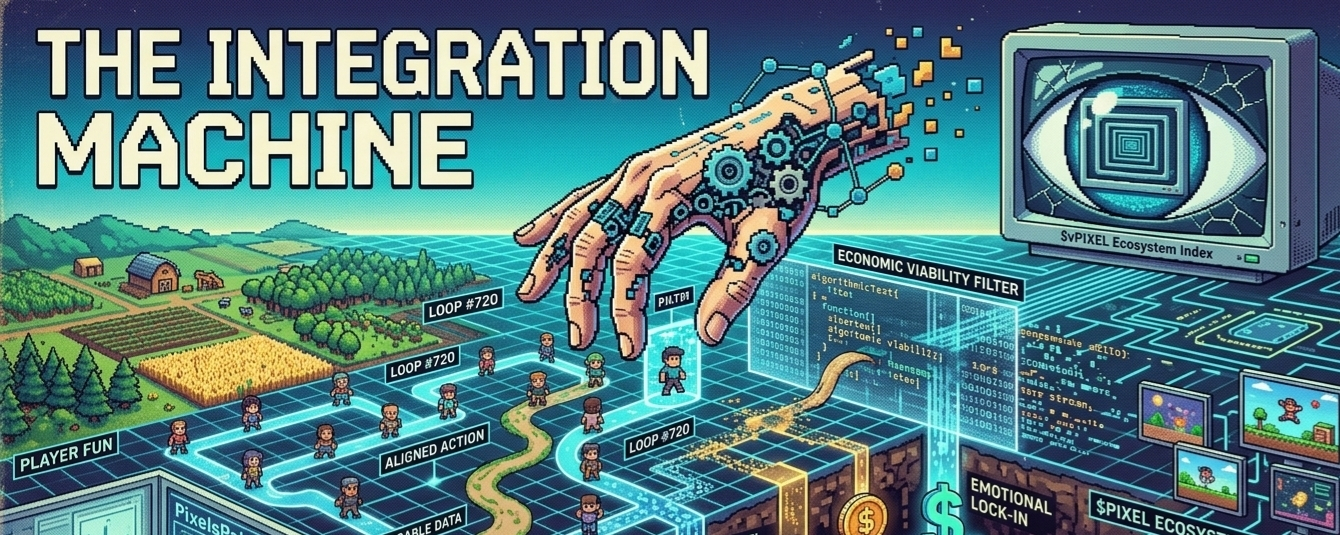

This isn’t a thread about a game. It’s a post-mortem of how we think value works in digital spaces. I’ve been sitting with the PIXEL ecosystem for a while now, not just clicking tiles or watching charts, but observing the "invisible hand" behind its design. And what I’m seeing is a masterclass in behavioral engineering that most people are completely missing because they’re too busy looking for the next "claim" button.
The Filter and the Noise
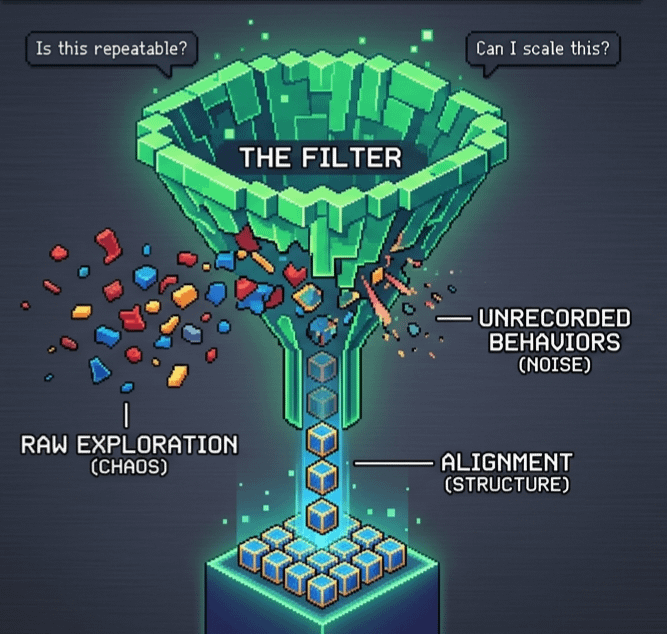
We like to tell ourselves that systems reward "exploration." Try things, be creative, move fast. But as I watch the way Pixels is structured, I realize that’s a lie. The system doesn't reward exploration; it filters it.
In any economy, most exploration is just noise. It’s messy, non-repeatable, and frankly, useless to the machine. I’ve noticed a "hidden filter" sitting between the player's action and the economic result. The system isn't asking, "Is this fun?" or "Is this clever?" It’s asking: "Is this repeatable? Can I turn this behavior into an infrastructure?"
If a behavior can’t be measured, standardized, and looped, it effectively doesn't exist. It disappears into the void. What remains—what we call the "gameplay loop"—is just the residue of exploration that the system managed to solidify. In Pixels, when a behavior passes this filter, it stops being "exploration" and becomes Alignment. You aren't just playing; you’re being integrated into a structure.
From Extraction to Existence
I remember the old Web3 days (which feel like a decade ago). It was all "Earn-Only." You enter, you extract, you dump, you leave. It was a parasitic relationship. But looking at the shift toward "Enjoy & Spend," I see the team trying to solve the ultimate economic riddle: Who actually funds the party?
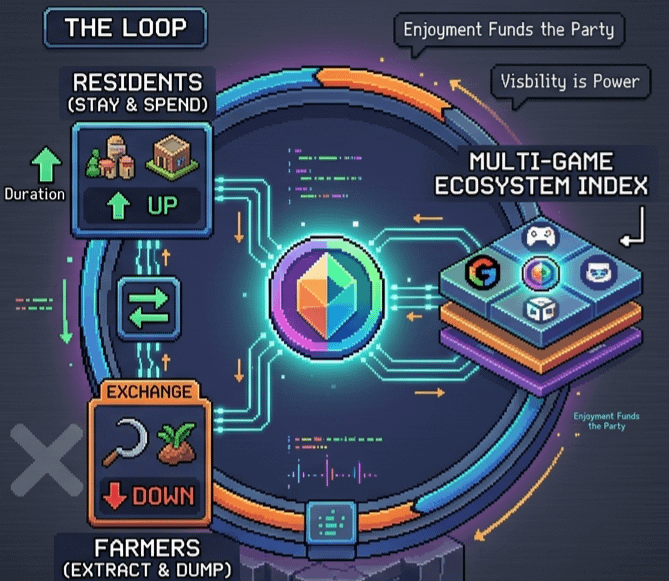
If everyone is selling, the system is just a slow-motion car crash. The brilliance of the Pixels shift isn't just "making it fun"—it’s about creating Residents instead of Farmers. A Resident stays because the cost of leaving (socially and emotionally) is higher than the profit of selling. This is where $PIXEL moves from being a reward token to a behavioral anchor.
The vPIXEL and the Ecosystem Index
What fascinates me most is the integration of vPIXEL. It wasn't patched in as an afterthought; it was woven into the DNA. Every action—planting, spending, staking—is a data point.
When you look at Multi-Game Staking, the philosophy shifts again. PIXEL is no longer a "game token." It’s becoming an Ecosystem Index. This is a high-stakes bet. If you link the token to the entire network, you diversify the risk (one bad game won't kill you), but you also create a massive web of interdependence. I’m watching this closely because it transforms the token into a proxy for the network's collective attention.
The Invisible Mirror: PixelsPals
I look at PixelsPals and I don't see a "casual social layer." I see a lab. It’s a behavior layer designed to monitor why a human returns to a screen when there isn't a direct financial carrot dangled in front of them. It’s studying the "Why" of the player.
The system is learning. It’s a self-refining organism that uses our movements to calibrate its rewards. We think we’re playing the game, but the game is "playing" us to find the most efficient way to sustain its own life.
The Philosophical Weight of the Unrecorded
This brings me to a thought that keeps me up: What about the behaviors that didn't make it? All those hours spent in-game doing things the system couldn't track or monetize—did they fail? Or were they simply denied "economic existence"? In the world Pixels is building, visibility is power. If the system can't see it, it didn't happen. We are witnessing the compression of human chaos into measurable, predictable patterns.
My Final
PIXEL isn't a game. It’s a front-end for a massive socio-economic experiment. The team isn't just trying to build a fun loop; they are trying to design the Ideal Economic Behavior. The goal isn't for you to "win" money from the game. The goal is for you to become a permanent part of an economy that you never want to leave. It’s not about the rewards—those are just the interface. It’s about the permanence. I’m not just a spectator here; I’m a student of this machine. Whether this succeeds or fails depends on one brutal tension: Can you optimize a system until it's perfectly efficient without squeezing the "soul" (the fun) out of it? Because once the exploration is fully replaced by alignment, the game ends, and the utility begins. And I’m still trying to decide which one I prefer.
