
You can mirror everyone else’s effort and still end up with very different outcomes. Some players consistently land in the right place at the right time. It doesn’t fully feel like skill or luck. It feels like positioning.
That’s where PIXEL starts to reveal a different role.
On the surface, it’s straightforward: off-chain activity builds momentum, and PIXEL is used when it’s time to finalize meaningful actions,
upgrades, land, high-value interactions. But the distance between “playing” and “finalizing” feels wider than expected.
Most of the game runs in a low-friction loop. You farm, craft, move resources, nothing forces urgency. Then suddenly, a scarce opportunity appears, and everything changes. Speed matters. Readiness matters. That’s the moment where PIXEL quietly decides who moves and who hesitates.

It doesn’t act like a reward. It behaves more like access.
Those holding it aren’t just participating more, they’re present exactly when it counts. And over time, that compounds. Not loudly, but consistently.
This isn’t new in broader markets. Liquidity often beats effort. The players with capital don’t just trade more, they capture the moments that define outcomes. Pixels is starting to mirror that structure.
What makes it interesting is that the system still looks open. Anyone can play, earn, engage. But not every action carries equal weight. Some remain background noise, while others get elevated into real value.
$PIXEL seems to sit at that boundary.
It doesn’t control what you do, it influences whether what you did actually matters.
That changes how “fairness” feels. If effort alone determined outcomes, returns would flatten over time. But when a system filters which actions are recognized and finalized, scarcity shifts, from resources to access.
More specifically, system attention.
Not social visibility, but which actions the economy chooses to process and lock into value.
This likely wasn’t entirely intentional, it’s a natural consequence of mixing off-chain scale with on-chain limits. Not everything can be finalized. A gate forms. And once there’s a gate, access gets priced.
That’s where $PIXEL diverges from a typical in-game token.
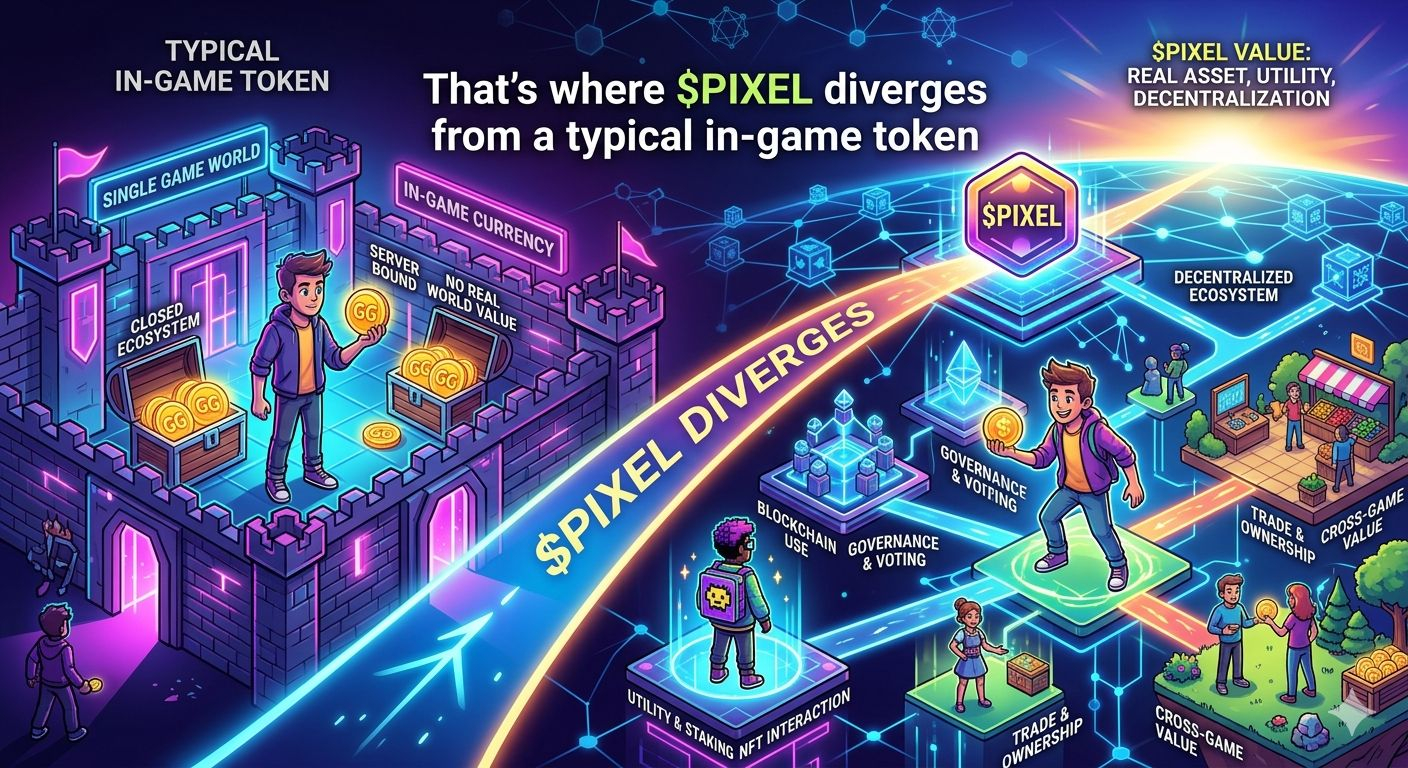
It’s less about earnings, more about timing your relevance.
There’s a benefit to this. It prevents overload, adds structure, and keeps the economy from collapsing under constant activity. But it also introduces drift.
Players adapt. They stop wandering and start targeting conversion points. The game shifts from exploration to precision.
And that’s where fragility creeps in.
As more players converge on high-value moments, the advantage shifts further toward those already prepared. Those holding PIXEL don’t need to rush, they’re already positioned. Over time, that edge compounds quietly.
New players still join, still contribute, still stay active. But their actions don’t always translate into the same level of economic impact. They’re in the system, but not always in the moments that define value.
That gap is easy to miss if you’re only watching surface growth.
User numbers can rise. Activity can spike. The world can feel alive. Meanwhile, the actual points where value crystallizes remain selective
maybe even more so over time.
That’s why calling $PIXEL a simple reward token feels incomplete.
It’s closer to a coordination layer
something that sits between effort and outcome, filtering which actions pass through and which fade into the background.
And if that dynamic continues, the usual metrics won’t tell the full story.

The real signal becomes harder to track:
Who consistently shows up when activity turns into value, and who doesn’t.