
Something about PIXEL's behavior still feels stuck.
Supply is already above 3 billion in circulation, unlocks are still coming in steady increments, and every time volume spikes $15M, $20M it fades just as quickly. Price doesn't break down, but it doesn't reprice either. It just absorbs what comes in and settles back into the same range. That kind of behavior usually means the system isn't failing. It means something underneath isn't changing.
That's what makes this harder to ignore now, because the system clearly has changed.
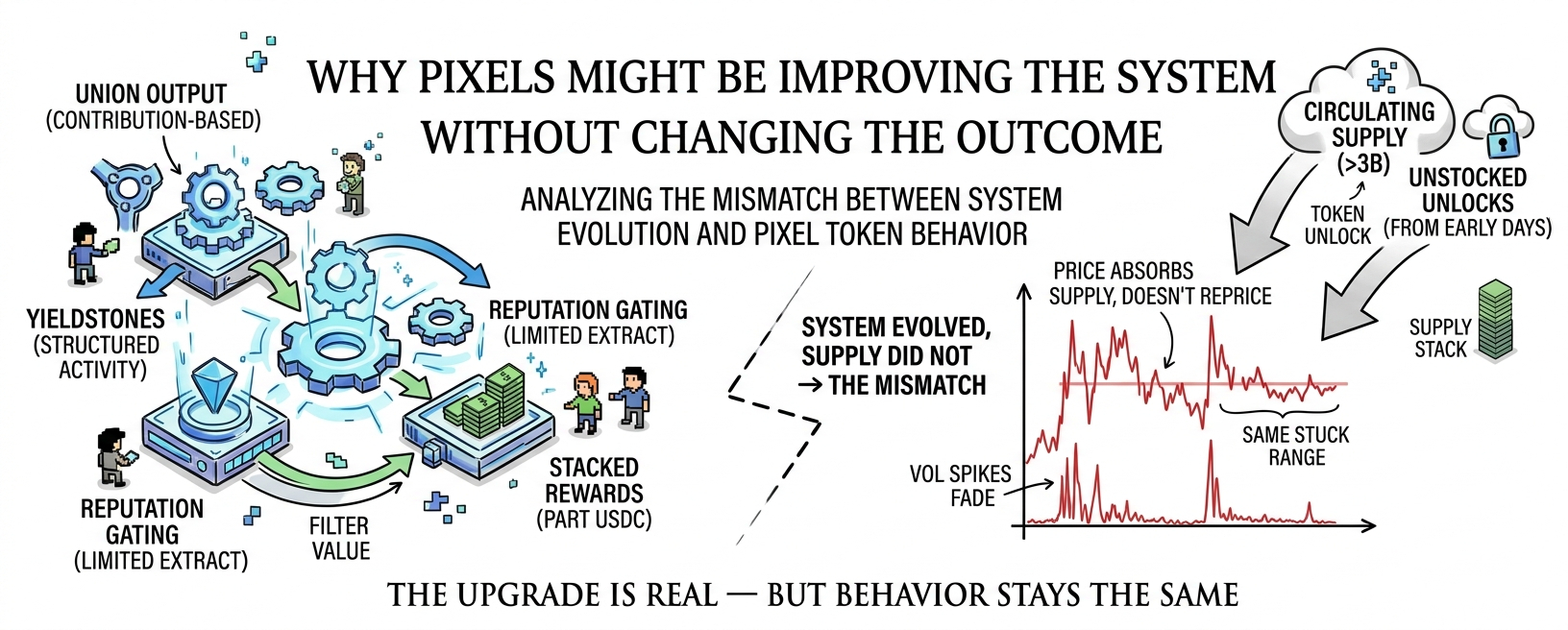
Chapter 3 reshaped how players participate. Union output depends on actual contribution, Yieldstones reward structured activity, and reputation gating quietly limits who can extract value freely. Then Stacked adds another layer, routing part of rewards through USDC instead of pushing raw PIXEL into circulation. These aren't cosmetic changes. They're direct attempts to control how supply enters the market.
But that only solves one side of the equation.
Because supply doesn't just come from rewards anymore. It's already out there. Tokens distributed under earlier conditions are still sitting in wallets, and unlocks keep adding to that base. Those tokens don't need to follow any of the new rules to exit. So even as the system improves how new tokens are emitted, the existing supply behaves the same way it always has.
The system evolved. The supply didn't.
That's where the mismatch shows up in the chart.
You see controlled emission on one side, but unchanged behavior on the other. Volume spikes when movement happens, but it doesn't carry forward. Price absorbs new supply, but doesn't build pressure in the opposite direction. The system is filtering activity internally, but the token is still reacting to the same external behavior.
So the upgrade is real—but the outcome doesn't fully reflect it.
And that's what keeps pulling me back. The design is clearly moving toward a more sustainable model. It's trying to align rewards with real participation and reduce unnecessary sell pressure. But as long as circulating supply keeps expanding and the broader holder base isn't structurally tied to those changes, the improvement stays partial.
It shows up as stability instead of growth.
I'm not fully convinced this is the final state. If Union-based participation, land usage, and staking start pulling more PIXEL back into the system, then the same supply could start behaving differently. But that shift has to be visible in how the token moves, not just in how the system is designed.
So the part I'm watching is simple. As unlocks continue, does the token start to respond differently? Not just absorbing supply, but holding it.
Because if it doesn't, then Pixels hasn't failed to improve its system.
It's just improving it faster than the supply it still has to carry.
Pixels built something worth watching. The question was never whether the game could grow it's whether the token learns to move with it.
