
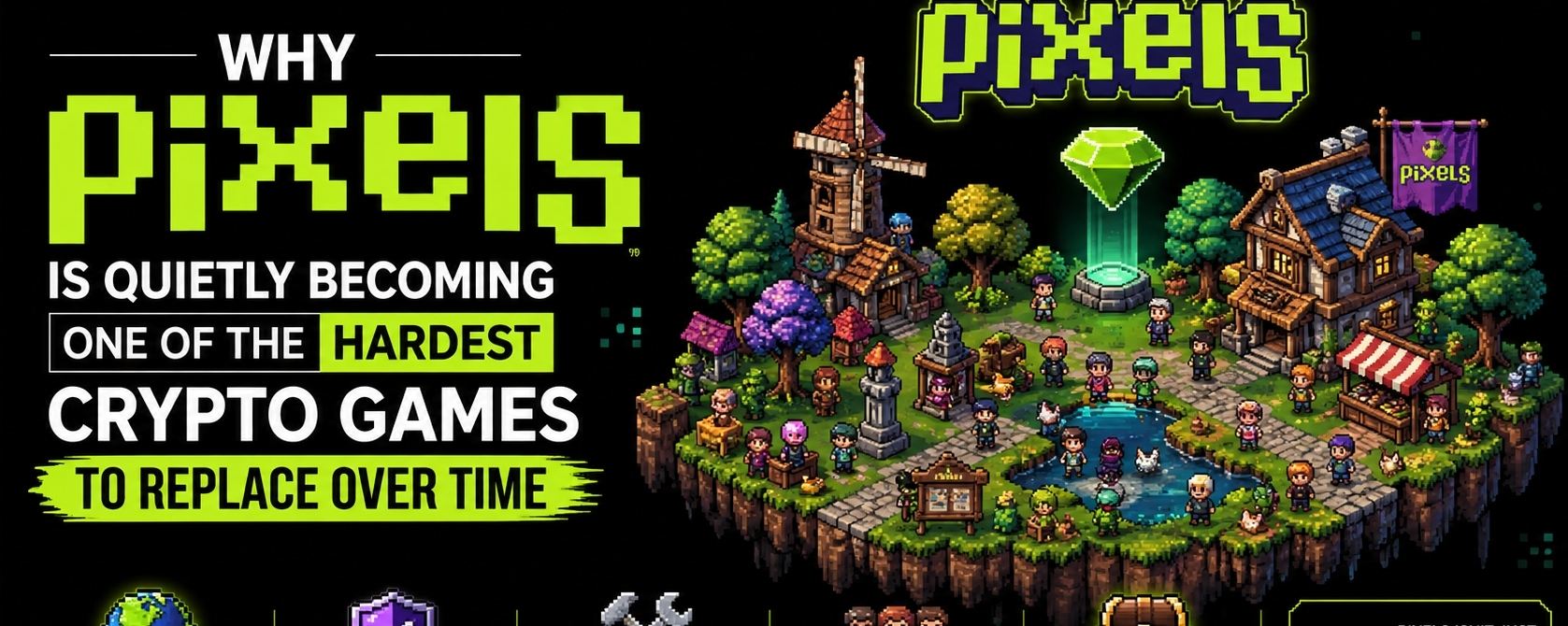
I didn’t understand Pixels immediately.
At first, it looked almost too simple. A farming world, pixel graphics, daily tasks, social movement, and a token somewhere in the background. I had seen enough crypto games to know how these stories usually go. Big energy early, people rush in, rewards become the main reason to stay, then everything starts feeling empty once the excitement cools.
So I did not want to force conviction.
But the more I looked at Pixels, the more I felt there was something different happening.
Not loud different. Not revolutionary in the obvious way. More like the kind of difference you only notice after spending real time with it.
Pixels does not feel like a project trying to impress you every second. It feels like a world trying to become part of your routine. That is a much stronger thing than people realize.
A lot of crypto games are built around urgency. Hurry before rewards change. Hurry before the next campaign ends. Hurry before someone else extracts value first. Pixels feels calmer than that. You log in, do a few things, see familiar activity, progress a little, and leave with the feeling that the world will still be there tomorrow.
That sounds small, but it is not.
The strongest products are often the ones that become ordinary in someone’s life.
This is where the stacked idea matters to me. Pixels is not relying on one reason for people to stay. It is slowly stacking reasons on top of each other.
Someone may enter because of rewards. Then they understand the land system. Then they meet people. Then they learn the economy. Then they build a habit. Then they have history inside the world. After that, leaving is no longer a simple decision. It feels like walking away from something you have already placed time into.
That kind of attachment cannot be copied quickly.
A competitor can copy farming. It can copy pixel art. It can copy quests, rewards, marketplaces, even social features.
But it cannot instantly copy memory.
That may be the most underrated part of Pixels.
The project is not only building gameplay. It is building accumulated context. The longer users stay, the more the world means to them. Their progress, routines, social circles, and understanding of how things work all become part of the product.
This is why Pixels may become harder to replace with time.
Not because it is perfect. It is not. The economy still has to stay balanced. The game still needs fresh reasons to return. The team has to keep improving without making the world feel too complicated. And the token has to feel useful without turning the whole experience into a financial machine.
Those are real challenges.
But at least Pixels is dealing with the right challenges. It is not asking, “How do we make people care?” It is asking, “How do we keep giving people reasons to care?”
That is a better position to be in.
What I respect most is that Pixels does not seem to depend only on hype. It has something quieter: repetition, familiarity, and community rhythm. Those things do not trend as easily, but they last longer.
Markets often miss projects like this because they are looking for explosions. They want the next huge announcement, the next sudden pump, the next viral moment.
But some projects grow differently.
They grow by becoming familiar.
Pixels feels like one of those projects.
The more time passes, the more its strength may come from all the small things people ignored at first. The daily habits. The social comfort. The simple design. The feeling of already belonging somewhere.
That is not easy to replace.
And maybe that is the point.
Pixels does not need to look unstoppable today. It only needs to keep becoming harder to leave tomorrow.
