People still talk about crypto sanctions enforcement like it is mostly a game of chasing bad actors after the money has already scattered. That frame feels too old now. What happened this week looks different. The U.S. Treasury said it sanctioned multiple wallets tied to Iran, resulting in the freezing of $344 million in cryptocurrency, and Tether’s ability to blacklist USDT made that action immediate rather than theoretical. That matters because it turns a blockchain rail into something closer to a live pressure point in geopolitics, not just a record of where value moved after the fact.
The headline number is big, but the real story is where this freeze sits in the broader structure. Reuters reported the action as part of Washington’s wider economic pressure campaign on Iran. TRM Labs, a blockchain intelligence firm, described the wallets as associated with Iran’s central bank and said the freeze was the largest on-chain freeze of Iranian sovereign crypto reserves on public record. That wording is important. This was not just some random enforcement hit on a small intermediary. It appears to have reached closer to reserve-like storage. In other words, closer to the vault than the cashier.
And that is why the on-chain behavior matters so much. According to TRM’s analysis, the two wallets received about $370 million across nearly 1,000 transactions, had very limited outbound activity, and then largely sat dormant after late 2023. TRM said that pattern looked more like reserve infrastructure than active operational wallets. Reuters also reported separately that Iran’s central bank and Nobitex, the country’s biggest crypto exchange, used Tron and BNB Smart Chain networks to move at least $2.3 billion since the start of 2023, with the central bank acquiring at least $500 million of Tether on Tron last year according to Elliptic and analysts cited by Reuters. So the freeze is not interesting only because it is large. It is interesting because it suggests authorities were watching a deeper layer of the financial plumbing.
That makes the older argument about crypto being “beyond state reach” look thinner than ever. Crypto can still help sanctioned actors move value. That part is obvious. But stablecoins introduce a strange contradiction into the system. They offer speed, liquidity, and dollar access, yet they also rely on issuers that can cooperate with law enforcement and freeze assets at the token level. Reuters reported in February that Tether said it had frozen about $4.2 billion tied to illicit activity overall, with $3.5 billion of that since 2023. So when a sanctioned network leans heavily on USDT, it is not just using a digital dollar. It is also accepting a form of embedded control.
Iran’s crypto footprint helps explain why this hit resonates beyond the two addresses. Chainalysis reported in January that Iran’s crypto ecosystem reached more than $7.78 billion in 2025 and that addresses associated with the IRGC represented about 50% of Iran’s total crypto ecosystem in the fourth quarter of 2025. Reuters also reported large post-strike outflows from Iranian exchanges earlier this year, showing how quickly crypto activity can spike under political stress. Put together, that paints a picture of crypto in Iran as both a public escape valve for citizens and a strategic financial tool for regime-linked networks. Same rail, very different users, very different stakes.
That split is what makes this story more complicated than a simple victory lap for enforcement. For the U.S., this freeze demonstrates that blockchain transparency, wallet attribution, and issuer cooperation can turn digital assets into an effective sanctions battleground. For sanctioned states, it is a warning that public-chain finance is still highly legible when enough intelligence, analytics, and institutional coordination are pointed at it. And for the crypto industry, it is another reminder that the market’s most widely used stablecoins are not neutral infrastructure in the pure ideological sense. They are programmable financial instruments sitting inside a power structure.
The part I keep coming back to is this: the biggest lesson here is not that crypto failed to evade pressure, or that sanctions enforcement suddenly solved everything. It is that the battlefield changed. The U.S. did not just trace flows. It appears to have frozen a meaningful chunk of value at the issuer layer while tying it to a wider network involving Iran’s central bank, IRGC-linked activity, and domestic exchange infrastructure. Once that becomes normal, crypto stops looking like a side channel in geopolitical finance. It starts looking like one of the main arenas where pressure is applied, tested, and measured.

Article
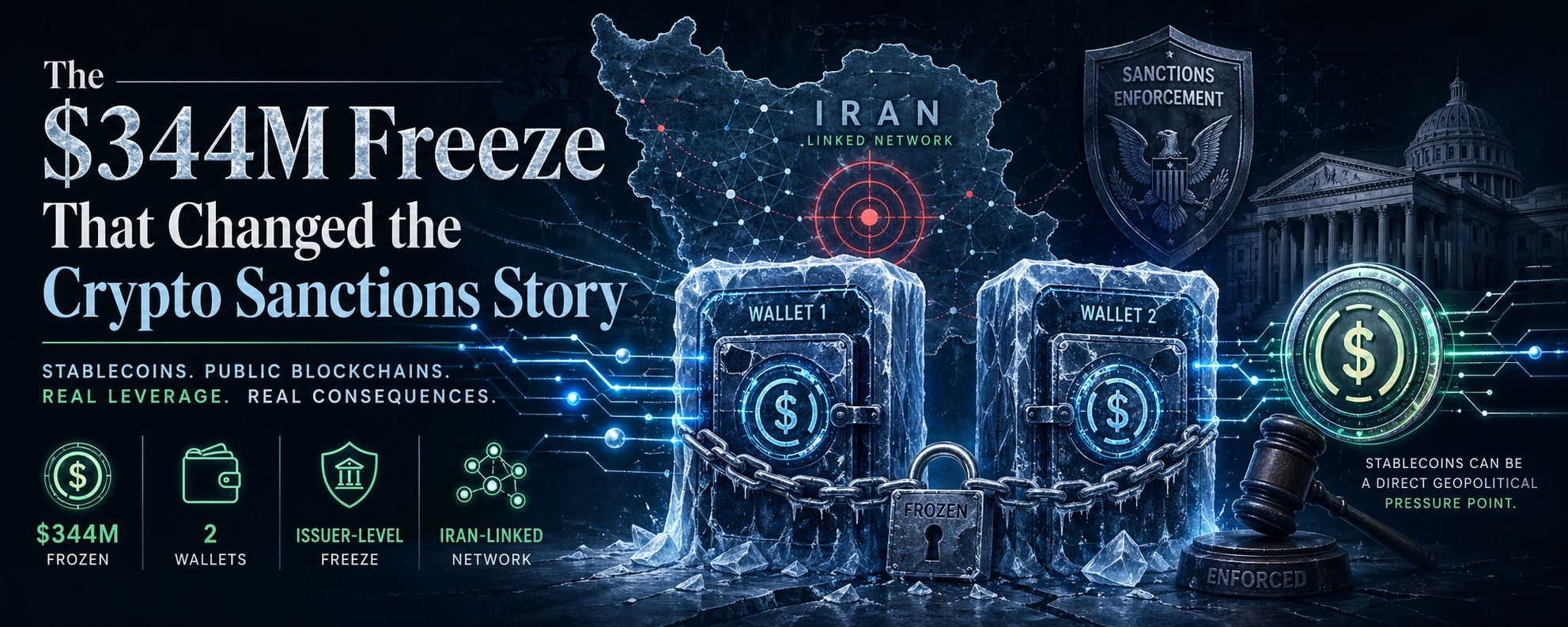
The $344M Freeze That Changed the Crypto Sanctions Story

--