
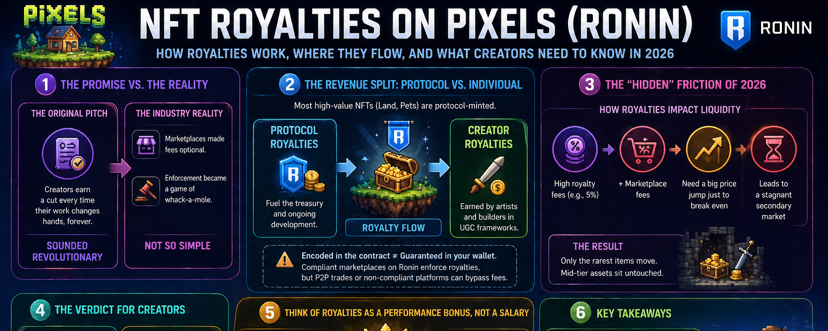
I approached the topic of NFT royalties with a healthy dose of skepticism. The original pitch was simple: creators would get a cut every time their work changed hands, forever. It sounded revolutionary until the industry reality hit marketplaces made fees optional, and enforcement became a game of whack-a-mole.
Looking at Pixels on the Ronin network, the situation is a bit more nuanced. Because Ronin is a more "curated" ecosystem compared to the Wild West of Ethereum, royalties actually have more teeth here, but there are still gaps you need to watch out for.
🏗️ The Revenue Split: Protocol vs. Individual
It’s important to distinguish between where the money goes. In Pixels, the vast majority of high-value NFTs (like Land and Pets) are protocol-minted.
• Protocol Royalties: These fund the treasury and ongoing development.
• Creator Royalties: These are for the artists and builders participating in user-generated content frameworks.
If you’re a creator, you’re looking at a contract-level percentage. However, "encoded in the contract" doesn't mean "guaranteed in your wallet." While Ronin’s top marketplaces are generally compliant, peer-to-peer trades or non-compliant platforms can still bypass these fees.
📉 The "Hidden" Friction of 2026
What isn't talked about enough is how royalties impact liquidity. High royalty fees can actually discourage frequent trading. If a player has to pay a 5% royalty plus marketplace fees, they need the asset price to jump significantly just to break even. In a fast-moving game economy, this can create a "stagnant" secondary market where only the rarest items move, while mid-tier assets sit untouched.
⚖️ The Verdict for Creators
If you’re building inside Pixels, think of royalties as a performance bonus, not a salary.
• The Good: Sky Mavis has a vested interest in keeping creators happy to grow the Ronin ecosystem. This alignment is stronger than almost anywhere else in Web3.
• The Reality: Royalties are a "soft right." They work when the system is healthy and the players use official channels, but they shouldn't be the foundation of your business model.
If you’re here because you love the ecosystem, royalties are a fantastic way to capture long-term value. But if you’re here purely for the "passive income" dream, keep your skepticism handy. In 2026, the most successful creators are the ones building utility into their assets, making them so valuable that players want to use the official (and royalty-paying) channels to trade them.