
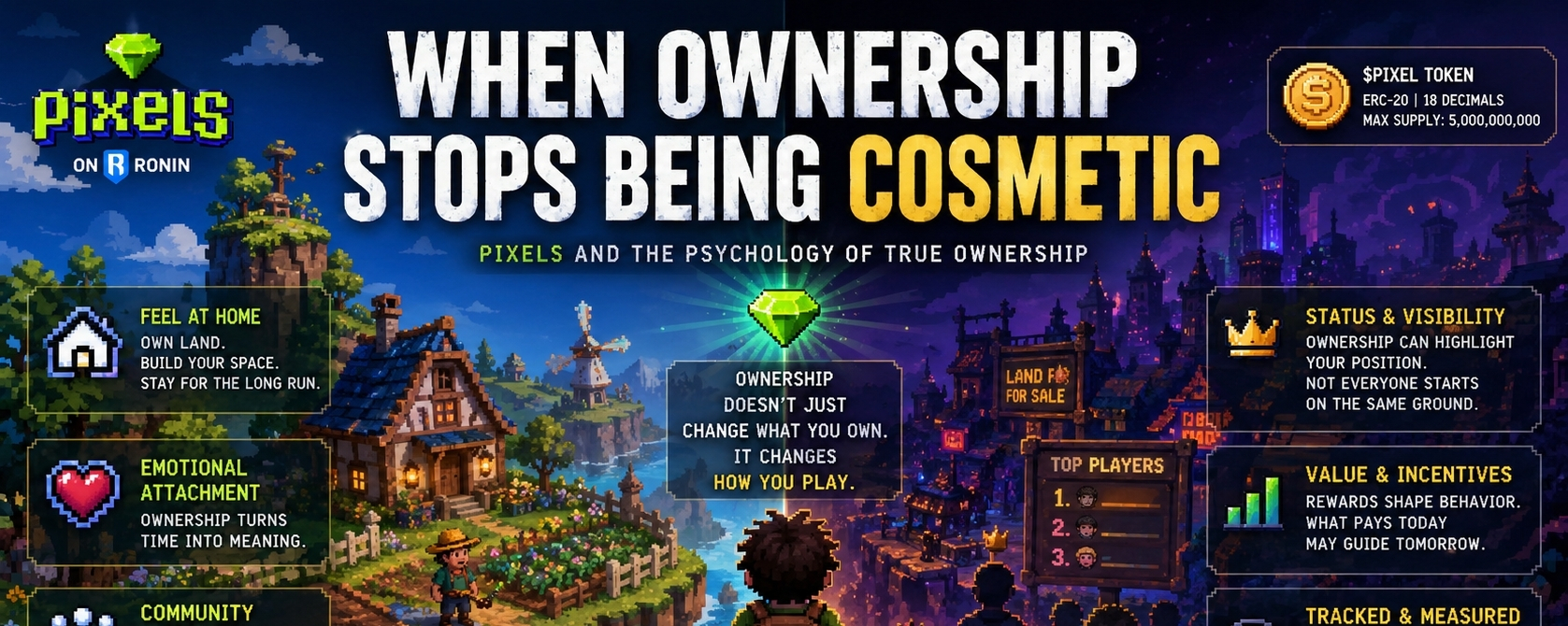
When Ownership Starts to Change the Player
The more time I spend thinking about Pixels, the less ownership feels like a feature and the more it feels like a change in atmosphere. The project talks about land, progress, collectibles, and a world where what you build can actually belong to you. It also says players can build games that integrate digital collectibles and truly own their progress. That may sound like product language on the surface, but it carries a deeper emotional promise underneath it. It asks the player to stop feeling like someone passing through and start feeling like someone with a real place in the world.
That shift matters more than it first appears. In most online games, I can put in hours collecting, decorating, upgrading, or grinding, and still know that none of it is really mine in any lasting sense. The time feels personal, but the space never fully does. It still belongs to the game company. Pixels seems to be trying to change that feeling. When it talks about land on Ronin, blockchain-backed rewards, and progress that players truly own, it is not only describing a system. It is changing the way a player is supposed to relate to their own time inside the game.
So the real question for me is not whether on-chain ownership exists here. It is whether that ownership genuinely changes the player, or whether it mostly adds another layer of visible status.
I think it can change player psychology, but probably not in the neat, simple way people sometimes suggest. Ownership often changes the way people think about time before it changes anything else. When players feel that something is actually theirs, they tend to think less in short sessions and more in longer arcs. They become a little more patient, a little more careful, and usually a little more invested in what happens next. Pixels feels built to create that kind of attachment. The project keeps returning to homes, land, community, creativity, and shaping the world over time. This is not the language of a disposable game session. It is the language of staying.
But ownership also changes the social feeling of a world, and this is where things become more complicated. The moment land, progress, or identity becomes something ownable and visible, it can also become something that marks difference. Ownership does not always feel like belonging. Sometimes it starts to feel like ranking. Pixels does not hide the economic side of this. The project links ownership with rewards, and the litepaper places token mechanics, incentives, and long-term value creation close to the center of the ecosystem. Once ownership begins connecting to access, rewards, or influence, it no longer works only as a source of emotional attachment. It also starts shaping the social order of the game.
That is where I think the deeper tension sits. Does ownership make players feel more rooted in the world, or does it mostly make them more aware of their position inside it? If I own land, do I feel more at home, or do I just become more visible to the game’s economy? If my progress lives on-chain, does that deepen my connection to the world, or does it quietly turn identity into something that can be displayed, tracked, and rewarded? In a project like Pixels, those are not side questions. They shape the kind of world the game becomes.
What makes Pixels interesting is that it seems to be leaning into both possibilities at once. The litepaper talks about rewarding meaningful player actions, supporting different kinds of players, and using data to identify behaviors that create long-term value. That may sound careful and well-designed, but it also means ownership does not sit on its own. It lives inside a system that is constantly deciding what matters, what counts, and what deserves more value. So ownership may not only change how a player feels. It may also change what kind of behavior starts to feel worth repeating.
Even the token gives that feeling more weight. PIXEL is not just a decorative part of the story. It has a verified ERC-20 contract, 18 decimals, and a maximum supply of 5 billion. That gives the ownership layer real structure, but it also gives it pressure. And pressure always shapes behavior in some way.
So yes, I do think on-chain ownership can change player psychology in Pixels. But I do not think it only makes players feel empowered. It also makes them more conscious of value, position, and future advantage. That is why ownership here feels more serious than a nice extra feature. It can deepen attachment, but it can also sharpen status. And in a world like Pixels, those two feelings may end up sitting much closer together than they first seem.
