
I’ve been thinking lately about why we gravitate toward digital chores. You log into a game like @Pixels
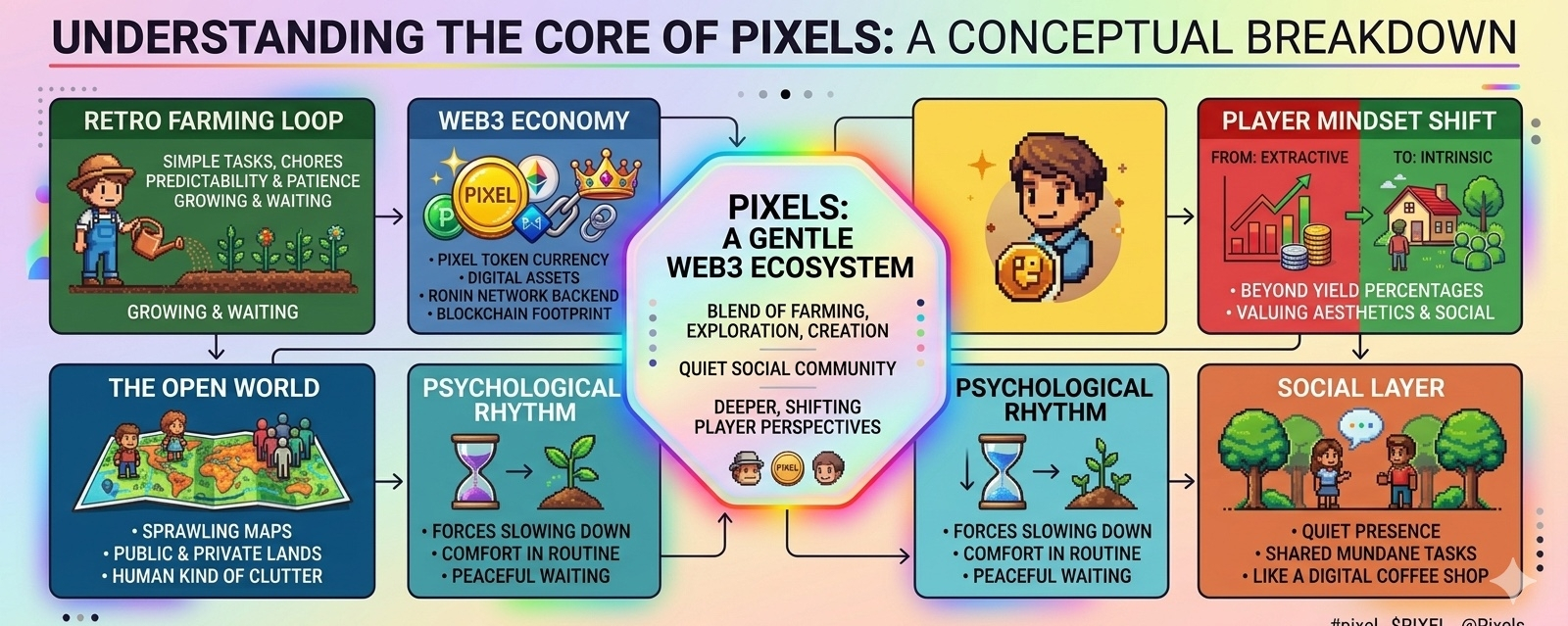
Pixels, and basically, you’re just planting things. You water them. You wait. There’s something inherently strange about coming home from a long day of actual work just to do more work on a tiny glowing screen. But it feels different, I guess. The world is made of these little colorful squares. It feels safe. It doesn't ask too much of you.
It runs on the @Ronin Network , which is a detail that matters to some people a lot, and to others, not at all. It’s a web3 game. Usually, when people hear that phrase, they immediately picture finance bros, complicated charts, or aggressive marketing campaigns. They think of everything moving at a hundred miles an hour. But when you’re actually walking around in the game, it doesn’t feel like that. It just feels like a top-down, retro farming game. You wander around. You chop wood. You talk to people.
Sometimes I just walk through the different maps to see what people are doing. The world is broken up into these different land parcels. Some are public, some are private. You transition from one to the next, and the landscape changes entirely based on whoever owns it. You might walk out of a dense, perfectly organized orchard and step straight into a chaotic, messy plot where someone clearly just threw down whatever seeds they had in their inventory. It’s a very human kind of clutter.
And you can usually tell quite easily who has been playing for months and who just started today. It isn't just about the gear they have or the size of their farm. It’s how they move. The new players are frantic. They run to the store, they run back to the soil, they click on everything to see what it does. They are trying to beat a game that doesn't really have an ending. The older players are still. They stand by the communal areas. Maybe they have a rare item equipped, but they aren't flaunting it. They're just existing in the space.
Farming in games has always been a weird psychological hook. You clear a patch of land. You drop a seed in the dirt. In Pixels, this whole process is tied to an actual economy. The things you grow, the resources you gather, they have some kind of footprint on a blockchain somewhere. It’s an odd bridge between pretend farming and real value.
But honestly, when I’m playing, I kind of forget about the network running beneath it. It’s just me and a little digital watering can.
There’s a rhythm to it that forces you to slow down. You can’t rush the crops. You just have to let time pass. And while the time passes, you go explore. The map is sprawling. There are all these different lands, crowded with little pixelated characters running back and forth.
That’s where things get interesting, really. The social layer of it all. Because it’s an open world, you’re constantly bumping into other people doing the exact same mundane tasks. You share a little space near a tree you’re both trying to chop down. You don't even necessarily have to talk to them. It’s just the quiet presence of other people sharing a routine. It’s a lot like sitting in a coffee shop. You aren't interacting with the person at the next table, but their presence makes the space feel alive.
I wonder sometimes about the PIXEL token itself. It’s the currency that ties the whole thing together. People buy it, trade it, use it to upgrade things or buy land. The Ronin network part of it is always lingering in the background, acting as the engine. It tracks the tokens, the land ownership, the rare items.
In the beginning, I think a lot of people show up just for the token. They read somewhere that you can earn something by playing, so they log in and treat it like a job. They look at a digital tree and see a yield percentage. They look at a crafted item and see a profit margin. They calculate the exact financial output of a digital carrot. It’s a very modern, very exhausting way to look at a game.
And I get that, in a way. The real world is expensive. But it becomes obvious after a while that a purely extractive mindset burns people out. You can only click on the same pixelated dirt so many times before your brain demands to know what the point is. If the only point is a fraction of a cent, the magic fades pretty fast.
For the people who stick around, the perspective seems to shift. The question changes from this to that. It shifts from "how do I extract the most value from this plot of land?" to "does this fence look good next to my house?" or "who is hanging out in the town square today?" They stop looking at the ledger and start looking at the screen.
It’s a funny kind of irony. Web3 games are often pitched as this hyper-financialized version of the internet, where everything has a strict price tag and ownership is everything. But when you strip away the whitepapers and the Twitter debates, the actual experience of playing Pixels is surprisingly gentle. It’s mostly just chopping wood and listening to soft music.
You gather some sap. You find some iron. You craft a stove. It takes hours. Sometimes days, if you only play a little bit at a time. There is no shortcut. The waiting is the game.
I sit there sometimes, my hand off the mouse, just watching the little animations. The way the pixelated water splashes from the can. The way the crops slowly change state from seeds to sprouts to fully grown plants. It’s a very simple loop. It doesn't ask much of you.
There is a comfort in that predictability. The real world is loud and mostly out of our control. You don't know what's going to happen tomorrow. But in this little browser tab, you know exactly what will happen. If you water the seeds, they will grow. If you chop the tree, you will get wood. It’s a closed system that makes sense.
I don't know where the game will be in a year or two. Games like this evolve. The economy might shift, new lands might open up, the developers might add new things to craft. People will come and go. Some will write long essays about what it all means for the future of digital economies and the metaverse.
I try not to think about it too much. When I start thinking about the blockchain infrastructure or the long-term viability of the token, it feels like I'm breaking the spell. I’d rather just look at the colors.
The evening light in the game is shifting again. The screen gets a little darker, the pixels turning to deeper blues and purples. My character is just standing there near a patch of freshly tilled soil. I should probably plant something before I close the window. Or maybe I’ll just leave it empty for tonight.
There’s no rush. The dirt will still be there tomorrow. The network will remember where I left off. I watch the tiny, blocky stars start to appear in the digital sky, blinking in a slow, steady rhythm.
