

There’s a certain kind of tiredness that comes from staying in crypto too long. Not anger. Not disappointment exactly. Just fatigue. The kind that builds slowly after watching the same story repeat itself every year with different branding. New narratives appear, everyone suddenly becomes an expert, influencers post threads pretending they discovered the future, and for a few months people convince themselves this cycle will somehow be different.
Then it isn’t.
Crypto has become strangely predictable in that way. One year it’s yield farming. Then NFTs become cultural revolutions overnight. Then metaverse land gets sold like digital beachfront property. Then AI enters the conversation and suddenly every project claims intelligence, automation, agents, assistants, prediction layers — words stacked on top of each other until nothing means anything anymore.
And somewhere inside that noise, gaming keeps returning.
Honestly, crypto gaming has always felt like an unfinished idea pretending to be a finished industry. The promise makes sense. Ownership makes sense. Players already spend billions inside traditional games buying cosmetics, skins, progression systems, rare items, and virtual status. On paper, blockchain should fit naturally into that world.
But reality has been messier.
Most crypto games never felt like games. They felt like spreadsheets wearing costumes. Grind loops disguised as entertainment. Token extraction wrapped inside pixel art. People weren’t logging in because they loved playing. They logged in because they hoped to make money before everyone else left.
That’s the shadow hanging over every Web3 game now.
And that’s why Pixels feels interesting in a strange, cautious way.
Not exciting. Not revolutionary. Just… interesting.
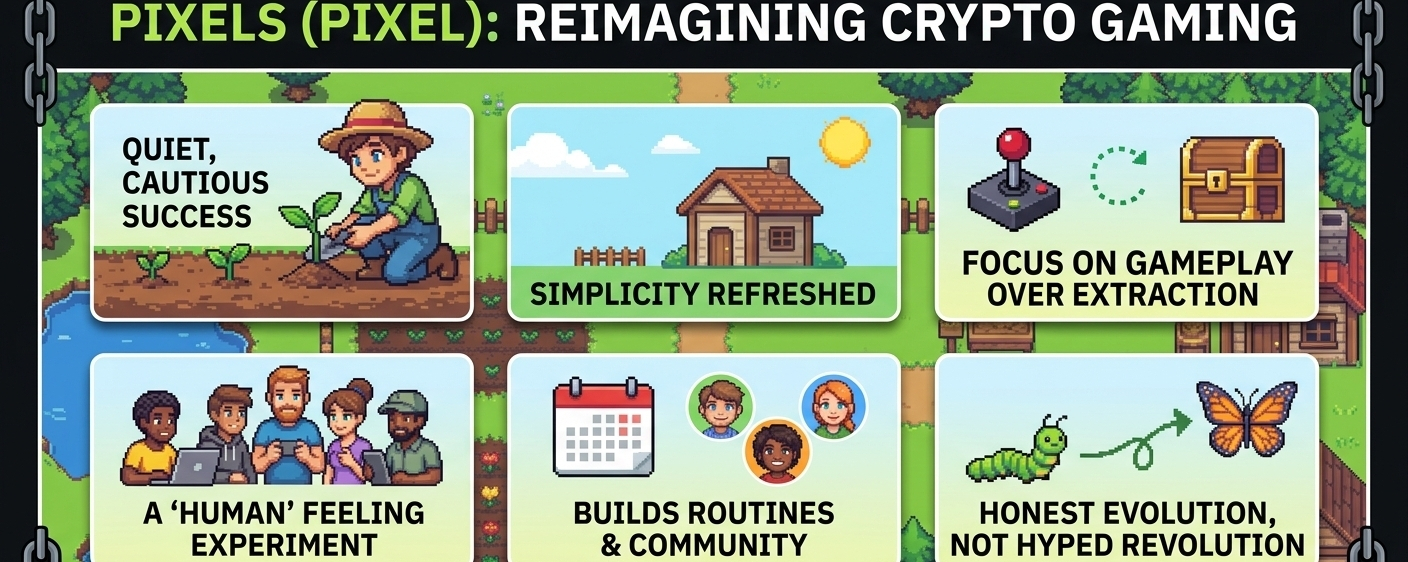
Pixels doesn’t immediately scream at you the way many crypto projects do. It doesn’t carry that aggressive energy where everything feels engineered to sound bigger than it really is. It’s quieter than that. A farming world. Exploration. Crafting. Land. Social interaction. Pixel graphics that feel intentionally simple instead of overly ambitious.
It almost feels old-fashioned.
And honestly, that may be its biggest advantage.
Because after years of watching crypto projects promise digital empires and metaverse economies, simplicity starts feeling refreshing. There’s something weirdly human about a game that doesn’t pretend to reinvent civilization.
Pixels exists on Ronin, which already carries history behind it. Ronin is impossible to separate from Axie Infinity, and Axie itself feels like an important memory for anyone who survived previous cycles. At one point Axie looked unstoppable. Entire communities formed around it. People built income strategies around gameplay. It became more than a game for some users.
Then incentives slowed down.
And the cracks appeared.
That’s the uncomfortable thing crypto veterans carry with them now. We’ve seen growth before. We’ve seen player numbers. We’ve seen token hype. We’ve seen “mass adoption” trends appear and disappear faster than anyone expected.
So when something like Pixels gains attention, the reaction isn’t excitement anymore.
It’s caution.
Pixels feels like it learned from previous mistakes, or at least tried to. The farming mechanics feel slower. Less aggressive. Less dependent on constant urgency. You gather, craft, build, explore, interact. There’s a softer rhythm to it compared to many crypto-native games that immediately throw economics into your face.
And maybe that matters more than people realize.
Because games are supposed to be relaxing sometimes.
Crypto forgot that.
Everything became optimized for extraction. Maximize rewards. Compound returns. Daily missions tied to earnings. Suddenly gameplay stopped feeling like curiosity and started feeling like labor.
Nobody wants a second job disguised as fun.
Pixels appears aware of that tension. It doesn’t feel obsessed with proving blockchain superiority every five minutes. The crypto layer sits underneath rather than dominating every visible interaction.
That sounds small, but it’s actually important.
The best technology often disappears into the background.
Still, skepticism remains.
Because every crypto game eventually runs into the same uncomfortable question.
What happens when money stops being the main reason people show up?
That’s where things become difficult.
A farming game can survive if players genuinely enjoy existing in that world. Traditional games prove that every day. People spend years inside cozy virtual spaces without financial incentives. They decorate, collect, roleplay, socialize, build routines.
But crypto changes motivation.
Once tokens exist, behavior changes.
Players stop asking whether something feels fun.
They start asking whether something is worth their time financially.
That shift is subtle, but it changes everything.
PIXEL as a token creates another layer of uncertainty. Tokens always sound useful when explained. Governance, upgrades, marketplace interaction, ecosystem rewards, progression systems. Every crypto project has a list of reasons its token matters.
But utility and necessity are different things.
That’s the part that worries me.
If the token disappeared tomorrow, would players still care about the game?
That question matters more than tokenomics charts ever will.
Because crypto has a habit of attaching tokens to products that never truly needed them. Sometimes it works. Sometimes it feels forced. Sometimes the token exists because investors expect one, not because users genuinely require it.
Pixels sits somewhere in the middle.
The token doesn’t feel completely detached from the experience, but it also doesn’t feel undeniably essential yet.
And maybe that uncertainty is honest.
Crypto rarely allows uncertainty anymore. Everything has to be declared a revolution immediately. Every project becomes either “the future” or “dead.” There’s no patience left for things that might simply evolve over time.
Pixels feels less certain than that.
Less loud.
Less desperate.
And strangely, that makes it easier to trust.
Not trust completely. Just enough to keep watching.
Adoption remains a real question though.
Web3 games struggle with audiences because they exist between two worlds. Traditional gamers often dislike blockchain integration. Crypto users often care more about economics than gameplay. That creates an awkward middle ground where projects try to satisfy both groups and sometimes satisfy neither.
Gaming communities are difficult to build. Loyal communities are even harder.
Wallet numbers can look impressive.
Activity charts can look strong.
But crypto has taught people to question metrics.
Wallets aren’t emotions.
Transactions aren’t attachment.
People can farm incentives without caring about the product itself.
That distinction matters.
Pixels may attract curiosity now, but long-term survival depends on whether players build routines around it. Whether they return without needing rewards. Whether they enjoy existing there when speculation fades.
That’s the real test.
And honestly, nobody knows that answer yet.
Maybe Pixels succeeds because it stays simple.
Maybe it survives because it doesn’t try too hard.
Maybe it becomes another temporary cycle narrative that people forget once the next trend arrives.
Crypto history gives enough reasons to doubt everything.
But there’s also something valuable about projects that don’t feel overly polished or overpromised. Pixels feels closer to experimentation than certainty. Less like a corporate pitch deck and more like a slow attempt to figure something out.
That doesn’t guarantee success.
It just makes the project feel slightly more human.
And maybe that matters more than hype now.
After enough cycles, you stop looking for perfect ideas.
You just look for things that feel honest enough to keep observing.
Pixels might be one of those things.
Or maybe it’s another reminder that crypto still hasn’t fully figured out how to make games people genuinely love.
Honestly, both outcomes feel equally possible.