
Most game economies are judged by activity metrics. Active users. Daily loops. Visible engagement. The assumption is simple: more players create more demand.
But in layered systems like @Pixels , activity and demand don’t move in perfect sync.
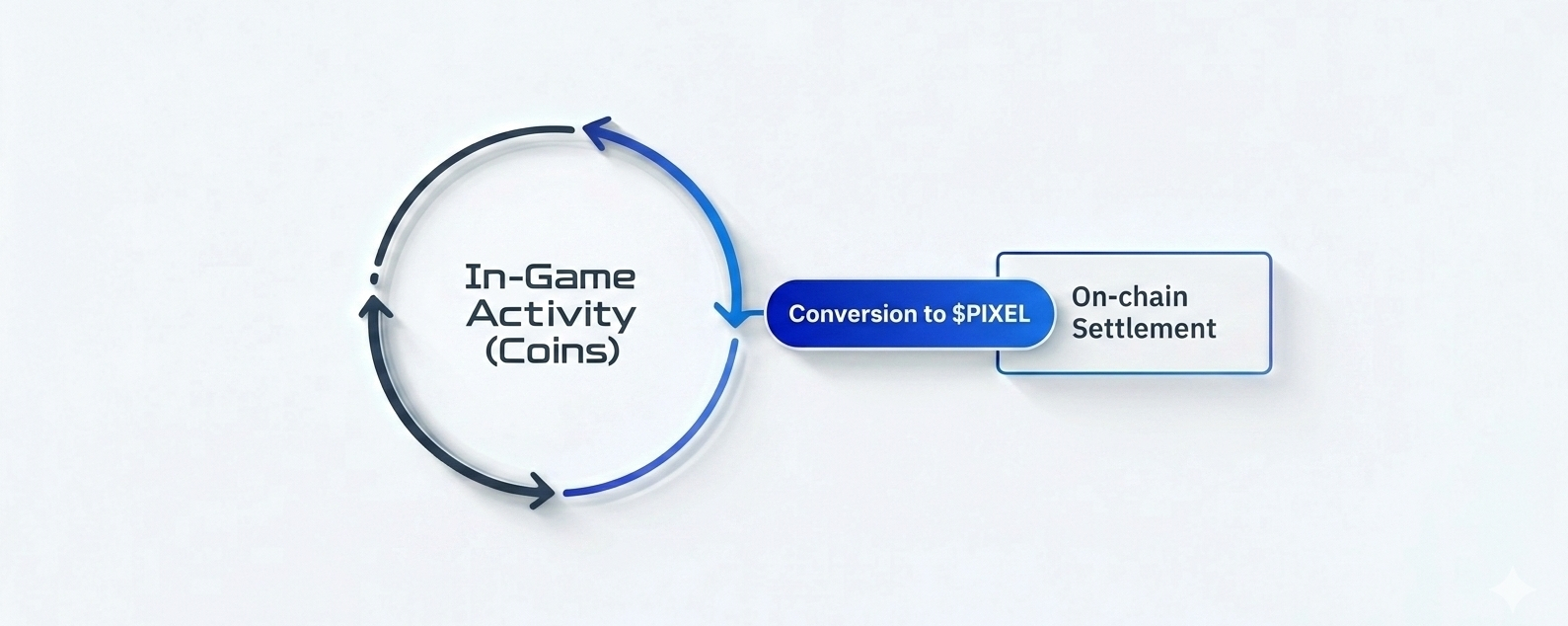
The majority of gameplay happens inside internal loops — farming, crafting, Coins circulation. These layers feel expansive. They respond directly to time and repetition. But $PIXEL only becomes relevant at specific conversion points: asset minting, structural upgrades, settlement-linked actions.
That separation changes the demand profile.
If a token is required continuously, demand looks smooth. If it’s only required at conversion checkpoints, demand becomes episodic. Spikes appear when players cross boundaries. Between those moments, usage slows.
That means $PIXEL may not be pricing raw activity. It may be pricing transitions.
Transitions are different from loops.
Loops scale with effort. Transitions scale with necessity.
If players can remain productive within internal Coins cycles without repeatedly needing $PIXEL, then token demand concentrates around strategic milestones rather than everyday engagement. That concentration creates volatility in both usage and perception.
There is also timing risk.
Unlock schedules and emissions don’t wait for organic conversion growth. If supply expands steadily while conversion demand remains intermittent, liquidity absorbs the difference. Markets interpret that as weakness, even if gameplay remains active.
This creates a subtle tension inside the system:
The game can feel healthy.
The token can feel pressured.
That divergence often confuses observers who equate engagement with demand.
In constrained settlement environments, growth doesn’t automatically translate upward. It must cross a boundary first. If the cost of crossing that boundary feels justified — accelerating progress, unlocking durable assets, anchoring status — then conversion becomes habitual.
If it feels optional, players delay it.
Habitual conversion stabilizes demand. Optional conversion destabilizes it.
The sustainability of Pixel, then, depends less on how often players farm and more on how often they choose to convert activity into settlement. If those conversion moments become integral to progression rather than peripheral, internal circulation strengthens.
But if progression increasingly happens without needing settlement, the token risks drifting away from core engagement.
Game economies rarely collapse suddenly. They diverge slowly.
Activity grows in one layer. Demand weakens in another.
The real question for Pixels isn’t how many loops players complete.
It’s how many of those loops ultimately require crossing the boundary where $PIXEL becomes indispensable.
That crossing point is where value either compounds… or leaks.