
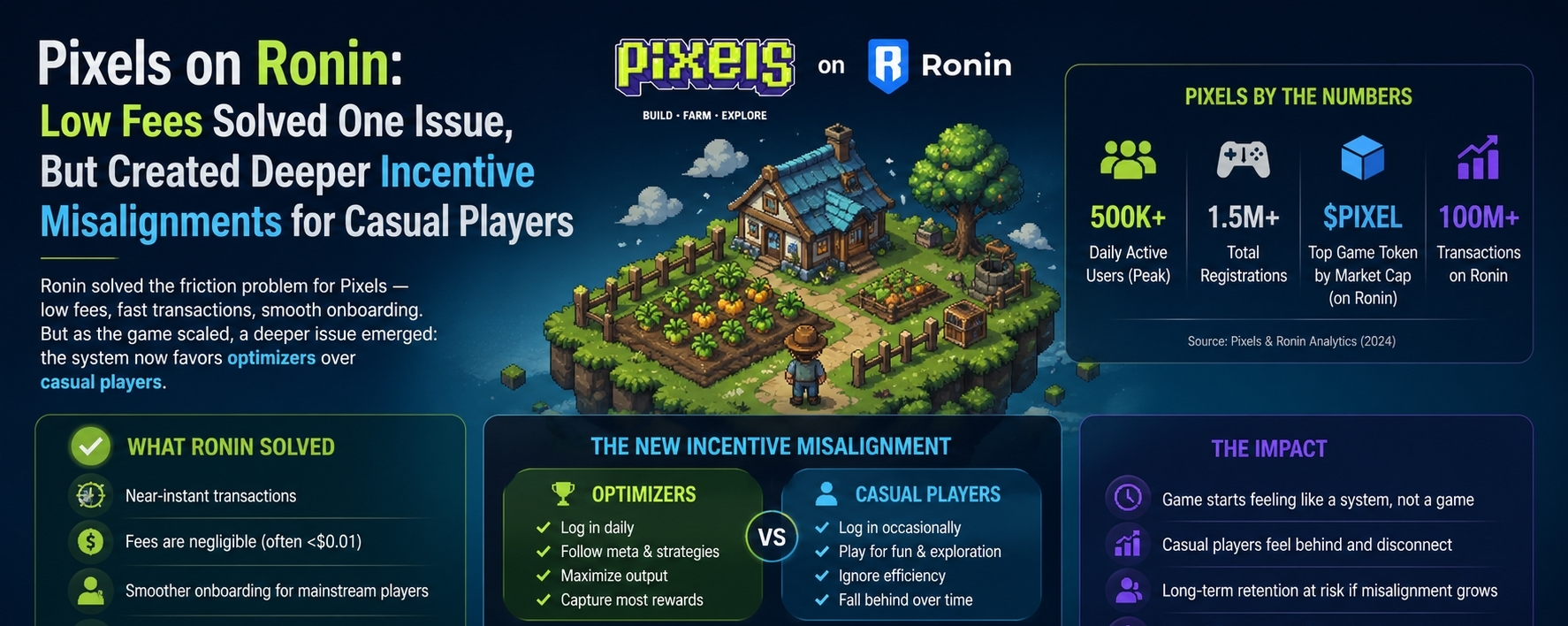

I’m going to be honest—when Pixels moved to Ronin, I thought this was it. This was the moment Web3 gaming finally figured something out.
No crazy gas fees.
No delays.
No friction.
Everything just worked.
And for a while, it really felt like a breakthrough. You could log in, farm, trade, interact—without constantly thinking about transaction costs. That alone removed one of the biggest pain points that had been holding GameFi back for years.
You could actually play.
And the numbers backed it up. Pixels started pulling in hundreds of thousands of daily active users. Activity exploded. The ecosystem felt alive. On the surface, it looked like success.
But the longer I stayed in the game, the more I started noticing something that didn’t feel right.
Not broken… just off.
At first, I couldn’t explain it. Everything looked busy—players farming, markets moving, constant interaction. But when you actually observe how people are playing, a pattern becomes obvious.
Most people aren’t playing for fun.
They’re playing for efficiency.
That shift sounds small, but it changes everything.
Instead of exploring or experimenting, players are optimizing loops. Log in, complete tasks, cycle resources, repeat. It becomes structured, predictable—almost mechanical. And once you see it, you can’t unsee it.
Low fees made it easier to do more, but they didn’t change why people are doing it. The motivation is still heavily tied to rewards.
And that’s where the deeper issue starts.
Because if a game is driven mostly by output, then naturally the players who win are the ones who can maximize that output. And in Pixels, that usually means one thing: time.
The more time you put in, the more efficient you become. The more cycles you complete, the more you earn, the faster you progress.
Now here’s where it gets interesting—and honestly, a bit uncomfortable.
If you’re a casual player, you’re not competing on the same level.
You log in for maybe 20–30 minutes. You farm a bit, check things, maybe complete a few tasks. But you’re not optimizing every move. You’re not running perfect loops. You’re just… playing.
And slowly, without realizing it, you fall behind.
Not because you’re bad.
Not because you don’t understand the game.
But because the system rewards consistency and repetition more than anything else.
And the crazy part? The game never tells you this directly. It just makes you feel it.
You start noticing that others are progressing faster. Their farms are more efficient. Their returns look better. And suddenly, your playstyle starts to feel… inefficient.
That’s when the experience quietly shifts.
You stop asking, “Am I enjoying this?”
And start asking, “Am I doing this right?”
That’s a very different mindset.
And ironically, this is where Ronin’s low fees play a role in making things worse—not better.
Because when transactions are frictionless, high-frequency players can scale endlessly. They can repeat actions faster, optimize harder, and extract more value without any cost barrier slowing them down.
In traditional systems, friction creates balance. It limits how far and how fast someone can push. But here, that limiter is gone.
So instead of leveling the field, low fees actually amplify the gap between casual players and grinders.
On the surface, everything still looks strong. There’s constant activity, active trading, and new players joining regularly. But if you zoom in, you’ll notice something important.
A large part of the economy is driven by people trying to maximize returns—not necessarily enjoy the game.
And that creates a cycle I’ve seen play out again and again.
New players join.
They’re excited.
They start grinding.
At first, it feels rewarding. Progress is fast, returns look good, everything feels worth it.
But over time, the returns start to feel smaller. The grind feels heavier. And eventually, the motivation drops.
Then they leave.
And the system keeps going by bringing in new players to replace them.
From the outside, it looks like growth.
From the inside, it feels like rotation.
What really stuck with me is how this changes player behavior over time.
Pixels doesn’t force you to grind—but it quietly encourages it. And if you don’t follow that path, you start feeling out of sync with the system.
That’s the real misalignment.
It’s not about fees.
It’s not about blockchain.
It’s about how effort, reward, and enjoyment connect—or don’t.
Right now, Pixels leans heavily toward rewarding time and repetition. And that works for a certain type of player. But for casual players, it creates friction that isn’t visible—but is definitely felt.
And that’s why I think this matters.
Because Pixels has already proven something important—it can scale. It can attract players. It can build activity.
But scaling isn’t the hard part.
Sustaining meaningful engagement is.
And if the experience keeps drifting toward optimization over enjoyment, then eventually, even growth starts to feel fragile.
For me, the takeaway is simple.
Fixing fees solved a surface-level problem.
But underneath, the incentive structure still needs work.
Because at the end of the day, a game shouldn’t just be something you can earn from.
It should be something you actually want to come back to—even when there’s nothing to earn.
