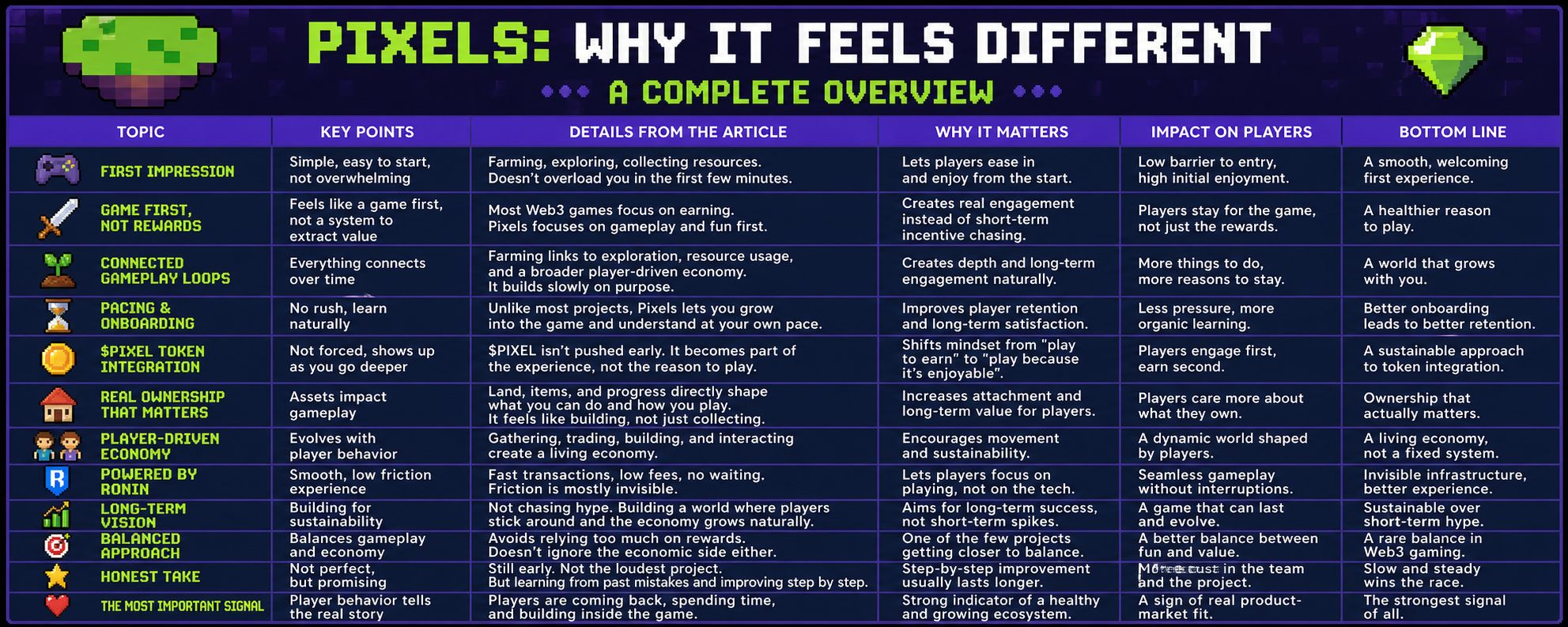
I’ve spent time in a lot of Web3 games over the years, and most of them follow a familiar script. You join, grind a bit, earn some tokens, and eventually realize the whole system leans more on rewards than actual gameplay. Once the incentives fade, so does the interest.
That’s why I went into @Pixels with pretty low expectations.
But after actually spending time in it, I’ll be honest… it feels different.
Not in a loud or overhyped way. More in a subtle, steady way that only becomes clear after a few sessions.
At the start, it looks simple. Farming, exploring, gathering resources. Nothing overwhelming. And that’s exactly what pulls you in. It doesn’t try to overload you from the first minute like most Web3 games.
You just start playing.
And that alone sets it apart.
Because usually, you’re not really “playing” Web3 games. You’re interacting with systems built to extract value. Here, it actually feels like a game first.
The more time you put in, the more you notice how everything connects. Farming isn’t just a loop. It ties into exploration, resource management, and eventually a player-driven economy.
It builds slowly, and that pacing matters more than people think.
Most projects rush users. They want instant understanding, fast onboarding, quick monetization. Pixels does the opposite. It lets you ease into it. You learn naturally instead of being pushed.
Then there’s the part everyone looks for… the token.
$PIXEL isn’t forced on you from the beginning. You’re not constantly being pushed to earn or extract. It comes into play as you go deeper.
And that shift changes how you approach the game.
You’re not there just to earn. You’re there because you’re already engaged, and the economy becomes part of the experience instead of the reason for it.
That’s a big difference.
Ownership also feels more meaningful here. A lot of projects talk about it, but in reality, assets often just sit in your wallet without impacting gameplay.
In Pixels, they matter.
Your land, your items, your progress… they actually shape how you play and what options you have. It feels like you’re building something over time, not just collecting things.
And that naturally makes you care more.
The economy itself is also worth looking at. It doesn’t feel rigid or fully predefined. It moves based on player behavior. People gather, trade, build, and interact, and over time that creates real activity inside the system.
It’s not perfect, and it’s still evolving, but the direction is clear.
It’s aiming for something sustainable instead of something that spikes and fades.
The choice of Ronin in the background helps too. Everything feels smooth. No constant delays, no friction from fees every time you do something small. That kind of friction usually kills Web3 games, and here it’s mostly out of the way.
You just play.
And honestly, that’s how it should be.
What stands out the most is that Pixels isn’t trying too hard to prove itself. It’s not constantly chasing hype or attention. It’s just building, step by step.
In a space where most projects move fast and chase visibility, that approach feels different.
More grounded.
If you zoom out, Pixels isn’t just building a game. It’s testing whether Web3 can actually support a world where players stick around, where progress matters, and where the economy grows naturally.
That’s not easy.
Most projects lean too heavily on rewards and collapse when incentives slow down. Others ignore the economic layer and lose what makes Web3 interesting in the first place.
Pixels is trying to balance both.
And from what I’ve seen so far, it’s one of the few getting closer to that balance.
My honest take?
It’s not perfect. It’s early. And it’s definitely not the loudest project out there.
But it feels like one of the few that’s actually learning from what hasn’t worked before.
Instead of trying to reinvent everything overnight, it’s improving step by step.
And in this space, that usually lasts longer.
Right now, most people are focused on price, trends, short-term moves.
But if you look at behavior instead, you start seeing something more important.
Are players coming back?
Are they spending time, not just farming?
Are they building something inside the game?
With Pixels, it feels like those answers are slowly turning into yes.
And that’s probably the strongest signal you can get right now.